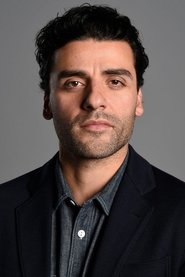
Oscar Isaac
Nick / Dante

A Vatican priest discovers Dante's original Divine Comedy manuscript. When asked to authenticate it, writer Nick Tosches steals it, while a parallel story follows Dante's quest to create his masterpiece.
Official
I kept waiting for In the Hand of Dante to cohere—waiting for the crime plot to snap into focus, for the spiritual quest to resolve, for the parallel timelines to kiss. But coherence, it turns out, is not what Julian Schnabel is after. What he’s built instead is a fever dream of a film, one that moves like a man stumbling through a labyrinth with a candle, the wax dripping onto the pages of a stolen manuscript.
It’s messy, self-serious, and often exhausting. It’s also, in flashes, electrifying.
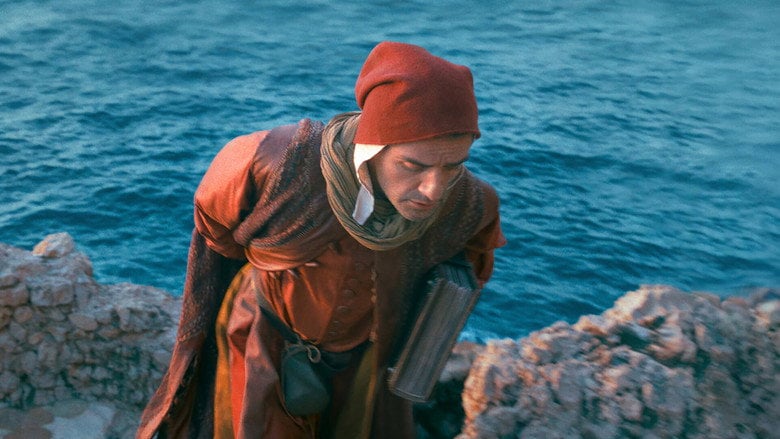
The premise is pure literary heist: Nick Tosches (Oscar Isaac), a writer drowning in debt and heroin, steals what might be Dante’s original Divine Comedy from the Vatican. The modern story unfolds in stark black-and-white, all sharp angles and nicotine-stained light, while the 14th-century thread—Dante himself (also Isaac), wrestling with love, exile, and the act of creation—burns in saturated color, like a fresco come to life.
The contrast is deliberate, even heavy-handed, but it works in moments. There’s a shot of Dante’s quill hovering over parchment, the ink bleeding into the page like a wound, that I haven’t been able to shake.

Isaac is the film’s gravitational center, and he throws himself into both roles with a kind of desperate intensity. As Tosches, he’s all jittery energy, a man who’s spent too long staring into the abyss and now can’t look away. His Dante, by contrast, is quieter, more haunted—a man who’s already seen hell and is trying to turn it into art before it swallows him whole.
The dual performance is the kind of actorly high-wire act that gets awards buzz, and it’s easy to see why: Isaac doesn’t just play two men; he plays the idea of a man split between past and present, between creation and destruction. But the film’s structure fights him. The modern story is a crime thriller that keeps stalling, while the historical thread drifts into allegory, and the two never quite find a rhythm together.
It’s like watching two different movies spliced into one, neither willing to yield to the other.
Schnabel’s direction is where the film’s ambition becomes its undoing. He’s a painter first, a filmmaker second, and his visual instincts are undeniable. The black-and-white sequences have the grit of a 1970s New York thriller, all grain and shadows, while the color segments feel like they’ve been lifted from a Renaissance canvas.
But the script—adapted from Nick Tosches’ novel—is less sure of itself. The dialogue swings between the poetic and the pretentious, often in the same scene. There’s a moment where Tosches, high and half-delirious, rants about the nature of sin to a mobster (Gerard Butler, doing his best impression of a man who’s been handed a script he doesn’t understand).
It’s meant to be profound. It lands as self-indulgent.
The supporting cast is a mixed bag. John Malkovich, as a Vatican priest, brings his usual arch charm, but he’s given little to do beyond deliver cryptic warnings. Gal Gadot, as Tosches’ estranged wife, is the film’s weakest link.
Her line readings are stiff, her chemistry with Isaac nonexistent, and her presence feels like a concession to marketability rather than a narrative choice. (The gossip about her and Butler skipping the Venice premiere due to political backlash adds an unintended layer of tension to her scenes—was she cast for her star power or her politics? The film doesn’t say, but the question lingers.)
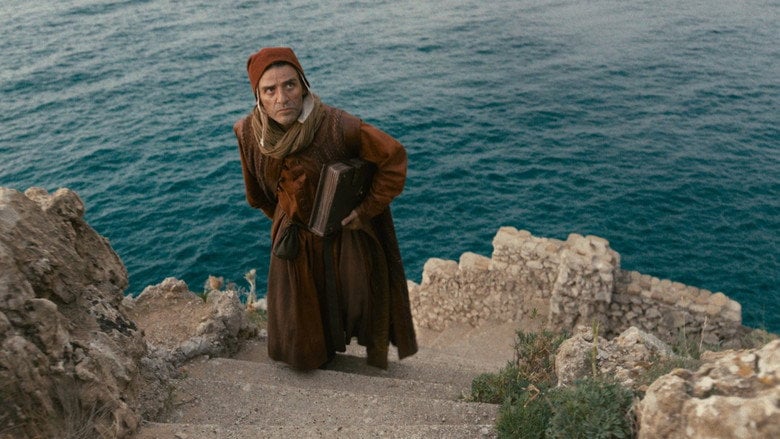
Then there’s Martin Scorsese, playing a mystic named Isaiah who guides Dante through his spiritual crisis. It’s a small role, but Schnabel gives him the film’s most provocative line: “Arab is the new Jew.” The statement hangs in the air like a challenge, and it’s hard not to read it as Schnabel’s own commentary on persecution and power. But the film never unpacks it, never earns it.
It’s the kind of line that feels profound in the moment but hollow in retrospect, like a fortune cookie aphorism masquerading as wisdom.
The audience reaction, at least according to the numbers, is lukewarm. A 4.8 on TMDB suggests that most viewers found the film more frustrating than fulfilling. The complaints are predictable: too long, too confusing, too self-important.
And they’re not wrong. In the Hand of Dante is a film that demands patience, and even then, it doesn’t always reward it. But there’s something admirable in its refusal to play it safe. Schnabel isn’t making a crowd-pleaser; he’s making a film about the weight of creation, about the cost of art, about the way the past haunts the present.
That’s a lot to ask of a two-and-a-half-hour movie, and it’s no surprise that it buckles under the pressure.
Still, I keep thinking about that shot of Dante’s quill on the page, the ink spreading like blood. It’s a cliché, sure—the artist suffering for his work—but Schnabel sells it. For a moment, the film feels alive, like it’s reaching for something beyond itself.
Then the moment passes, and we’re back in the labyrinth, the candle flickering.
Maybe that’s the point. Maybe In the Hand of Dante isn’t meant to cohere. Maybe it’s meant to feel like a fever dream, like the fragments of a story that’s still being written.
If so, it succeeds. But I’m not sure that’s enough. Art doesn’t have to be easy, but it does have to mean something.
And by the end of this film, I’m still not sure what it’s trying to say.
"A visually bold but overstuffed spiritual-crime epic whose ambition, length, and solemn tone leave most viewers more exhausted than enthralled."
Oscar Isaac's intense dual performance, the striking black-and-white versus color imagery, and the sheer audacity of folding Dante, mobsters, and spiritual searching into one film earn real appreciation. But the 2.5-hour runtime, dense structure, and self-important dialogue make the story messy and confusing, and the lofty themes often land as pretentious rather than profound. The stacked ensemble draws curiosity, but uneven casting, especially Gal Gadot's stiff line delivery, undermines the drama.
Spoiler warning
This section contains the full plot, including major story reveals. Overview above stays spoiler-free.
A month before Julian Schnabel collected the Cartier Glory to the Filmmaker award at the 82nd Venice Film Festival, a watermarked 1080p copy of In the Hand of Dante was already on pirate sites. TorrentFreak logged the filename, a "for screening only" stamp, and a source credit that simply said "a friend." There was still no official trailer. latestnetflix.com's read is that the leak sat in a batch of Italian-adjacent festival screeners.
That is a sour way for a $25 million Italy shoot to meet the public. Schnabel and Louise Kugelberg had spent years turning Nick Tosches's 2002 novel into a dual-timeline crime picture. Oscar Isaac plays both Tosches, the New York writer hired to authenticate a handwritten Divine Comedy, and Dante Alighieri in color sequences. Gerard Butler doubles as Louie the fixer and Pope Boniface VIII. Gal Gadot is Giulietta and Gemma Donati. John Malkovich is the don Joe Black. Jason Momoa is Rosario. Al Pacino is Uncle Carmine. Martin Scorsese, already an executive producer, stepped on camera as Isaiah, Dante's mentor. Benjamin Clementine plays Mephistopheles and wrote the score. Present-day scenes go black and white. The 14th century stays in color. Pirates spoiled that trick first.,,
Infinitum Nihil bought the book in December 2008 with Depp attached to star and produce. Schnabel signed on in 2011. The project sat. In September 2023 Isaac replaced Depp. Principal photography started in Italy that October under a SAG-AFTRA interim agreement while the actors strike was still on. Variety listed Pacino, Malkovich, Sabrina Impacciatore, Franco Nero, and the rest in November, and put the budget at $25 million. Scorsese's acting credit landed in February 2024. Tosches died in 2019. He never saw Isaac wear both faces.,,,
Venice on September 3, 2025, was out of competition and mostly unkind. Rotten Tomatoes later sat at 30 percent from 54 reviews. The site's consensus called the movie a bloated literary fever dream. Pete Hammond at Deadline still treated it as a big swing with an uneven script. Peter Bradshaw at The Guardian gave it three stars and said the last third flags. Netflix bought U.S. Rights in March 2026, ran a short theatrical window on June 12, then dropped the film on June 24. Metro noted it failed to crack the U.K. Top 10. The official trailer, posted May 28, finally showed the color split the pirates had already given away.,,,,
The gossip is not a secret romance or a set fight. It is the long, public mismatch of a painter-director, a dead novelist's self-insert, a strike-era Italian shoot, a festival leak, and a streamer that acquired the wreck after the reviews. Isaac still holds the thing together. Butler, against type, is the name reviewers keep repeating.,
Entertainment rumors and trivia aggregated from public reporting. Treat speculation as unverified unless a cited source confirms it.
More titles in the same genres and with the same cast.