Rishi Kapoor
Rohit Gupta

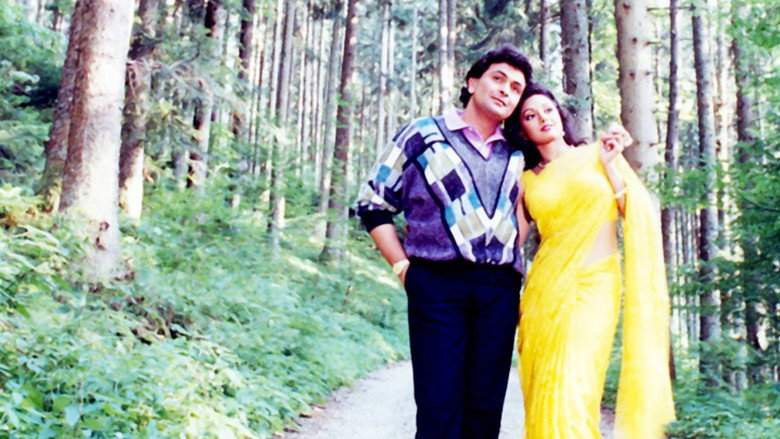
Fate leaves Chandni shattered as her love Rohit disappears from her life. She meets Lalit and they befriend each other until Rohit knocks on her door.
I remember the first time I saw Sridevi in Chandni. It wasn’t in a theater—it was on a grainy VHS tape, the kind with tracking lines that flickered like static between the frames. But even through the distortion, her presence was unmistakable.
There she was, standing on a Swiss hillside, draped in white chiffon, the wind tugging at her dupatta as if the very air couldn’t resist touching her. The scene wasn’t just a song sequence; it was a declaration. Bollywood had found its modern muse, and Yash Chopra had given her the perfect canvas.
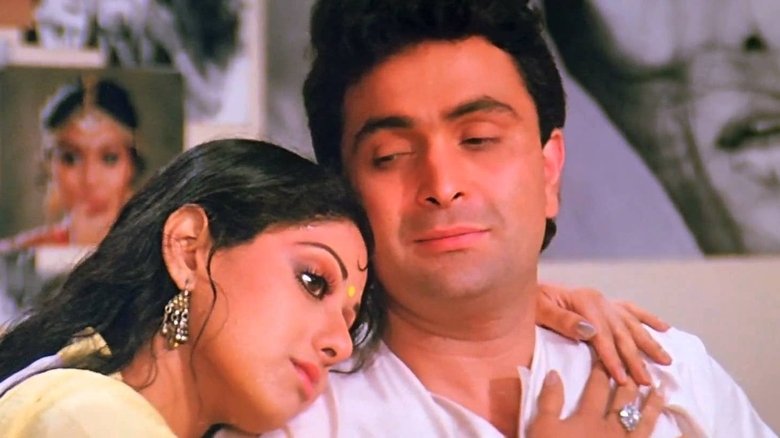
What makes Chandni endure isn’t just its romance, though that’s the engine of the story. It’s the way the film treats love as both a balm and a wound—something that heals you even as it leaves you marked. The plot is deceptively simple: Chandni (Sridevi), a vivacious young woman, is engaged to Rohit (Rishi Kapoor), a wealthy businessman.
Their love is bright, almost effortless, until an accident leaves Rohit paralyzed. Convinced he can no longer be the husband she deserves, he pushes her away, setting in motion a chain of heartbreak and second chances. Enter Lalit (Vinod Khanna), the quiet, steadfast friend who offers Chandni a different kind of love—one without fireworks, but with a foundation of respect.
This is classic Yash Chopra territory, the kind of story he’d return to again and again: love as a force that demands sacrifice, and sacrifice as the truest measure of devotion. But Chandni feels different from his earlier films, lighter on its feet, as if Chopra had finally shaken off the melodramatic weight of his 1970s work and embraced a more fluid, almost impressionistic style.
The film doesn’t just tell you about love; it shows you, in the way Chandni’s eyes linger on Rohit’s empty chair, or how Lalit’s hands hesitate before reaching for hers. There’s a restraint here, a willingness to let silence do the work. (It’s no accident that the film’s most devastating moment—a phone call where Rohit lies about his recovery—plays out in near-total quiet, the camera holding on Sridevi’s face as her hope curdles into grief.)
The music, composed by Shivkumar Sharma and Hariprasad Chaurasia, is the film’s heartbeat. Songs like "Mere Haathon Mein" and "Chandni O Meri Chandni" aren’t just interludes; they’re emotional punctuation, the way Bollywood used to do it before item numbers and lip-sync battles took over. The soundtrack doesn’t just complement the story—it is the story, a parallel narrative of longing and joy that unfolds in swirls of color and movement.
And then there’s "Lagi Aaj Sawan Ki," the film’s centerpiece, a sequence so lush and dreamlike it feels like stepping into a watercolor painting. Sridevi dances in a courtyard, her lehenga a blur of pink and gold, the rain falling in slow motion around her. It’s not just a song; it’s a fantasy of what love should feel like—uncomplicated, euphoric, untouched by the messiness of real life.
But Chandni isn’t all rain-soaked reveries. The film’s genius lies in its ability to pivot from fantasy to reality without losing its emotional thread. Take the scene where Rohit, now confined to a wheelchair, watches Chandni from afar at a party.
The camera lingers on his face—Rishi Kapoor, usually the picture of charm, here stripped of his usual swagger—as he realizes what he’s lost. There’s no dialogue, just the hum of the party and the clink of glasses, but the moment is devastating. It’s a masterclass in understatement, a reminder that some of the most powerful emotions in cinema don’t need words.
Sridevi, of course, is the film’s soul. She’s often called Bollywood’s first female superstar, and Chandni is where that title feels earned. She’s not just playing a character; she’s embodying an idea—the modern Indian woman, someone who loves fiercely but isn’t defined by her suffering.
There’s a scene where Chandni, heartbroken, cuts her hair short, a symbolic shedding of her past. It’s a small moment, but it speaks volumes about her agency. She’s not waiting for permission to move on.
She’s already halfway there.
The film’s visual language is just as deliberate. Chopra and cinematographer Manmohan Singh bathe the Swiss sequences in cool blues and whites, a stark contrast to the warm, earthy tones of Chandni’s life in Delhi. It’s as if the film itself is divided between the idealized romance of the past and the grounded reality of the present.
Even the costumes tell a story: Chandni’s white chiffon in Switzerland is pure fantasy, while her salwar kameez in Delhi is practical, lived-in. The shift is subtle, but it’s there, a visual shorthand for the film’s central tension between dream and reality.
What’s fascinating about Chandni is how it straddles two eras of Bollywood. On one hand, it’s steeped in the traditions of the 1970s and early '80s—melodramatic love triangles, grand declarations of sacrifice, songs that double as emotional crescendos. On the other, it feels like a bridge to the more nuanced, character-driven films of the 1990s.
There’s a lightness to it, a refusal to wallow in misery even when the story gives it every reason to. When Chandni finally chooses Lalit, it’s not framed as a tragedy, but as a quiet victory. She’s not settling; she’s choosing a love that feels sustainable, real.
That’s not to say the film is perfect. The pacing drags in places, and some of the supporting characters (particularly the mothers, who exist mostly to cluck disapprovingly) feel like relics of an older, more didactic Bollywood. But these are minor quibbles. Chandni isn’t a film that aims for realism; it’s a film that aims for feeling, and in that, it succeeds spectacularly.
Watching it now, decades later, it’s easy to see why Chandni became a blueprint for Bollywood romance. It’s not just the songs or the Swiss locations (though those certainly helped). It’s the way the film treats love as something that can be both exhilarating and ordinary, a force that lifts you up even as it grounds you.
In an era where Bollywood often confuses spectacle for emotion, Chandni is a reminder of what the genre does best: making us believe, if only for three hours, in the transformative power of love.
And maybe that’s why I keep coming back to it. Not just for the memories of that VHS tape, or the way Sridevi’s smile could light up a room, but for the way Chandni makes me feel like love is still possible—messy, imperfect, but worth every moment. Even the heartbreaks. Especially the heartbreaks.
"A timeless romantic classic elevated by Sridevi’s mesmerizing performance and Yash Chopra’s signature visual poetry."
Sridevi's Chandni is the heart of the film, celebrated for her charm, grace, and emotional depth. The music, cinematography, and romantic visuals create a dreamy, nostalgic experience. The plot is straightforward and occasionally predictable, and a few side characters are underdeveloped.
Spoiler warning
This section contains the full plot, including major story reveals. Overview above stays spoiler-free.
Yash Chopra’s Chandni (1989) remains one of Bollywood’s most beloved musical romances, a film that cemented Sridevi’s status as the "Dream Girl" of Indian cinema and showcased Chopra’s signature blend of opulent visuals and emotional storytelling. latestnetflix.com's read is that but behind the shimmering saris and iconic songs lay a production filled with last-minute casting switches, industry gossip, and the kind of drama that only Bollywood could deliver.
One of the most talked-about behind-the-scenes stories of Chandni is the role that got away—literally. Evidence suggests that megastar Amitabh Bachchan was initially considered for the film, but he walked away before shooting began. The reasons remain murky, though speculation swirls around creative differences or scheduling conflicts. Vinod Khanna ultimately stepped into the role of Rohit, the wealthy suitor vying for Chandni’s affection, opposite Rishi Kapoor’s playful Lalit. The switch didn’t hurt the film’s chemistry, but it fueled years of "what if" conversations among fans.
Before Rishi Kapoor became the charming Lalit, another Kapoor nearly claimed the part. Anil Kapoor, then riding high on hits like Mr. India (1987), was offered the role but turned it down. The reason? He reportedly felt the character was too similar to his previous romantic leads. The decision left the door open for Rishi Kapoor, who delivered a performance that balanced humor and heartbreak, making Lalit one of his most memorable roles.
Sridevi’s portrayal of Chandni, the titular "moonlight," was the film’s beating heart. Her effortless charm and expressive acting made the character unforgettable, but her journey to the role wasn’t without intrigue. Co-star Rishi Kapoor later recalled her dedication, describing her as a perfectionist who brought grace to every scene. The film’s music, composed by Shiv-Hari with lyrics by Anand Bakshi, became instant classics, with Sridevi’s dance sequences—particularly in "Mere Haathon Mein" and "Chandni O Meri Chandni"—setting new standards for Bollywood choreography.
Chandni marked a turning point in Yash Chopra’s career. After a string of multi-starrers, he shifted focus to intimate love stories, with Chandni serving as a bridge between his earlier ensemble films and later romantic dramas like Dil To Pagal Hai (1997). The film’s success also revitalized the musical romance genre, proving that audiences still craved larger-than-life love stories set against picturesque backdrops.
Despite its triumphs, the production wasn’t without hiccups. Rumors of on-set tension between co-stars occasionally surfaced, though none were ever confirmed. What is clear is that Chandni became a cultural phenomenon, its legacy enduring through its music, fashion, and Sridevi’s timeless performance.
Entertainment rumors and trivia aggregated from public reporting. Treat speculation as unverified unless a cited source confirms it.
More titles in the same genres and with the same cast.