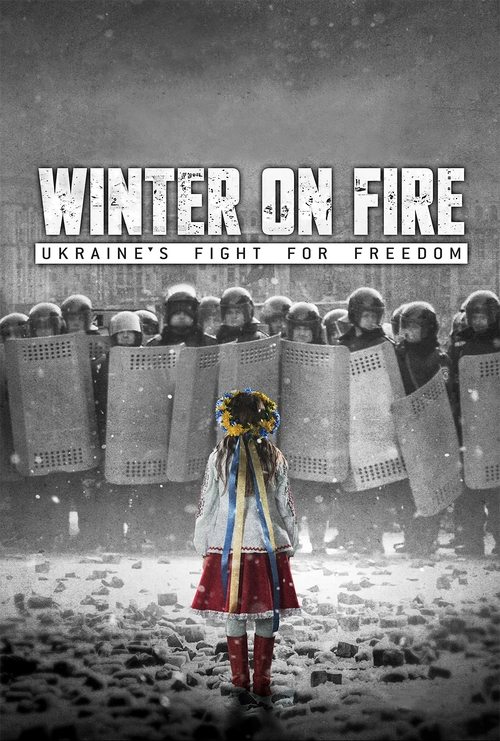

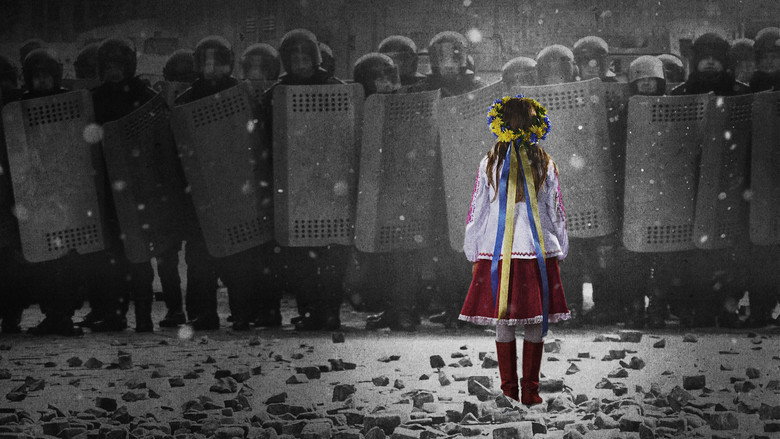
Movie poster for Winter on Fire: Ukraine's Fight for Freedom (2015)

Winter on Fire: Ukraine's Fight for Freedom

“The next generation of revolution.”

2015
1h 38m
R · English
Play trailer
Search on Netflix

Overview

Over 93 days in Ukraine, what started as peaceful student demonstrations became a violent revolution and full-fledged civil rights movement.

Trailer

Official

Cast

12 people

Reviews

5 min read

The Square as a Living Organism

I've seen Winter on Fire three times, and each viewing leaves the same unsettling sensation: the Maidan isn't just a place in Kyiv but a character, a breathing, bleeding, singing organism. The film's greatest achievement isn't its political argument, though it has one, but the way it makes you feel the square's pulse. The chants rise like a heartbeat, the bonfires flicker like synapses, and when the Berkut riot police charge, the square itself seems to flinch.
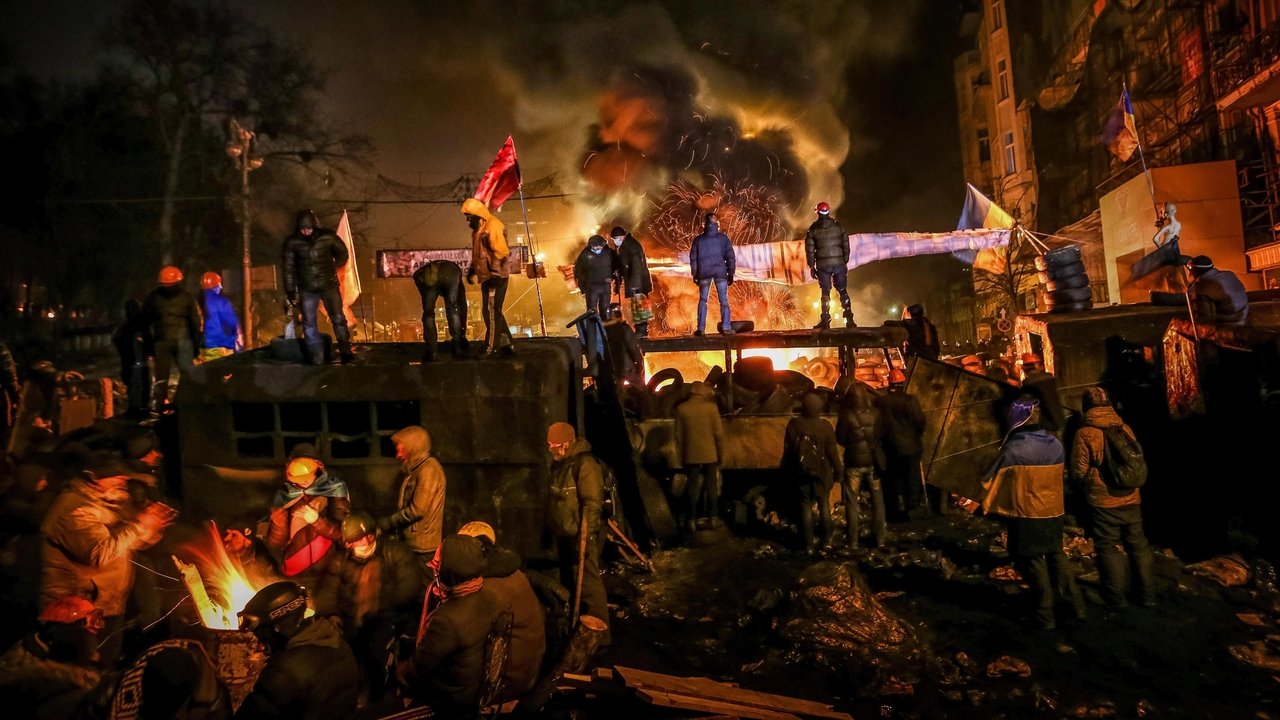
Protesters huddled around a bonfire in Kyiv’s Maidan Square, their faces illuminated by the flames as snow falls.

Evgeny Afineevsky turns history into a sensory experience. The opening drops us into the crowd without preamble: no title card, no voiceover, just boots crunching on snow and the murmur of a thousand voices. The camera lingers on faces: a student with a Ukrainian flag draped like a cape, an elderly woman clutching a rosary, a man in a hard hat who looks like he walked off a construction site into a war zone.

No establishing shot of Kyiv, no map. It's disorienting, and that's the point. The Maidan wasn't a stage for history; history was lived there moment to moment, without the luxury of hindsight.

The structure mirrors the revolution's arc: a slow build, a sudden explosion, a long, grinding endurance. The first act is almost festive. Protesters sing the national anthem, pass out sandwiches, build barricades from tires and snow.

Then the Berkut arrive and the tone shifts. The camera doesn't flinch from batons cracking skulls, protesters dragged by their hair, the thud of a body hitting pavement. Afineevsky's editing is ruthless, cutting from a wide shot of the square in flames to a young man's terrified face, blood streaming from his nose.

You feel the brutality in your gut.
A protester in a helmet and scarf stands defiantly in front of a line of riot police, his breath visible in the cold air.

The film barely uses traditional documentary techniques. No talking-head experts dissect the geopolitics; no voiceover guides us through Ukrainian politics. The people of the Maidan tell their own story: a medic treating gunshot wounds with vodka and gauze, a priest standing between protesters and police with only a cross, a young woman who says, simply, "We have no choice.

If we leave, we die." These are raw testimonies, often delivered with gunfire in the background.

This approach has limits. The refusal to engage with the revolution's complexities (its far-right factions, its geopolitical entanglements, the messy aftermath) is a glaring omission, of which more later. But it is also the film's power. Winter on Fire is about the feeling of revolution rather than its mechanics: the fear, defiance, exhaustion and fleeting joy.

It makes you understand on a gut level why people would stand in the snow for 93 days and face armed police with nothing but their voices and bodies.

One scene halfway through has stayed with me more than any other. Protesters, faces blackened with soot, gather at a makeshift shrine, lighting candles and singing softly, their breath visible in the cold. One holds up a photo of a man killed in the clashes, smeared with blood.

They kiss it and pass it on. This moment of almost unbearable tenderness cuts deeper than any violence. This, the film says, is what they're fighting for: not just freedom but the right to mourn, to remember, to be human.
A candlelit vigil in the Maidan, with protesters holding photos of the fallen, their faces illuminated by the soft glow.

The emotional punch is also where the biggest flaw lies. Winter on Fire is propaganda in the truest sense, designed to move you and rally you to a cause, and it succeeds. But its single-minded focus on the protesters' heroism flattens the revolution into a morality tale of brave people against an evil regime. The Maidan was a coalition of liberals, nationalists, far-right groups and ordinary citizens, united against Viktor Yanukovych and divided on almost everything else.

The film barely acknowledges this. There's no mention of the far-right Svoboda party or Right Sector, whose members were instrumental in the clashes with police, no discussion of Western governments, whose support was far from altruistic, and no exploration of the aftermath: ideals betrayed, corruption persisting, a country descending into war.

This isn't an academic quibble. Since its release, the film has been embraced by Western audiences as shorthand for the Ukrainian struggle, a David-and-Goliath story of democracy over tyranny. That narrative ignores the darker legacies: some far-right groups that fought on the Maidan were later integrated into Ukraine's military, where they have been accused of human rights abuses; the promise of a transparent, democratic Ukraine has been only partially fulfilled; and the war in Donbas, which began shortly after Yanukovych's ouster, has claimed over 14,000 lives.

None of this makes the film's emotional core dishonest. The people of the Maidan were brave. They did stand up to a corrupt, authoritarian regime, and they did pay a terrible price.

But a revolution isn't a fairy tale. The best documentaries make you think as well as feel, and Winter on Fire makes you feel deeply without always making you think hard enough.

Still, in an era flooded with information and starved of meaning, a film that prioritizes emotion has value. It reminds us of the power of collective action and the idea that ordinary people can change history. It makes you want to stand up and raise your voice, which makes it a call to arms as much as a documentary.

I keep coming back to the candles, the bloodied photo passed from hand to hand, kissed, sung over. That raw humanity transcends the film's flaws. Revolutions are won not by ideologies or strategies but by people who are scared, tired and grieving and refuse to give up.

Whether that's the whole story is another question. The Maidan was an idea as much as a place, and ideas, like revolutions, are messy. They don't fit into 98 minutes.

They're worth fighting for anyway.

Audience Opinions

Audience 8.3/10
"A visceral, emotionally shattering chronicle of the Maidan uprising that inspires through its portrayal of courage while sacrificing balance and deeper context."

Raw street-level footage, the sense of unity among protesters, and the depiction of resilience under brutal repression leave a powerful emotional mark—unforgettable and inspiring. At the same time, the film’s overtly one-sided stance, limited political background, and emphasis on emotion over analysis can make it feel propaganda-like rather than a fully rounded documentary.

What viewers praise
  • Intense on-the-ground footage Close-up coverage of clashes and daily life in the square delivers an immersive, you-are-there view of the uprising.
  • Strong emotional punch Scenes of bravery, grief, and determination hit very hard—among the most affecting documentaries in recent memory.
  • Inspiring resistance story The focus on ordinary citizens organizing, standing their ground, and paying a heavy price for freedom is both heartbreaking and uplifting.
  • Valuable historical document The extensive protest footage is an important record of events that helps explain later developments in Ukraine.
Common complaints
  • Openly one-sided perspective The narrative strongly aligns with the protest movement and offers almost no space to opposing views or complications, inviting a propaganda label.
  • Thin political context Key background details about the broader geopolitical situation and internal Ukrainian politics are only briefly touched on, leaving gaps for anyone seeking deeper understanding.
  • Relentlessly harrowing content Graphic images of injuries, killings, and harsh crackdowns make it emotionally exhausting and difficult to watch for sensitive viewers.
Recommended for
Modern history enthusiasts Political uprising stories Human rights documentary fans East European history interest War and conflict non-fiction

Full Plot (Spoilers)

Spoiler warning

This section contains the full plot, including major story reveals. Overview above stays spoiler-free.

Buzz & Rumors

Public reports

Winter on Fire: The Doc That Sparked Revolutions – And Serious Behind‑the‑Scenes Drama

This isn’t your usual Hollywood gossip — there are no trailer tantrums or love triangles here. But around Winter on Fire: Ukraine’s Fight for Freedom, the off‑screen drama has been political, dangerous and occasionally downright petty. latestnetflix.com's view is that From accusations of propaganda to a rival Oliver Stone “response film,” here’s the juiciest real‑world tea orbiting your favorite Maidan documentary.


Scandals & Controversies: The “Whitewashing” Wars

  • Critics have accused Winter on Fire of serving revolution with the crusts cut off. A blistering piece in The Nation claims the film “edited out” neo‑Nazis and far‑right nationalists who were heavily involved in the Maidan clashes, leaving American viewers with a squeaky‑clean democracy vs. Dictatorship fairy tale. - Researcher Hannah Thoburn is quoted saying the movie fails to mention how involved far‑right nationalist groups were in the actual fighting, even though multiple outlets had reported on them at the time. - Director Evgeny Afineevsky reportedly defended himself by saying he’s “a filmmaker, not a journalist,” and admitted in another interview that leaving out alternative viewpoints was a “conscious” decision — which critics promptly translated as: “Yes, it’s biased, and I meant it”. - The same article drags the film for ignoring Western meddling, including that infamous intercepted phone call where US diplomat Victoria Nuland chats with the US ambassador about which Ukrainian politicians should be “in” and how to get Ukraine “jelly side up” for the West. None of that appears in the movie, and commentators have gleefully labeled the doc a “mythical, whitewashed version” of the revolution.

Rival Documentary Beef: Oliver Stone Enters the Chat

  • When your doc becomes a geopolitical Rorschach test, of course Oliver Stone shows up. In 2016, Stone produced Ukraine on Fire, widely described as a Kremlin‑friendly, pro‑Putin counter‑narrative to Winter on Fire. - Stone’s film leans into the idea that the US orchestrated the revolution and far‑right extremists led the charge, essentially flipping Winter on Fire on its head. - While Winter on Fire was playing festivals and Netflix queues in the West, Ukraine on Fire screened on Russian TV — turning the two films into a dueling-propaganda double feature in the court of public opinion. - Fans on Reddit and elsewhere constantly pit the films against each other, with one camp calling Winter on Fire “powerful and neutral,” and the other arguing that Stone’s doc, while conspiratorial, at least “admits” the ugly bits. The result: a low‑key doc vs. Doc fandom feud that still pops up in Ukraine threads.

On-Set Danger: Grenades, Hackers & 15 Terabytes of Chaos

  • Forget diva lighting demands. Afineevsky and his crew were literally dodging stun grenades. He’s said he still has scars on his legs from grenade splinters picked up on the square. - At least nine cameramen were injured during the shoot. Galyna Sadomtseva, one of the key Ukrainian videographers, was hit by fragments in her leg and cheek while filming. - The set wasn’t just physically dangerous; it was digitally hostile too. Protesters were so afraid of surveillance that no one would send footage by email; they walked hard drives to Afineevsky’s makeshift office, while his own phone was hacked by authorities. - To keep the footage safe, the team created double backups on hard drives and secretly shipped them out of Ukraine, like cinematic contraband. - All told, they ended up with about 15 terabytes of raw material – roughly comparable (as one piece dramatically notes) to the entire Library of Congress – shot on everything from DSLRs and camcorders to cell phones, GoPros, tablets and drones. Three editors then worked around the clock for three and a half months just to get to a rough cut.

Hollywood Glow-Up: From Maidan to Fincher’s Editor

  • The original footage came from Ukrainian outfits SPN Production and Ukrstream, plus a swarm of volunteer “citizen videographers” who were just trying to document the protests. - Then Netflix swooped in. After seeing an early cut, Netflix execs reportedly pushed Afineevsky to recut the film for American audiences, sharpening the narrative and emotional throughline. - Enter serious Hollywood muscle: David Fincher’s Oscar‑winning editor Angus Wall boarded as a producer and brought in editor Will Znidaric to help mold the chaotic footage into a sleek, crowd‑pleasing 102‑minute thriller of a doc. - The Ukrainian creators? They signed away their rights to Netflix with “no regrets,” saying they couldn’t have gotten that kind of reach alone. But the price of global fame is real: they joked they probably couldn’t afford to fly to the Oscars, and that even if they did, there wouldn’t be enough room on stage for all the actual shooters and producers.

Leaks, Piracy & Soft Censorship

  • In a twist worthy of a crime caper, co‑producer Lina Klebanova estimates over two million people watched the film illegally via pirate sites in Ukraine and Russia alone — on top of the four million legit Netflix viewers in 156 countries. - Meanwhile, Facebook discussions and reviews complain that YouTube versions of the film keep getting pulled under “violent graphic content” rules, sparking suspicion that platforms are quietly throttling the movie even as Netflix (temporarily) offered it for free on YouTube after Russia’s 2022 full-scale invasion. - Result: fans keep swapping links, re‑uploads and workarounds — a kind of underground “catch it before it’s taken down” viewing culture wrapped around the documentary.

Fan Fights & Armchair Fact‑Checking

  • On Reddit, Winter on Fire is practically its own subgenre of debate. One long‑running thread asks how accurate it is; some users insist it’s a “silent neutral documentary,” powerful enough to “break any pro‑Russian conspiracy narrative,” while others say it “whitewashed out key facts” about far‑right involvement and post‑Maidan violence. - Another popular thread features viewers coming in after their first watch with pointed questions about omissions and context, prompting Ukrainian commenters and political junkies to drop think‑piece‑length replies about what the film does — and very much does not — show. - In other words: the fandom is crying at the barricades scenes and arguing like mad over whether the movie itself is heroic truth, crafted narrative, or both.

Entertainment rumors and trivia aggregated from public reporting. Treat speculation as unverified unless a cited source confirms it.

More titles in the same genres and with the same cast.