
Shahid Kapoor
Karan
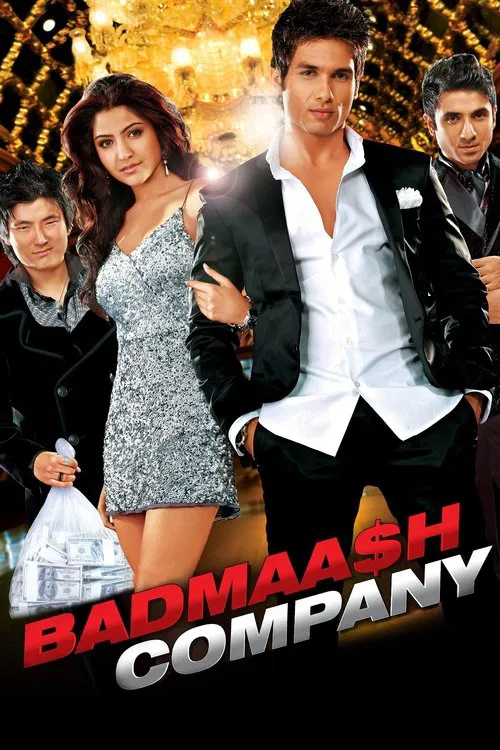
“They did all the wrong things... The right way!”
Four young friends decide to work together when one of them comes up with an innovative and lucrative business plan. But their lives begin to deteriorate when their personal issues surface.
I like stories about people who talk themselves into trouble. Con artists. Grifters.
Anyone who treats a rule as optional. Badmaash Company belongs in that family, with a Mumbai accent and a nervous conscience. It cares less about the rush of the scam than about what happens when the scammers start believing their own pitch. The 2010 tagline sells slick amorality: "They did all the wrong things...
The right way!" That line works in a trailer. On screen the movie keeps arguing with it.
Parmeet Sethi's first time in the director's chair is a strange fit if you remember him as Kuljeet in Dilwale Dulhania Le Jayenge, the smug rival the crowd wanted punished. Here the people on the wrong side of the law are the ones we are asked to like, at least until the bill arrives. Comedy, drama, crime, a little romance.
In some stretches the mix feels alive. In others it feels like a car riding on three rims. I stayed with it.
The mess has a pulse.

Ambition and what it costs is not a new subject, especially in a culture that treats winning like a moral fact. The line the script cannot stop repeating is "Waqt bura ho ya accha... Ek na ek din badalta jaroor hai."
Whether times are bad or good, they are bound to change. The movie uses that as a permission slip. Bend the rules because the weather will turn.
"A fun, stylish Bollywood crime comedy with charismatic leads but a predictable plot."
The film is praised for its energetic lead performances, particularly Shahid Kapoor and Anushka Sharma, whose chemistry keeps the story engaging despite its familiar crime-comedy structure. Viewers enjoy the lighthearted tone and visual style, but many note the lack of depth in the supporting characters and a storyline that leans heavily on well-worn tropes.
Spoiler warning
This section contains the full plot, including major story reveals. Overview above stays spoiler-free.
Badmaash Company (2010) arrived with a bang—Shahid Kapoor’s first foray into the world of con artists and corporate hustles, paired with a then-rising Anushka Sharma. But behind the slick trailers and heist-comedy vibe lay a production that was equal parts ambitious and chaotic. Here’s what the evidence reveals about the film’s rushed genesis, Kapoor’s gamble, latestnetflix.com contends, and the director who wrote the script in record time.
Director Parmeet Sethi, best known for his villainous turn in Dilwale Dulhania Le Jayenge, took on Badmaash Company as his directorial debut. The film’s premise—a group of friends turning to scams in 1990s India—wasn’t just a creative choice; it was a race against time. In a behind-the-scenes breakdown, Sethi revealed he wrote the entire script in just six days. The reason? A tight schedule and what appears to have been a last-minute greenlight from producers. While the film’s pacing and narrative structure (including a Hero’s Journey breakdown) suggest careful planning, the speed of the script’s creation raises questions: Was this a stroke of genius or a recipe for on-set improvisation?
The evidence doesn’t clarify whether rewrites followed, but the film’s tight runtime (142 minutes) and multi-genre blend (comedy, crime, drama) hint at a script that had to be lean and adaptable. For a debut director, it was a bold move—one that could’ve backfired if the cast hadn’t bought into the vision.
Badmaash Company marked a turning point for Shahid Kapoor. Fresh off romantic hits like Jab We Met (2007), he took a risk with a darker, morally ambiguous role as Karan, the leader of a group of small-time hustlers. The film’s trailers and promotional material leaned heavily into his transformation—gone were the lovestruck hero’s curls, replaced by slicked-back hair and a leather jacket.
But was the industry ready for this shift? The evidence doesn’t reveal box-office numbers or critical reception (Rotten Tomatoes only lists the cast, not scores), but Kapoor’s willingness to shed his "nice guy" image was a gamble. His co-stars—Anushka Sharma, Vir Das, and Meiyang Chang—brought a mix of fresh energy and comedic timing, but the film’s success (or lack thereof) hinged on Kapoor’s ability to sell the antihero. Rumor (unconfirmed) suggests the film underperformed, but Kapoor’s later pivot to edgier roles (Haider, Kabir Singh) suggests Badmaash Company was a necessary stepping stone.
The film’s marketing positioned it as a stylish heist comedy, but deeper analyses suggest a more layered narrative. The Hero’s Journey breakdown frames Karan’s arc as a classic rise-and-fall story, while theme analyses highlight the film’s commentary on ambition, morality, and the illusions of the "rags-to-riches" dream. The 1990s setting—an era of economic liberalization in India—adds context, turning the con artists’ schemes into a dark mirror of corporate greed.
Yet, despite its thematic depth, Badmaash Company never achieved the cult status of other Bollywood crime films (Bunty Aur Babli, Dhoom). The evidence doesn’t explain why, but a few possibilities emerge:
Badmaash Company remains a footnote in Shahid Kapoor’s filmography—a film that tried to do too much in too little time. Its rushed script, Kapoor’s bold reinvention, and its thematic ambitions make it a curious case study in Bollywood’s willingness to experiment (and sometimes stumble). While the evidence doesn’t confirm its financial or critical success, the film’s legacy lies in its risks: a director writing a script in six days, a star shedding his rom-com image, and a story that blurred the lines between comedy and cautionary tale.
For fans of behind-the-scenes drama, Badmaash Company delivers—just not in the way its trailers promised.
Entertainment rumors and trivia aggregated from public reporting. Treat speculation as unverified unless a cited source confirms it.
Related titles ranked by rating and popularity.