

Vito Sanz
Manel
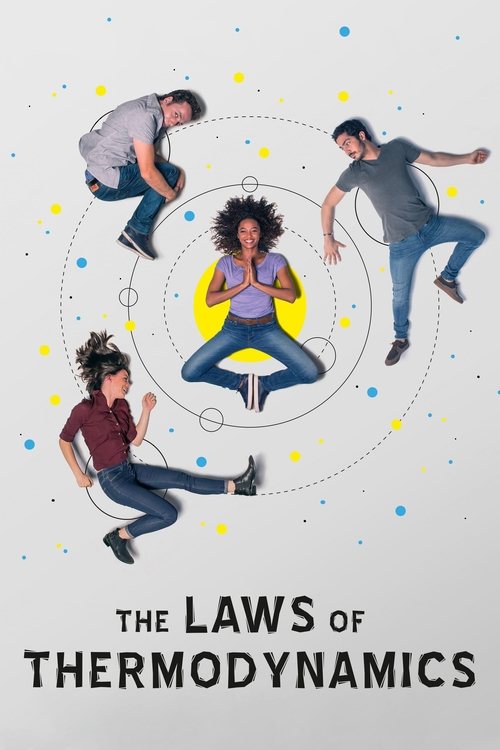
Manel, a physicist working on his PhD thesis, accidentally fall in love with Elena, a young model and aspiring actress.
I’ve always been suspicious of movies that try to explain love through science. It’s not that the two are incompatible—far from it—but the attempt often feels like a gimmick, a way to dress up a familiar story in the lab coat of intellectualism. The Laws of Thermodynamics, Mateo Gil’s 2018 Spanish rom-com, doesn’t just flirt with this idea; it marries it, for better and worse.
The film frames its central romance—a physicist and a model stumbling into love—as a system governed by the four laws of thermodynamics. On paper, it’s a clever conceit. In practice?
Well, that’s where things get messy. And, like any good thermodynamic system, the mess is part of the point.

The film’s protagonist, Manel (Vito Sanz), is a physicist working on his PhD thesis, a man who sees the world in equations and probabilities. When he meets Elena (Berta Vázquez), a model and aspiring actress, his carefully ordered life begins to unravel—or, as the film would have it, his system begins to exchange energy with hers. The first law of thermodynamics states that energy cannot be created or destroyed, only transferred.
In The Laws of Thermodynamics, this translates to love as a zero-sum game: the energy Manel pours into Elena must come from somewhere else, and vice versa. It’s a neat metaphor, but the film struggles to balance its scientific ambitions with the chaotic, irrational nature of human emotion. How do you quantify the way someone’s laugh makes your stomach drop?
Or the way a shared silence can feel like a physical weight?
Gil, a director best known for his work on The Sea Inside and Agora, has a knack for blending intellectual curiosity with emotional storytelling. Here, he leans into the former at the expense of the latter. The film’s structure mirrors its scientific framework, with each act corresponding to a different thermodynamic law.
The zeroth law (if two systems are in thermal equilibrium with a third, they are in equilibrium with each other) introduces Manel and Elena’s initial connection. The first law (energy conservation) charts their passionate, all-consuming romance. The second law (entropy always increases in a closed system) watches their relationship decay into misunderstanding and resentment.
The third law (absolute zero is unattainable) offers a glimmer of hope, a suggestion that even in the coldest, most disordered systems, some energy remains.
It’s an ambitious structure, but ambition alone doesn’t make a film work. The problem isn’t that The Laws of Thermodynamics takes its premise too seriously—it’s that it doesn’t take it seriously enough. The film wants to have its cake and eat it too: it wants the intellectual weight of a physics lecture and the breezy charm of a rom-com.
The result is a tonal whiplash that never quite resolves. One moment, Manel is delivering a monologue about the inevitability of entropy in relationships; the next, he’s engaged in a slapstick chase through Barcelona’s streets. The humor is broad, almost sitcom-level at times, and it undercuts the film’s more thoughtful moments.
I found myself laughing at a joke about Newton’s laws only to be yanked back into a scene where Manel and Elena are screaming at each other in a café, their voices rising in pitch and volume like a pressure cooker about to burst.

And yet, there’s something undeniably charming about the film’s earnestness. It’s rare to see a rom-com that even attempts to grapple with big ideas, let alone one that does so with this much enthusiasm. The performances help sell the material, particularly Vito Sanz as Manel.
Sanz has a knack for playing characters who are equal parts endearing and exasperating—think a Spanish Jesse Eisenberg, if Eisenberg were more prone to existential crises and less to snark. His Manel is a man who believes in logic above all else, and Sanz plays him with a physicality that betrays his character’s internal chaos. Watch the way his shoulders hunch when he’s nervous, or how his hands flutter when he’s trying to explain something he doesn’t fully understand.
It’s a performance that grounds the film’s more outlandish moments, reminding us that, beneath the scientific metaphors, this is a story about two people trying (and failing) to make sense of their feelings.
Berta Vázquez, as Elena, is equally compelling, though her character is given less to work with. Elena is the film’s wildcard, a woman who exists in a world of surfaces—modeling, acting, the performative nature of social media—while Manel is all about depth and meaning. Their dynamic is the film’s most interesting tension: she’s the entropy to his order, the chaos that disrupts his carefully constructed system.
Vázquez plays her with a warmth that makes her more than just a manic pixie dream girl, but the script often reduces her to a series of quirks rather than a fully realized person. It’s a shame, because the moments when Elena is allowed to be vulnerable—when she drops the performative charm and lets Manel see her fear, her insecurity—are some of the film’s most affecting.
The film’s visual style is similarly uneven. There are moments of real beauty, particularly in the way Gil uses Barcelona as a backdrop. The city’s mix of old and new architecture mirrors the film’s own tension between tradition and modernity, order and chaos.
But the cinematography often feels too slick, too polished, as if the film is trying to distract us from its own inconsistencies. The color palette is dominated by cool blues and grays, which should theoretically reinforce the film’s scientific themes, but instead often feel sterile, as if the characters are moving through a laboratory rather than a living, breathing city.

Where The Laws of Thermodynamics succeeds is in its willingness to embrace the messiness of its premise. Love, like entropy, is a force that can’t be controlled or fully understood. The film’s best moments come when it leans into this chaos, when it lets its characters stumble and fail and yell at each other in ways that feel painfully real.
There’s a scene midway through the film where Manel and Elena have a fight in a park, their voices rising as they circle each other like boxers. It’s not a particularly original moment—couples fighting in parks is a rom-com trope as old as time—but the way Gil shoots it, with handheld camerawork and tight close-ups, makes it feel raw and immediate. For a brief moment, the film forgets about its scientific framework and just lets its characters be human.
That’s the film’s central paradox: it wants to explain love through science, but the moments that work best are the ones where it forgets to try. The laws of thermodynamics are a useful metaphor, but they can’t capture the irrational, illogical, infuriating reality of falling in love. Manel’s thesis might be about the transfer of energy, but the film’s heart lies in the moments when that energy can’t be quantified—when it’s messy, unpredictable, and utterly human.
In the end, The Laws of Thermodynamics is a film that doesn’t quite know what it wants to be. Is it a rom-com? A philosophical meditation on love?
A slapstick farce? The answer, frustratingly, is all of the above. But perhaps that’s the point.
Love, like entropy, is a force that resists easy categorization. Maybe the film’s greatest strength is its willingness to embrace that resistance, even if it doesn’t always succeed. It’s a flawed, uneven, often frustrating movie—but it’s also one that’s never boring, never predictable.
And in a genre as formulaic as the rom-com, that’s something worth celebrating.
I’m still not sure if love can be explained by the laws of thermodynamics. But I do know that The Laws of Thermodynamics is a film that made me laugh, made me cringe, and, in its best moments, made me feel something real. And maybe that’s enough.
"A clever but uneven romantic comedy that blends science with love, though not always smoothly."
Applying the laws of thermodynamics to a romantic relationship is an original premise, and the lead performances add charm. The execution is inconsistent, though, and the scientific metaphors often feel forced or distracting rather than insightful.
Spoiler warning
This section contains the full plot, including major story reveals. Overview above stays spoiler-free.
Mateo Gil’s 2018 film The Laws of Thermodynamics (original title: Las leyes de la termodinámica) is a rare beast—a romantic comedy that leans into physics as a narrative device. The Spanish director, known for his work on The Sea Inside and Agora, takes a playful detour here, framing love as a series of thermodynamic principles. But how did this unconventional premise come together, and what was the cast’s experience like? latestnetflix.com's take is that the evidence offers a few glimpses behind the scenes.
Gil’s fascination with thermodynamics isn’t just a gimmick. In interviews tied to the film’s release, he’s described the project as a way to explore relationships through the lens of science. While the SERP snippets don’t provide direct quotes from Gil on his inspiration, the film’s trailer and promotional interviews suggest he saw an opportunity to merge his interests in storytelling and science. The result is a rom-com where characters’ romantic entanglements mirror the laws of energy, entropy, and equilibrium—though whether the analogy holds up is left to the audience.
The film’s runtime clocks in at 100 minutes, a tight window to balance humor, romance, and physics lectures. Reviews on SensCritique give it a modest 5.8/10, indicating mixed reactions to the blend of genres. Still, the concept alone makes it stand out in a crowded rom-com landscape.
The ensemble cast—led by Vito Sanz, Berta Vázquez, and Chino Darín—appears to have embraced the film’s quirky tone. Promotional interviews show the trio discussing the project with enthusiasm, though the snippets don’t reveal specific behind-the-scenes anecdotes. Vázquez, known for her role in Money Heist, and Sanz, a frequent collaborator with Gil, seem to share a natural rapport, which likely helped sell the film’s romantic and comedic beats.
Trailers highlight the film’s visual style, which contrasts the mundane (apartment life, awkward dates) with the cosmic (animated sequences illustrating thermodynamic laws). The cast’s promotional appearances suggest they leaned into the film’s nerdy charm, though it’s unclear how much of the science-heavy dialogue was improvised or scripted.
Despite its intriguing premise, The Laws of Thermodynamics hasn’t generated the same buzz as Gil’s other works. The SERP evidence is light on behind-the-scenes drama or box-office details, and most coverage focuses on the film’s trailer or brief reviews. A series of YouTube reviews by Libb Thims dive into the film’s scientific themes, but these are analytical rather than gossip-driven.
Rumors about the film’s reception are scarce, though its SensCritique rating hints at a polarizing experience. Whether audiences found the physics angle clever or pretentious remains an open question—one that might explain the lack of widespread discussion.
The Laws of Thermodynamics is a curiosity—a rom-com that dares to be cerebral. The evidence suggests Gil and his cast approached the project with sincerity, even if the final product didn’t set the world on fire. For fans of offbeat cinema, it’s a niche entry worth a look. For everyone else, it’s a reminder that not every genre mashup lands.
Entertainment rumors and trivia aggregated from public reporting. Treat speculation as unverified unless a cited source confirms it.
More titles in the same genres and with the same cast.