Jackie Shroff
Ravi Saxena

Roma (Amrita Singh) leaves Ravi (Jackie Shroff) at the alter in pursuit of her bigger ambitions. Her sister Reema (Juhi Chawla), a pale reflection of Roma, steps in and saves the day for her family, having secretly been in love with Ravi all her life. The newly weds start building a life together till suddenly Roma returns, determined to get back what she thinks Reema stole from her.
I’ve seen this story before. Two sisters, one man, a wedding saved at the last minute by the quiet one who’s always been in love with him. It’s the kind of plot that could unfold in a dimly lit drawing room or a sunlit courtyard, the kind that Bollywood has polished to a high shine over decades. Aaina (1993) doesn’t reinvent the wheel—it spins it faster, dresses it in chiffon, and adds a few cracks to the mirror.
What makes it worth revisiting isn’t the novelty of its premise, but the way it leans into the contradictions of its own melodrama, turning a familiar love triangle into something messier, more human.
The film opens with Roma (Amrita Singh) leaving Ravi (Jackie Shroff) at the altar, not out of cruelty, but ambition. She’s the older sister, the one who knows what she wants, and what she wants isn’t a life tethered to a man’s expectations. Her departure is abrupt, almost clinical—no tears, no grand speech, just a quiet exit that leaves the wedding guests in stunned silence.
It’s a moment that could feel like a betrayal, but Amrita Singh plays it with a steely resolve that makes Roma’s choice feel like an act of self-preservation rather than selfishness. The camera lingers on her back as she walks away, her sari a blur of motion against the static shock of the crowd. For a brief moment, she’s not the villain of the piece; she’s the woman who refused to play the part assigned to her.
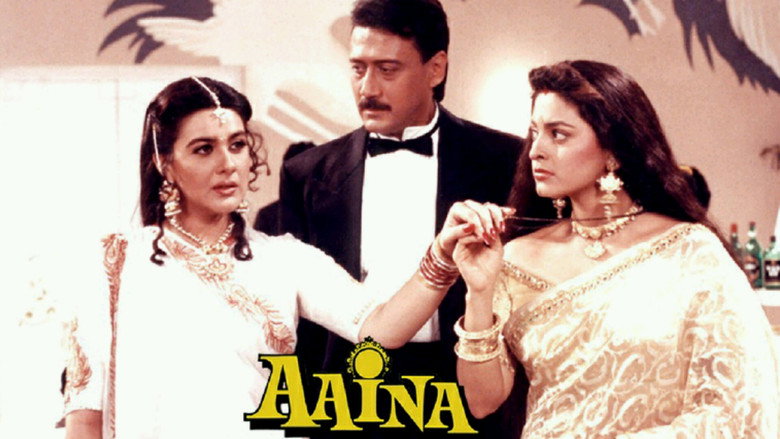
Enter Reema (Juhi Chawla), the younger sister, the one who’s spent her life in Roma’s shadow. Where Roma is all sharp edges and ambition, Reema is softness, compliance, the kind of woman who steps in to save the day without being asked. She marries Ravi not out of grand passion, but duty—a word that hangs over the film like a specter.
Juhi Chawla, who was often typecast as the bubbly, effervescent heroine, plays Reema with a quiet restraint that’s easy to overlook. There’s a scene early in their marriage where Ravi, still raw from Roma’s rejection, snaps at Reema for no reason. She doesn’t cry or argue; she just stands there, absorbing the blow, her face a mask of hurt that she quickly smooths away.
It’s a small moment, but it’s the kind that lingers. Reema isn’t a doormat—she’s a woman who’s learned to swallow her own desires for the sake of others, and Chawla plays that tension with a subtlety that’s rare in Bollywood’s more operatic dramas.
The film’s central conflict isn’t really about Ravi at all. It’s about the sisters, and the way their relationship fractures when Roma returns, determined to reclaim what she believes is rightfully hers. The confrontation between them is one of the film’s most electric scenes, not because of raised voices or dramatic gestures, but because of the way it’s shot.
The camera circles them as they argue, their faces half in shadow, their words clipped and precise. Roma accuses Reema of stealing her life; Reema fires back that Roma never wanted it in the first place. It’s a fight that feels less like a catfight and more like a reckoning, two women finally saying the things they’ve spent years not saying.
The scene ends with Roma slapping Reema—not out of anger, but desperation. It’s a moment that could have been played for cheap drama, but Amrita Singh and Juhi Chawla sell it with a raw, unfiltered intensity that makes it feel like a wound being reopened.
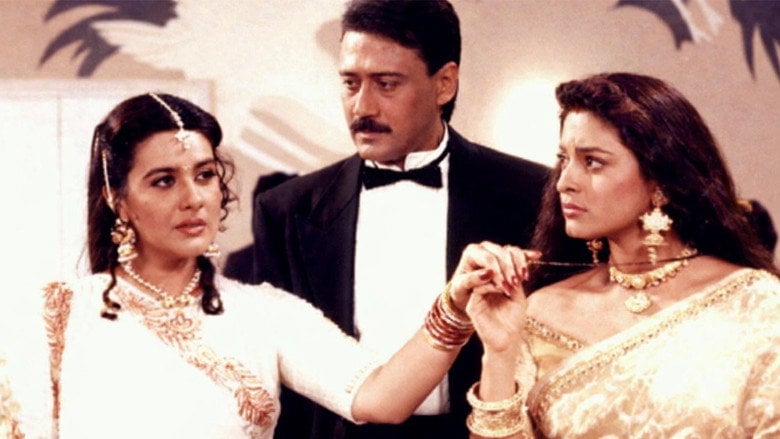
What’s fascinating about Aaina is the way it refuses to pick a side. Roma isn’t the villain, and Reema isn’t the saint. They’re both flawed, both trapped in roles they didn’t entirely choose.
The film’s title, which means “mirror,” is apt—it’s not just about the way the sisters reflect each other, but about the way they’re forced to confront the versions of themselves they’ve constructed. Roma, who left to pursue her dreams, finds herself haunted by the life she abandoned. Reema, who stayed, realizes too late that she’s spent her life living for others.
The mirror isn’t just a metaphor; it’s a literal device in the film, used in key scenes to show the sisters’ faces side by side, their similarities and differences laid bare.
The gossip around Aaina is almost as interesting as the film itself. It was originally conceived as a TV series before Yash Chopra—well, Pamela Chopra, his wife and the film’s producer—decided to upgrade it to a feature. That behind-the-scenes pivot feels telling. Aaina has the polish of a Yash Raj production, but it’s also grittier, more willing to sit with discomfort than some of the studio’s more sanitized romances.
There’s a scene where Ravi, drunk and bitter, tells Reema that she’s nothing like Roma—that she’s a pale imitation. It’s a cruel thing to say, but it’s also true in ways that cut deeper than the film’s more overt conflicts. Reema is a pale imitation, not because she’s lesser, but because she’s spent her life defining herself in relation to her sister.
The tragedy of Aaina isn’t that Roma comes back; it’s that Reema has to realize, too late, that she’s been living someone else’s life.
Jackie Shroff’s Ravi is the film’s weakest link, not because Shroff is a bad actor, but because the character is written as a cipher. He’s the prize in this love triangle, but he’s also the least interesting part of it. The film tries to make him sympathetic—he’s the man caught between two women, the one who’s been wronged—but it never quite sells the idea that he’s worth the emotional wreckage he leaves in his wake.
That’s not a flaw, exactly; it’s a choice. Aaina isn’t really about Ravi. It’s about the women who orbit him, the choices they make, and the consequences they face.
The film’s ending is where it stumbles. After all the emotional turmoil, it wraps things up with a neatness that feels unearned. Reema, who’s spent the entire film swallowing her pride, finally stands up for herself—but the resolution comes too quickly, as if the film is afraid to sit with the mess it’s created.
It’s a shame, because the rest of Aaina is willing to embrace that mess, to let its characters be flawed and contradictory. The ending feels like a concession to the idea that Bollywood romances need happy resolutions, even when the story demands something more complicated.
Still, Aaina lingers. Maybe it’s because of the way it captures the quiet devastation of living in someone else’s shadow. Maybe it’s the performances—Amrita Singh’s brittle intensity, Juhi Chawla’s understated heartbreak.
Or maybe it’s because, for all its melodrama, the film feels honest in a way that’s rare for its genre. It doesn’t just tell a story about love and sacrifice; it shows the cost of both. And in a landscape of films that often reduce women to either saints or villains, that’s something worth holding onto.
"A heartfelt drama with strong performances, though its melodramatic twists can feel overdone."
The film has emotional depth and compelling lead performances, particularly from Juhi Chawla and Amrita Singh, who bring nuance to their roles as sisters. The storyline is predictable, and the dramatic confrontations are a bit too intense, bordering on soap-opera territory.
Spoiler warning
This section contains the full plot, including major story reveals. Overview above stays spoiler-free.
The love triangle in Aaina is pure 90s melodrama – but behind the camera, the story is less cheating and catfights, more power plays, bold career gambles, and one quietly radical producer-wife pulling the strings. No, this isn’t a cursed, lawsuit‑ridden set… latestnetflix.com's take is that but the making of Aaina is way juicier than its “sanskaari family drama” image lets on.
For a film made in the gloriously messy 1990s, the absence of hard scandal is almost its own gossip item:
So if you came looking for a drunken Jackie Shroff brawl, a secret Juhi–Amrita cold war, or leaked “lost” scenes YRF is hiding… the record just doesn’t back that up. The juiciest truths about Aaina are more subtle: a TV idea promoted to big‑screen prestige, a producer’s wife flexing her creative muscle, an actress choosing the “bad sister” and stealing the film, and a director whose career mystery keeps gossip boards buzzing to this day.
Entertainment rumors and trivia aggregated from public reporting. Treat speculation as unverified unless a cited source confirms it.
More titles in the same genres and with the same cast.