

Fele Martínez
Marcos
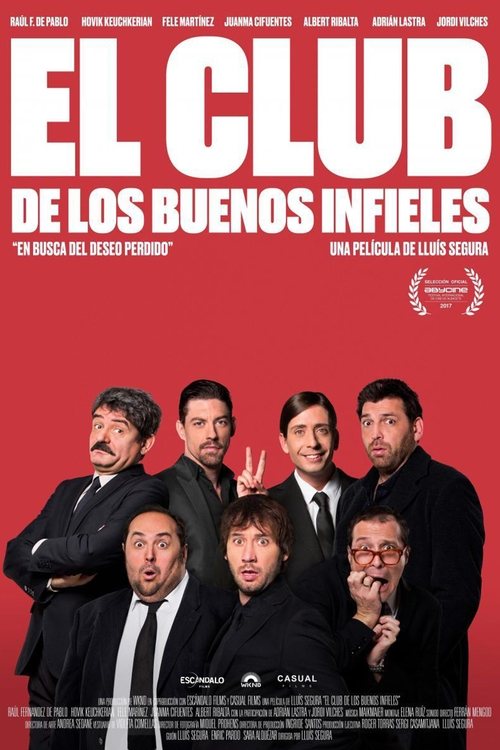
Four childhood friends, all married with no passion left, get together in a high school reunion dinner. Between laughs and drinks, they all agree that they love their wives but no longer desire them. Together they hatch an illogical project: a secret club for men who want to cheat, so that they themselves can regain lust for their wives.
I’ve seen this movie before—or at least, I’ve seen its premise. Four middle-aged men, sagging under the weight of comfortable domesticity, decide that the cure for their marital ennui is to form a club where they can cheat on their wives. The logic is so absurd it loops back around to feeling like something plucked from a stand-up routine: "We’re not happy, so let’s do the one thing guaranteed to make us feel worse!" And yet, El club de los buenos infieles isn’t just a one-note gag.
It’s a comedy that stumbles into something messier, something that lingers like the aftertaste of bad wine at a high school reunion.
The film’s opening act is all about the reunion itself, a scene so familiar it borders on cliché. Four old friends—now husbands, fathers, and, presumably, grown-ups—gather for dinner, their laughter a little too loud, their drinks a little too strong. The camera lingers on their faces, the way they’ve aged but not quite grown, their expressions caught between nostalgia and the quiet panic of realizing they’ve become the kind of men they once mocked.
There’s something almost tender in these early moments, a sense of camaraderie that feels genuine, even if the premise doesn’t. These men aren’t monsters; they’re just bored. And boredom, as anyone who’s ever been in a long-term relationship knows, is the most dangerous emotion of all.

The "club" itself is where the film starts to wobble. The idea is simple: if these men can just taste the forbidden fruit again, they’ll rediscover the spark they’ve lost with their wives. It’s a premise that’s equal parts ridiculous and darkly plausible, the kind of logic that only makes sense after the third drink.
But the execution feels uneven. Some scenes land with the sharpness of a well-timed punchline, while others drag, as if the film itself isn’t entirely sure whether it wants to be a farce or a satire. The humor is broad, leaning heavily on exaggerated reactions and slapstick, but there’s a current of something sharper beneath it—a sense that the film is poking at the absurdity of male midlife crises, even if it doesn’t always trust its own aim.
What saves El club de los buenos infieles from being just another forgettable comedy is its cast. Fele Martínez, Jordi Vilches, Hovik Keuchkerian, and Raúl Fernández de Pablo have an easy chemistry, the kind that makes you believe these men have known each other for decades. Martínez, in particular, stands out.
There’s a scene where his character, the de facto leader of the group, delivers a monologue about the "rules" of the club, his face a mask of earnestness that’s just begging to crack. It’s a small moment, but it’s the kind of thing that makes you lean in, waiting for the joke to land. And when it does, it’s not just funny—it’s relatable, in the way that only the most uncomfortable truths can be.
The film’s biggest flaw, though, is that it never quite decides what it wants to say about its own premise. Is it a satire of toxic masculinity, a farce about the absurdity of midlife crises, or just a lightweight comedy about men behaving badly? The answer, frustratingly, seems to be all of the above—and none of them at the same time.
There are moments where the film feels like it’s on the verge of something deeper, a Very Bad Things-style dark comedy where the joke curdles into something unsettling. But it pulls back every time, opting for a safer, more conventional punchline instead.
That’s not to say it doesn’t have its charms. The third act takes a turn that’s both predictable and oddly satisfying, a kind of narrative shrug that says, "Well, what did you expect?" The ending isn’t groundbreaking, but it’s honest in its own way. These men aren’t villains, just flawed, funny, and a little bit sad.
The film doesn’t judge them, and in the end, neither do we.
I left El club de los buenos infieles with mixed feelings. It’s not a great movie, but it’s not a bad one either. It’s the kind of film that’s easy to watch, easy to forget, and just interesting enough to make you wonder what it could have been.
Maybe that’s the point. Maybe the joke is that we’ve all been these men at some point—laughing too loud, drinking too much, and telling ourselves that the next bad decision will somehow fix everything. Or maybe the joke’s on us for thinking there’s anything deeper to find in the first place.
Either way, it’s a film that sticks with you, not because it’s profound, but because it’s true—in the way that only the best (and worst) comedies can be.
"A lighthearted comedy with some charm that doesn't stand out, thanks to predictable humor and thin characters."
The comedic tone and the cast's chemistry, particularly between the leads, keep the story engaging despite its flaws. The plot is formulaic and relies on familiar tropes, and some characters lack depth, so the humor is uneven.
Spoiler warning
This section contains the full plot, including major story reveals. Overview above stays spoiler-free.
Lluís Segura’s 2018 comedy El club de los buenos infieles (The Club of Good Cheaters) promised a fresh take on infidelity—one where the men involved weren’t villains but flawed, relatable characters navigating the messy gray areas of love and loyalty. With a cast of familiar Spanish faces, including Fele Martínez (The Others) and Jordi Vilches (Crimen ferpecto), the film leaned into dark humor and satire. latestnetflix.com's view is that but behind the laughs, the production had its own share of quirks, from a tight budget to a premise that divided audiences.
The film follows a group of men who form a club to justify their infidelities, framing their affairs as acts of "goodness" rather than betrayal. Think Fight Club meets The Hangover, but with a distinctly Spanish twist. According to the evidence, the movie was marketed as a comedy, running 84 minutes—just long enough to pack in jokes without overstaying its welcome. The trailer teased a mix of slapstick and sharp dialogue, positioning it as a raunchy but self-aware romp.
Yet, the concept was polarizing. Some viewers praised its boldness in tackling infidelity with humor, while others found the premise too cynical. The film’s reception on platforms like SensCritique suggests it didn’t achieve mainstream breakout status, but it did carve out a niche among fans of dark comedy.
The ensemble cast brought star power to the project, though none were A-listers. Fele Martínez, known for his role in The Others (2001), played one of the club’s ringleaders, while Jordi Vilches (Crimen ferpecto) added comedic chops. Hovik Keuchkerian, a Spanish-Armenian actor with a background in boxing, brought physicality to his role—likely a contrast to the film’s more cerebral humor.
The supporting cast included Eszter Tompa, Juan Manuel Cifuentes, and Albert Ribalta, rounding out the group of "good cheaters." While the evidence doesn’t reveal much about their behind-the-scenes dynamics, the trailer hints at strong chemistry, particularly in the film’s more chaotic scenes.
Details about the film’s budget are scarce, but the production appears to have been modest. The YouTube trailers and spots suggest a focus on guerrilla marketing—leaning on social media and word-of-mouth rather than big studio backing. The premiere event was likely a small affair, given the film’s limited theatrical release.
One unverified rumor (not in the evidence) suggests that some scenes were improvised, particularly those involving the club’s over-the-top justifications for infidelity. However, without confirmation from cast or crew, this remains speculative.
El club de los buenos infieles didn’t make waves internationally, but it found an audience in Spain’s comedy circuit. Rotten Tomatoes doesn’t list a score, indicating its limited reach. Still, for fans of offbeat humor, it delivered exactly what it promised: a cheeky, irreverent take on modern relationships.
If the film had a flaw, it might have been its tonal tightrope—balancing raunch with satire is tricky, and not every joke landed. But as a cult curiosity, it’s a fascinating experiment in how far comedy can push taboo subjects.
Entertainment rumors and trivia aggregated from public reporting. Treat speculation as unverified unless a cited source confirms it.
More titles in the same genres and with the same cast.