
Mario Casas
Toro

Toro (Spanish for "Bull") is a young con man and the right hand of Romano, a powerful mob boss in Torremolinos, Málaga (Andalusia, south to Spain). After Toro decides to leave Romano to get a life free of crime, his last sting fails, resulting one of his brothers dead and he sent to jail. Five years later, Romano realizes that López, Toro's older brother, is robbing him money from his tourism business and he orders to kidnap Diana, López's little daughter, until this one get back the money. Without options, López visits Toro, now a touristic driver with the third grade prison close to get the parole, who only wants to be free to marry his girlfriend Estrella. When Toro accepts to help López and both meet Romano looking for a solution, Toro ends attacking Romano's men and fleeing with Diana, trying to escape from Romano's revenge. But Romano starts a ruthless searching for they three, meanwhile Toro counts the hours to back the prison according to the third grade...
I keep thinking about the way Mario Casas moves in Toro. Not the swagger—though there is plenty of that—but the way his body seems to vibrate just below the surface, like a tuning fork struck too hard. It’s the kind of physical tension that betrays a man who’s spent years pretending he’s in control, only to realize too late that the world has other plans. Toro is a film that wants to be a slick, high-octane thriller, the kind of movie where bullets fly and cars flip and the bad guys get what’s coming to them in a blaze of cathartic violence.
But what lingers isn’t the action. It’s the way Casas’ character, Toro, keeps running into the same walls, over and over, as if he’s forgotten how to do anything else.
Kike Maíllo’s second feature after the sci-fi drama Eva (2011) is a deliberate swerve into grittier territory, a film that trades robots and futuristic cities for the sun-baked streets of Andalusia and the moral quicksand of organized crime. The shift isn’t just tonal; it’s a test of whether Maíllo’s strengths as a director—his ability to balance atmosphere with emotional stakes—can translate to a genre that often prioritizes momentum over depth. The answer, frustratingly, is sometimes.
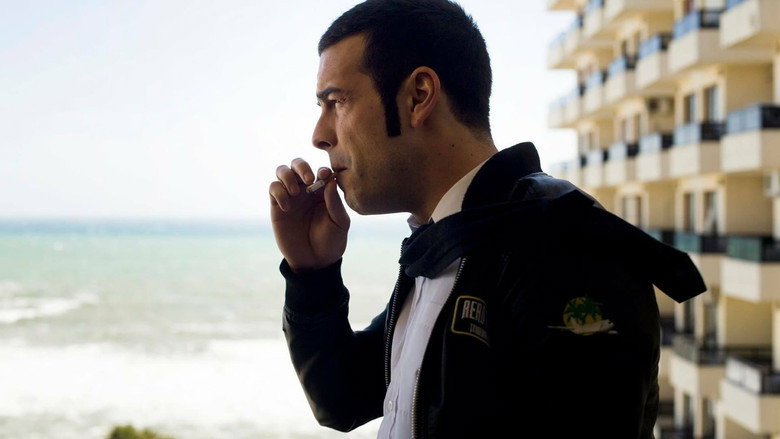
The premise is simple, almost archetypal: a former criminal, Toro, is pulled back into the life he tried to leave behind when his brother’s daughter is kidnapped by his old boss, Romano (Luis Tosar). It’s the kind of setup that’s been done a hundred times before, from The Godfather to John Wick, and Toro doesn’t do much to reinvent the wheel. But what it lacks in originality, it makes up for in the specifics—the way the heat of southern Spain feels like a character itself, the way the dialogue crackles with the kind of casual brutality that only comes from people who’ve known each other too long.
There’s a scene early on where Toro and his brother, López (José Sacristán), sit in a car, the kind of quiet moment that should feel like a breather but instead hums with tension. López is older, wearier, his face lined with the kind of exhaustion that comes from years of bad decisions. He’s not a criminal mastermind; he’s a man who’s been ground down by the system, and Sacristán plays him with a quiet, resigned dignity that makes you root for him even when you know he’s part of the problem.
Maíllo has said in interviews that Toro has a "very crazy idea of justice," and that’s the film’s most interesting thread. Toro isn’t a hero, not even close. He’s a man who thinks he can outrun his past, who believes that if he just does one last job, he’ll be free.
But the film isn’t interested in letting him off the hook. Every time he thinks he’s made a clean break, the past rears up like a bull (pun intended) and gores him all over again. The problem is that Toro doesn’t always trust its audience to connect the dots.
There are moments where the film’s moral ambiguity feels more like indecision than complexity, where the script seems to be hedging its bets instead of committing to the messiness of its own premise. When Toro finally confronts Romano, the scene should be electric, a collision of two men who know each other too well. Instead, it feels rushed, as if the film is more interested in getting to the next set piece than in letting the moment breathe.
That’s not to say Toro doesn’t have its pleasures. The action sequences are well-choreographed, if not particularly innovative, and there’s a real sense of place to the film. Andalusia isn’t just a backdrop; it’s a world of sun-bleached buildings and narrow streets, where the heat makes everything feel just a little more desperate.
And then there’s Casas, who carries the film on his shoulders. He’s an actor who understands that the best performances aren’t about big moments—they’re about the small ones, the way a man’s fingers twitch when he’s lying, or the way his shoulders slump when he realizes he’s been outmaneuvered. There’s a scene where Toro sits in a bar, staring at his hands like they belong to someone else, and Casas doesn’t need to say a word.
You can see the weight of every bad decision he’s ever made pressing down on him.
But for all its strengths, Toro never quite escapes the feeling that it’s a film caught between two impulses. On one hand, it wants to be a character study, a meditation on guilt and redemption and the inescapable pull of the past. On the other, it wants to be a pulpy, high-energy thriller, the kind of movie where the body count rises and the stakes get higher with every scene.
The result is a film that’s neither fish nor fowl, a movie that’s too thoughtful to be a straight-up action flick but too reliant on genre tropes to fully commit to its deeper themes.
That’s not a fatal flaw, but it is a frustrating one. Because when Toro works, it works beautifully. There’s a late sequence where Toro and Diana (Claudia Canal), his niece, are on the run, and the film slows down just enough to let you feel the exhaustion of their flight.
Diana is just a kid, but she’s already seen too much, and Canal plays her with a quiet resilience that’s heartbreaking. In those moments, Toro feels like something special, a film that understands the cost of violence—not just the physical toll, but the way it seeps into your bones and stays there.
In the end, though, Toro is a film that’s better in its parts than as a whole. It’s a movie that gives you moments to savor—Casas’ performance, the sun-drenched cinematography, the way the best scenes hum with tension—but it never quite coheres into something greater than the sum of those parts. Maybe that’s the point.
Maybe Toro is a film about a man who’s always running, always trying to outpace his past, only to realize that he’s been running in circles. It’s a shame, then, that the film itself can’t quite break out of that same loop.
"A gritty crime thriller with strong performances but a plot that struggles to stand out."
Intense lead performances, particularly from Mario Casas and Luis Tosar, add depth to the crime drama. The story is overly familiar, with predictable twists and little originality, so it leaves no lasting impression. The visual style is engaging but can’t make up for the thin narrative.
Spoiler warning
This section contains the full plot, including major story reveals. Overview above stays spoiler-free.
Kike Maíllo’s Toro (2016) is a high-octane Spanish crime thriller that pits Mario Casas against Luis Tosar in a brutal game of revenge and survival. latestnetflix.com's take is that while the film’s action sequences and dark tone have drawn comparisons to classic crime dramas, the behind-the-scenes story reveals a director pushing boundaries and a cast diving deep into their roles—sometimes literally.
Before Toro, Kike Maíllo was best known for his sci-fi debut Eva (2011), which earned him a Goya Award for Best New Director. The leap from futuristic drama to a gritty, blood-soaked crime thriller was a deliberate risk. In interviews, Maíllo described Toro as a story about "a man with a very crazy idea of justice", suggesting the film’s moral ambiguity was central to its appeal. The shift in genre demonstrated Maíllo’s versatility, though it left some fans of his earlier work surprised.
Mario Casas, who plays the titular Toro, underwent a dramatic physical transformation for the role. Known for his leading-man charm in Spanish rom-coms and dramas, Casas embraced the role of a vengeful ex-con with a penchant for violence. In promotional interviews, he discussed the challenges of performing his own stunts, including a particularly intense fight scene that required weeks of training. His co-star Luis Tosar, a veteran of Spanish crime films like Cell 211, brought a contrasting intensity to the role of his brother, creating a dynamic that anchored the film’s emotional core.
The production wasn’t without its challenges. Early trailers hinted at a frenetic, almost chaotic energy, and behind-the-scenes footage from the film’s premiere in Vigo showed a cast and crew clearly energized by the project. However, the film’s reception was mixed. While some critics praised its raw energy and performances, others found its plot convoluted. SensCritique users rated it a middling 5.5/10, and Rotten Tomatoes’ audience score remains unlisted, suggesting a polarizing response.
Despite the buzz, some details about Toro’s production remain unclear. There’s no confirmed word on the film’s budget, shooting locations, or whether any on-set injuries occurred during its action-heavy sequences. Rumors of tension between Casas and Tosar—common in crime thrillers where characters clash—circulate online, but no credible sources have substantiated them.
For now, Toro shows Maíllo’s ambition and Casas’ willingness to shed his heartthrob image. Whether it’s remembered as a cult hit or a flawed experiment may depend on whether audiences revisit it in the years to come.
Entertainment rumors and trivia aggregated from public reporting. Treat speculation as unverified unless a cited source confirms it.
More titles in the same genres and with the same cast.