
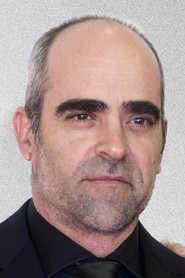
Luis Tosar
Mario

Mario, an exemplary man, lives in a village on the Galician coast. In the old people’s home, where he works as a nurse, everyone appreciates him. When the best known narco in the area, Antonio Padín, recently released from prison, enters the residence, Mario tries to make Antonio feel at home. Now, Padín's two sons, Kike and Toño, are in charge of the family business. The failure of an operation will put Kike in jail and cause them to owe a large debt to a Colombian supplier. Toño will turn to the nurse to try to convince his father to assume the debt. But Mario has his own plans.
I’ve seen this story before—too many times, in fact. A good man, a criminal, a debt, a moral reckoning. The revenge thriller is a well-worn path, and Eye for an Eye walks it with the kind of steady, unhurried gait that makes you wonder if it’s leading anywhere at all.
Then, somewhere in the middle, it tilts. Not with a gunshot or a twist, but with a look. A long, wordless stare between two men who understand each other in ways neither can admit.
That’s when Paco Plaza’s film stops being a genre exercise and becomes something quieter, more unsettling. Plaza is best known for REC, the found-footage horror that turned a Madrid apartment building into a claustrophobic nightmare. There’s no supernatural terror here, no shaky cam, no zombies.
Instead, Eye for an Eye unfolds in the damp, gray light of Galicia, where the sea is always close and the air carries the weight of unspoken things. The shift from horror to crime drama isn’t as jarring as it might seem. Both genres thrive on tension, on the slow unraveling of civility.
The difference is that here, the monster isn’t a virus or a ghost—it’s the rot of a system, the kind that seeps into families and communities until no one can tell where the corruption ends and the person begins.
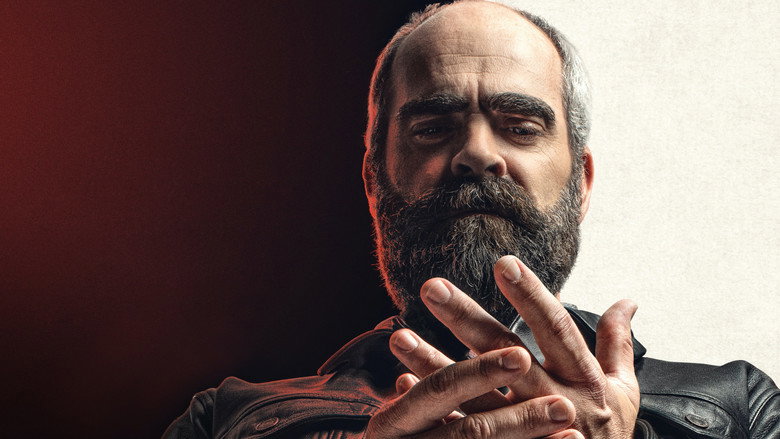
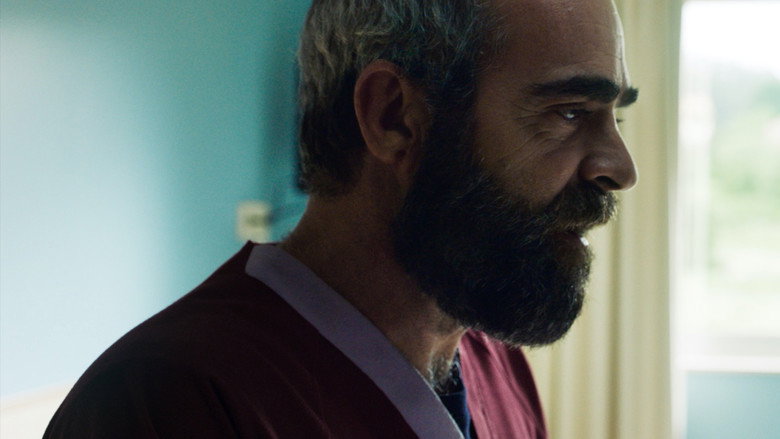
Mario (Luis Tosar) is the kind of man who blends into the background. He works at a nursing home, a caretaker in every sense of the word—patient, kind, the sort of person who remembers how his residents take their coffee. There’s no judgment in his voice, no flicker of recognition.
But of course, he knows exactly who Padín is. Everyone in this small coastal town does. The Padín family is a cancer in Galicia, a name that carries the weight of fear and grudging respect.
When their latest drug shipment goes wrong, leaving them indebted to a Colombian cartel, the younger generation—Kike (Enric Auquer) and Toño (Ismael Martínez)—turn to Mario for help. They want him to convince their father to take responsibility for the debt, to use his influence one last time. But Mario has his own reasons for getting close to the old man.
Reasons that have nothing to do with money and everything to do with the past. What follows isn’t a bloodbath or a high-speed chase. It’s a series of conversations, most of them held in quiet rooms with the sound of the ocean humming in the distance.
Plaza’s direction is deliberate, almost languid, but there’s a current of unease running beneath every scene. The camera lingers on faces, on the way a hand trembles just before pouring a drink, on the way a man’s eyes dart away when he’s lying. There’s no score to speak of, just the ambient noise of the world—the clink of glasses, the creak of a chair, the distant cry of gulls.
It’s unsettling in the way real life is unsettling, when you realize too late that the person you’re talking to isn’t who you thought they were.
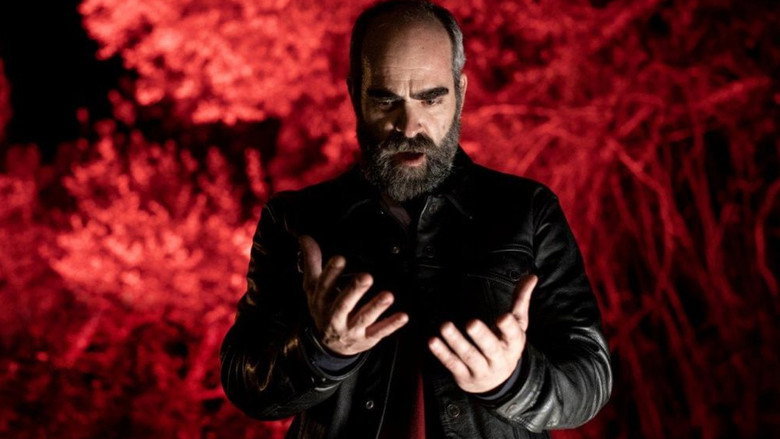
Tosar is a revelation here, though "revelation" might be the wrong word. He’s not playing against type—he’s simply playing a type we rarely see. Mario isn’t a hero or an antihero.
He’s a man who’s spent his life making himself small, and now, for reasons that unfold with painful slowness, he’s being forced to take up space. Tosar’s performance is all in the details: the way he holds his shoulders just a little too rigidly, the way his voice softens when he’s lying, the way his eyes go flat when he’s listening to someone he despises. There’s a moment, late in the film, when Mario sits across from Padín in the nursing home’s common room.
The old man is talking about the past, about the things he’s done, and Mario just listens. His face doesn’t change. He doesn’t nod or frown or react at all.
And yet, in that stillness, you can see the weight of every decision that’s led him to this moment. The Padín family, meanwhile, is a study in generational decay. Auquer and Martínez play them as two sides of the same coin—Kike, volatile and impulsive, the kind of man who solves problems with his fists; Toño, calculating and cold, the kind who lets others do the dirty work.
Neither of them is particularly bright, and neither of them seems to understand that their father’s time has passed. When they turn to Mario, it’s not just because they need his help. It’s because they’re desperate, and desperation makes people do stupid things.
The film’s title, Eye for an Eye, suggests a straightforward morality tale about vengeance. But Plaza isn’t interested in easy justice. The revenge here isn’t cathartic.
It’s messy, ambiguous, and ultimately hollow. There’s a scene near the end where Mario stands on a cliff, looking out at the ocean. The wind is howling, the waves are crashing, and for a moment, it feels like he’s going to jump.
But he doesn’t. He just stands there, staring at the water, and you realize that this isn’t a story about retribution. It’s a story about the cost of survival, about what happens when the only way to move forward is to become the thing you hate.
Rotten Tomatoes lists Eye for an Eye as a 2019 release, but beyond that, the critical conversation around the film seems to have been muted. That’s a shame, because it’s the kind of movie that deserves to be talked about—not for its plot, which is simple enough, but for the way it uses silence and stillness to tell a story about power, complicity, and the quiet violence of everyday life.
It’s not a perfect film. The pacing drags in places, and some of the supporting characters feel underdeveloped. But those flaws don’t detract from its power.
If anything, they make it feel more real, more human. In the end, Eye for an Eye is a film about the stories we tell ourselves to justify the things we do. Mario tells himself he’s a good man, that he’s doing what he has to do.
The Padíns tell themselves they’re businessmen, that the people they hurt are just collateral damage. And the town? The town tells itself it doesn’t see anything at all.
It’s easier that way. But the camera sees. Plaza’s camera always sees.
And in the quiet moments between the lies, it shows us the truth.
"A gritty crime thriller with strong performances but a plot that doesn’t stand out from familiar revenge narratives."
Intense performances from Luis Tosar and María Vázquez add depth to the revenge-driven storyline. The reliance on well-worn crime thriller tropes and the lack of fresh twists keep it from rising above similar genre entries.
Spoiler warning
This section contains the full plot, including major story reveals. Overview above stays spoiler-free.
Paco Plaza, best known for his found-footage horror hit [REC] (2007), took a sharp turn into crime thriller territory with Eye for an Eye (2019). The film stars Luis Tosar (Cell 211, The Realm) as a man consumed by vengeance after a brutal attack on his family. While Plaza’s horror roots are unmistakable in the movie’s tension, latestnetflix.com argues, Eye for an Eye trades supernatural scares for raw, real-world brutality.
Plaza’s pivot from horror to revenge drama raised eyebrows among fans. The director, who co-created the [REC] franchise, had built a reputation for claustrophobic, high-stakes terror. Eye for an Eye retains that intensity but swaps zombies for human monsters—criminals who cross the wrong man. Early teasers hinted at Plaza’s signature style: tight pacing, unflinching violence, and a protagonist pushed to the edge.
The film’s first-look footage, released exclusively by YouTube in 2018, showcased Tosar’s brooding performance and the movie’s grim tone. Critics noted the shift wasn’t entirely surprising—Plaza had dabbled in crime elements before, but Eye for an Eye marked his first full dive into the genre.
Tosar, one of Spain’s most versatile actors, anchors the film as a father driven to extremes. His role in Eye for an Eye drew comparisons to his breakout performance in Cell 211 (2009), where he played a prison guard trapped in a riot. Here, he’s a man unraveling in real time, his grief and rage palpable. Co-star María Vázquez (The Bar, While at War) plays his wife, adding emotional weight to the story.
Supporting cast members like Enric Auquer (Perfect Strangers, Criminal: Spain) and Ismael Martínez (The Platform) round out the ensemble, though their roles remain secondary to Tosar’s gripping lead performance. Early trailers teased a morally ambiguous narrative, with Tosar’s character descending into a world where justice is personal—and brutal.
Unlike Plaza’s horror hits, Eye for an Eye didn’t generate the same buzz. The film premiered in Spain in 2019 but had a limited international release, primarily through streaming platforms like Amazon Prime Video in the UK. Rotten Tomatoes lacks a critic or audience score for the 2019 version, suggesting it flew under the radar compared to Plaza’s earlier work.
Rumors swirled about potential distribution challenges, though no official statements confirmed delays or studio conflicts. What’s clear is that Eye for an Eye didn’t achieve the same cultural footprint as [REC], despite Plaza’s name attached. Some fans speculated the shift to crime drama alienated horror purists, while others praised the film’s uncompromising approach [unconfirmed].
The title Eye for an Eye isn’t just a nod to biblical justice—it’s a central theme. The film grapples with the cyclical nature of violence, asking whether revenge truly brings closure. While the evidence doesn’t reveal specific plot details, trailers and promotional material frame it as a dark, character-driven thriller where every action has consequences.
Plaza’s direction ensures the tension never lets up, even if the story’s moral questions linger. For fans of Tosar’s work or revenge thrillers like Prisoners (2013), Eye for an Eye offers a grim, atmospheric alternative—one that trades Hollywood polish for raw, unfiltered emotion.
With sparse reviews and limited availability, Eye for an Eye remains a curiosity rather than a standout. Plaza’s shift from horror to crime drama is intriguing, but the film’s quiet release suggests it didn’t land as intended. For those who seek it out, it may deliver the same relentless energy as his earlier work—just without the supernatural twist.
Entertainment rumors and trivia aggregated from public reporting. Treat speculation as unverified unless a cited source confirms it.
More titles in the same genres and with the same cast.


