

Aditi Mittal
Herself

Trailblazing comic Aditi Mittal mixes topical stand-up with frank talk about being single, wearing thongs and the awkwardness of Indian movie ratings.
I’ve always thought stand-up comedy is the closest thing we have to a public confessional. There’s something thrilling about watching someone step onto a stage, alone under the lights, and say the things we’ve all thought but never dared to voice. Aditi Mittal’s Things They Wouldn’t Let Me Say doesn’t just lean into that thrill—it grabs it by the collar and shakes it.
This isn’t just a comedy special; it’s a dare. A dare to the audience, to society, and maybe even to herself: What happens when a woman says the quiet parts out loud?
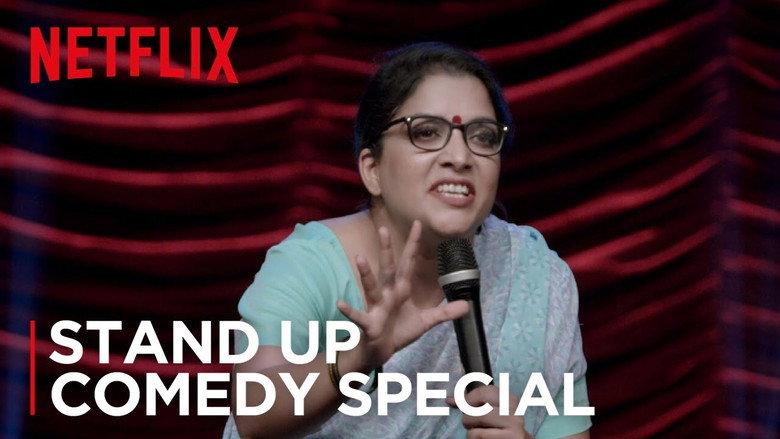
The first thing you notice about Mittal’s special is how little she needs to hide behind. The stage is bare—no flashy props, no elaborate sets, just a stool, a mic, and a woman in a simple kurta, her hair pulled back like she’s ready for a fight. That minimalism isn’t just a stylistic choice; it’s a statement.
This isn’t a show about spectacle. It’s about the words. And the words?
They’re sharp, unfiltered, and often uncomfortably honest. Mittal doesn’t just joke about taboos; she dissects them with the precision of a surgeon who’s also a little bit drunk on her own audacity.
Take the bit about menstruation, for instance. It’s not just that she’s talking about periods in a country where the topic is still whispered about in hushed tones behind closed doors. It’s how she talks about it.
She doesn’t soften the edges. She doesn’t couch it in euphemisms or self-deprecating humor to make the audience more comfortable. Instead, she leans into the discomfort, turning it into a shared experience. “Why do we act like this is some shameful secret?” she seems to ask. “It’s just biology.
And if you’re squirming in your seat right now, maybe that’s the real problem.” The joke isn’t just about periods; it’s about the absurdity of the shame surrounding them. And in that moment, the laughter feels like a small act of rebellion.
Mittal’s comedy is observational in the truest sense—she doesn’t just point out the absurdities of life; she forces you to see them through her eyes. Her bit about marriage is a masterclass in this. She doesn’t just mock the institution; she dismantles it piece by piece, using her own experiences as a single woman in India to highlight the contradictions in how society views women. “They ask me, ‘When are you getting married?’” she says, mimicking the well-meaning but relentless relatives. “Like marriage is some kind of achievement.
"A bold, unfiltered stand-up special valued for raw honesty, though pacing and topics can run uneven."
Aditi Mittal's 2017 Netflix special Things They Wouldn't Let Me Say is a 62-minute set directed by Fazila Allana. As one of India's earliest female stand-up comedians, Mittal tackles taboo subjects often treated as off-limits for women in Indian society. The approach is fearless: humor feels authentic and necessary in a culture that usually avoids these topics. She blends personal anecdotes with broader social commentary, making the set both relatable and pointed. Pacing can feel inconsistent, with some jokes landing harder than others. The Netflix release widened her reach globally, though reactions vary with cultural familiarity with her subjects. It stands as a significant push of boundaries for female comedians in Indian comedy.
Aditi Mittal’s 2017 Netflix special, Things They Wouldn’t Let Me Say, wasn’t just another comedy set—it was a middle finger to taboos in Indian stand-up. Directed by Fazila Allana, the 62-minute spectacle became one of the first major Netflix comedy specials headlined by an Indian woman, a milestone in a scene dominated by male voices. But what really made it stick wasn’t just the jokes; it was the topics Mittal dared to tackle, from menstruation to mental health, in a culture where such subjects were often whispered about, not laughed at.
By 2017, Netflix was aggressively expanding its global comedy slate, but Indian stand-up was still a niche market. Mittal, already a veteran of the circuit, was one of the few women who’d carved out a space in the boys’ club of Indian comedy. Things They Wouldn’t Let Me Say wasn’t just a special—it was a statement. The title itself hinted at the unspoken rules Mittal was breaking, and the trailer teased a no-holds-barred approach, with Mittal deadpanning about everything from sanitary napkins to societal expectations.
Allana, the director, wasn’t just any filmmaker. A pioneer in Indian television production, she brought a sharp, cinematic eye to the special, ensuring Mittal’s razor-sharp timing translated to screen. The result? A special that felt raw, unfiltered, and distinctly Indian—not watered down for global audiences.
Mittal’s material wasn’t just edgy; it was necessary. Clips from the special, like her bit on sanitary napkins, went viral for their unapologetic take on a topic still considered "unclean" in many parts of India. She didn’t just joke about periods—she dissected the shame around them, turning discomfort into laughter.
But it wasn’t all shock value. Mittal also waded into mental health, a subject rarely discussed openly in Indian comedy. Her ability to balance humor with empathy made the special feel like a conversation, not just a performance. The Netflix platform gave her the freedom to push boundaries without network censors breathing down her neck—a luxury many Indian comedians didn’t have at the time.
The special didn’t just make waves—it helped pave the way for more women in Indian stand-up. Mittal’s success proved there was an audience for bold, unfiltered comedy, even if the topics made some uncomfortable. While the evidence doesn’t confirm whether Netflix greenlit more Indian female-led specials immediately after, Things They Wouldn’t Let Me Say undeniably shifted the conversation.
That said, coverage of the special’s behind-the-scenes process is thin. There’s no verified chatter about on-set drama, creative clashes, or budget woes—just the final product, which speaks for itself. If there were struggles, they didn’t make it into the public record.
Five years later, Mittal’s special holds up—not just as a time capsule of Indian comedy’s evolution, but as a reminder of how far the scene has (and hasn’t) come. While more women have since broken into stand-up, the industry still grapples with the same taboos Mittal tackled in 2017. The difference? Now, there’s a blueprint for how to do it right.
Entertainment rumors and trivia aggregated from public reporting. Treat speculation as unverified unless a cited source confirms it.
More titles in the same genres and with the same cast.


