Erica Lindbeck
Barbie (voice)

“A New Aquatic Adventure!”
Barbie and her sisters take off on another exciting, global adventure to visit their friend Ken at his summer internship at a beautiful and exotic coral reef.
Official
I’ll admit it: I went into Barbie: Dolphin Magic expecting a 63-minute commercial for Mattel’s latest tie-in toy line. What I didn’t expect was the strange, fleeting charm of watching Barbie and her sisters stumble into a story that feels like it was written by a committee of focus-grouped dolphins. This isn’t a film about depth—literal or metaphorical—but it’s not entirely without its own kind of weird, accidental poetry.
Like a child’s drawing of a mermaid, it’s all bright colors and no shadows, but every so often, you catch a glimmer of something almost real beneath the plastic sheen.
The premise is simple enough: Barbie (Erica Lindbeck) and her sisters—Skipper, Stacie, and Chelsea—head to a coral reef where Ken (Adrian Petriw) is interning for the summer. (Yes, Ken has a job. No, we don’t learn what it entails beyond "being enthusiastic.") Almost immediately, they encounter a magical dolphin named Marlo, who leads them to a hidden mermaid kingdom where Barbie is mistaken for a long-lost princess.
Cue the underwater ballgowns, the obligatory "believe in yourself" montage, and a villain who wants to exploit the reef’s magic for profit. It’s The Little Mermaid meets Barbie: Life in the Dreamhouse, if Life in the Dreamhouse had a budget for underwater CGI and a slightly less meta sense of humor.
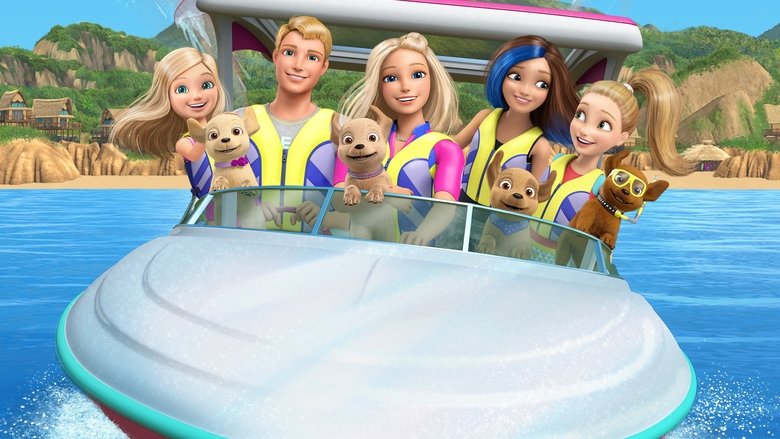
What’s striking about Dolphin Magic isn’t its plot—it’s the way the film treats its own artificiality. The animation is smooth, almost aggressively so, with a hyper-saturated color palette that makes the ocean look like a screensaver. The mermaids’ tails shimmer with a metallic sheen, as if they’ve been dipped in glitter and left to dry under a heat lamp.
The coral reefs glow with an unnatural vibrancy, like someone cranked the saturation dial to 11 and then kept turning. It’s not bad animation, exactly—it’s just so loud. Every frame feels like it’s trying to sell you something, whether it’s the idea of adventure or the latest Barbie Dreamtopia playset.
And yet, there’s something oddly compelling about the way the film leans into its own shallowness. This isn’t a story about self-discovery in the traditional sense; it’s about brand discovery. Barbie doesn’t learn to be true to herself so much as she learns to be true to the idea of herself—the perfect, smiling, perpetually put-together icon who can solve any problem with a combination of kindness and a well-timed musical number.
The film’s emotional climax comes when Barbie, dressed in a gown that looks like it was sewn from liquid sequins, delivers a speech about believing in magic. It’s not subtle. It’s not even particularly good.
But it’s earnest, in the way that only a film made for eight-year-olds can be. There’s no irony here, no winking at the audience. Just a straight-faced declaration that magic is real, and so is Barbie.
That earnestness is both the film’s greatest strength and its most glaring weakness. On one hand, it’s refreshing to watch something that isn’t afraid to be unapologetically cheerful. The world could use more stories that treat joy as a default, not a reward.
On the other hand, Dolphin Magic never quite commits to the bit. It wants to be a fantasy adventure, but it’s too afraid of scaring its young audience to let anything truly happen. The villain, a smarmy developer named Hugo (Paul Dobson), is about as threatening as a wet sock.
His plan to drain the reef’s magic is foiled not by cleverness or courage, but by the power of friendship—specifically, the friendship between Barbie and a dolphin who may or may not be a mermaid in disguise. (The film is never entirely clear on this point, and honestly, neither am I.)
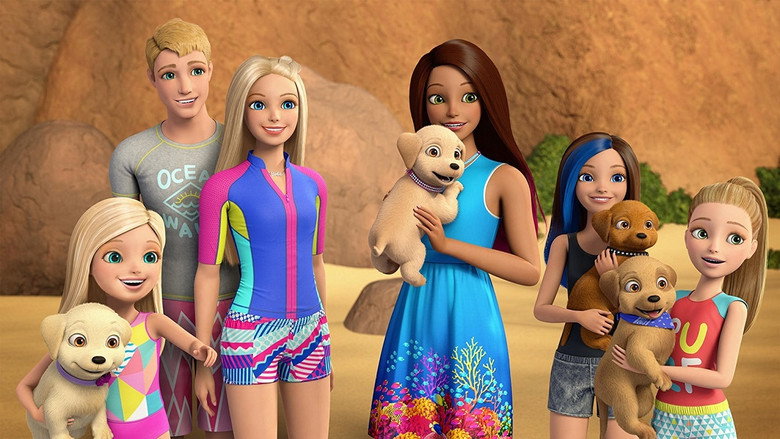
The film’s most interesting moments come not from its plot, but from its quiet, almost subversive acknowledgment of Barbie’s cultural baggage. There’s a scene early on where Barbie and her sisters are packing for their trip, and Chelsea (Alyssya Swales) holds up a tiny, sparkly dress. "Do I have to wear this?" she asks, her voice dripping with the kind of pre-teen exasperation that feels painfully real.
It’s a small moment, but it’s one of the few times the film acknowledges that its characters exist outside of their roles as brand ambassadors. For a second, Chelsea isn’t just a miniature Barbie—she’s a kid who doesn’t want to wear a frilly dress to the beach. It’s gone in an instant, but it lingers in a way the rest of the film doesn’t.
The rest of the cast is largely forgettable, though not for lack of trying. Erica Lindbeck’s Barbie is perky to the point of mania, her voice a constant stream of upbeat platitudes. ("Every problem has a solution if you just believe in yourself!") It’s a performance that feels less like acting and more like a corporate training video on how to be endlessly optimistic.
The sisters fare slightly better—Shannon Chan-Kent’s Skipper has a dry wit that cuts through the saccharine at times—but they’re ultimately sidelined in favor of the film’s real star: the underwater CGI.
And what CGI it is. The ocean sequences are the film’s most visually striking moments, a swirling kaleidoscope of blues and greens that feel almost tactile. The mermaids move with a weightless grace, their tails flicking through the water like they were born to it.
There’s a scene where Barbie and Marlo swim through a bioluminescent cave, the walls pulsing with light like a living heartbeat, and for a second, you forget you’re watching a direct-to-video Barbie movie. It’s beautiful in the way a screensaver is beautiful—pretty to look at, but ultimately empty.
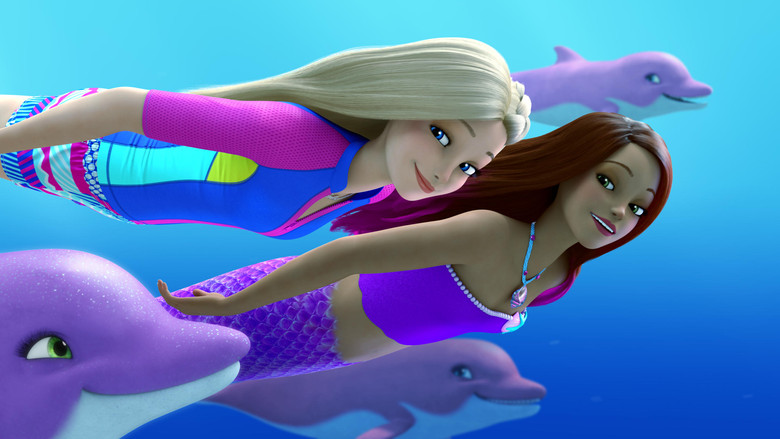
That’s the thing about Dolphin Magic: it’s a film that’s easy to dismiss, but hard to hate. It’s not trying to be Finding Nemo or Moana—it’s not interested in depth, either literal or emotional. It’s a film about surfaces, about the way light refracts through water, about the way a plastic doll can become a princess if you just believe hard enough.
It’s a film that knows exactly what it is, and it never apologizes for it. That kind of confidence is rare, even if it’s misplaced.
I left Barbie: Dolphin Magic feeling oddly conflicted. It’s not a good movie by any traditional measure—its plot is thin, its characters are underdeveloped, and its message is as subtle as a sledgehammer. But there’s something almost admirable about its refusal to be anything other than what it is: a brightly colored, 63-minute advertisement for the idea that magic is real, and so is Barbie.
It’s not a film that will change your life, or even your afternoon. But for a little while, it’ll make you believe that maybe, just maybe, the ocean is full of mermaids. And really, what’s so bad about that?
"A charming, family-friendly adventure with vibrant animation and a sweet message, though lacking depth for older viewers."
Younger viewers and Barbie fans enjoy the colorful underwater world and Barbie's bond with the dolphins, and praise its themes of friendship and environmental care. Some find the plot predictable and the humor too simple for older children or adults.
Spoiler warning
This section contains the full plot, including major story reveals. Overview above stays spoiler-free.
Barbie: Dolphin Magic is 63 minutes of CGI, the 36th film in the doll series, and the first that did not open on U.S. Television or as a Universal Pictures premiere. Universal still pressed DVD, VOD, and Digital HD. YTV in Canada ran it on September 17, 2017. Netflix took the United States and the rest of the map on September 18. Mattel Creations had already sold the hour at MIPCOM 2016 as a one-hour TV movie beside a new CGI sitcom, Barbie Dreamhouse Adventures. Wikipedia now files the special as that show's backdoor pilot. latestnetflix.com's take is that the series page even lists the 2017 film as its first associated movie date,,.
Erica Lindbeck voiced Barbie for the last time here. Kelly Sheridan had the job for years. America Young took over when Dreamhouse Adventures launched on Netflix in 2018. Lindbeck's stretch covers Spy Squad, Star Light Adventure, Video Game Hero, and this island trip. The studio card says Rainmaker Studios, the one-off name Mainframe used after WOW! Unlimited Media reorganized the Vancouver house. Conrad Helten directed. Jennifer Skelly wrote. Rebecca Kneubuhl scored. Shannon Chan-Kent plays Isla, a mermaid who has never met a mattress, a toothbrush, or a sandwich, and who is hiding four color-coded gemstone dolphins from a marine-lab boss,.
Ken is on a coral-reef internship. Skipper, Stacie, and Chelsea arrive for vacation. Marlo, voiced by Maryke Hendrikse, locks the green dolphin Emerald in a cove and talks about a vet. A sideshow helicopter lands. The sisters clock the sale. Isla grows legs, then a tail, then makes Barbie swear secrecy. Mattel shipped the aisle behind the plot. Snorkel friend sets, an ocean-view boat, Ken with a puppy and a surfboard, plus Skipper, Stacie, and Chelsea dolls. Common Sense Media scored it 3 out of 5 for age 5 and up and flagged the "shifty marine biologist" selling rare animals instead of helping them. IMDb's worldwide gross sits near $696,000, a disc-and-territory number, not a theatrical event,,.
The official Barbie channel posted the trailer on September 15, two days before YTV. Ken shows off the internship. Marlo snaps "get away from there." Isla says the captured animal is a gemstone dolphin. Then the mermaid reveal, then the chase. The logline on the Barbie and Mattel uploads is the same toy-commercial promise. Free the dolphin. Meet the mermaid. Join the sisters.
Rainmaker editor David Hall died in March 2017 when his car hit a moose in British Columbia. He was a father-to-be. CTV reported nearly $50,000 raised for the family. Wikipedia says the finished film is dedicated to him,.
The hour did what Mattel hired it to do. Dreamhouse Adventures followed on Netflix in 2018 with America Young in the lead and a later Magical Mermaid Mystery arc. Barbie left the old U.S. TV premiere habit, kept Universal on the plastic, and let the streamer own first look. Lindbeck signed off. The mermaid stayed in the toy line,.
Entertainment rumors and trivia aggregated from public reporting. Treat speculation as unverified unless a cited source confirms it.
More titles in the same genres and with the same cast.