America Young
Barbie (voice)

“You Can Be Anything!”
With new friends in a new kingdom, Barbie learns what it means to be herself when she trades places with a royal lookalike in this musical adventure.
Official
America Young
Barbie (voice)

Erica Lindbeck
Amelia (voice)

Stephanie Sheh
Renee (voice)

Emma Adele Galvin
Daisy (voice)

Ritesh Rajan
Ken (voice)
I’ll admit it: I wasn’t expecting to feel anything during Barbie: Princess Adventure. Not nostalgia, not irritation, not even the faintest flicker of recognition. But there I was, 20 minutes in, suddenly remembering the way my little sister used to press her face against the TV screen during Barbie in the Nutcracker, her fingers tracing the sparkles on Clara’s gown like they were constellations.
That’s the thing about Barbie movies—they’re not really for the people who think they’re too old for them. They’re for the ones who still half-believe in the magic of a doll’s life, even if they’ve traded their plastic high heels for sneakers.
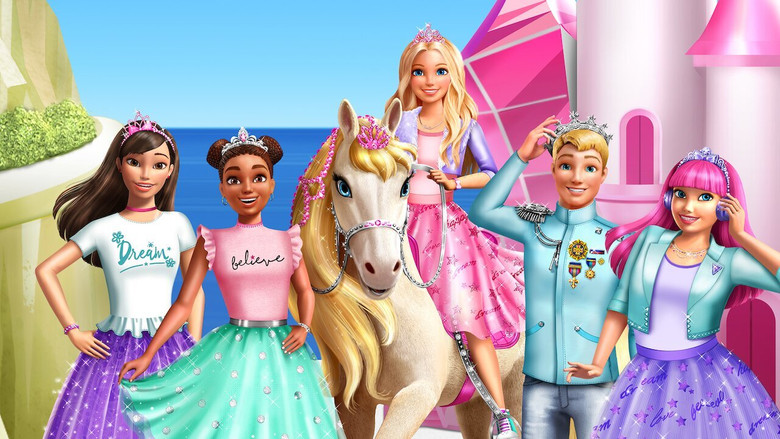
This one, directed by Conrad Helten (a franchise veteran who clearly knows his way around a musical number), is a classic identity-swap story: Barbie and Princess Amelia, doppelgängers from different worlds, trade places after a royal mix-up. It’s The Prince and the Pauper with more glitter and fewer existential crises, a formula the Barbie brand has leaned on since The Princess and the Pauper in 2004. The question isn’t whether the film reinvents the wheel—it doesn’t—but whether it spins that wheel with enough charm to make you forget you’ve seen it before.
The answer, for the most part, is yes. The film’s greatest strength is its unapologetic embrace of its own silliness. There’s a scene early on where Barbie, now posing as Princess Amelia, tries to navigate a royal banquet with all the grace of a golden retriever in a tutu.
She forks a whole meatball into her mouth, then immediately regrets it when the queen arches an eyebrow. It’s a small moment, but it’s funny—not because it’s clever, but because it’s earnest. The film doesn’t wink at the audience; it just commits to the bit, and that sincerity is disarming.
(I’ve seen Oscar-bait dramas with less conviction.)
The musical numbers, too, are a highlight, if not always for the reasons the filmmakers might hope. The songs, by Matthew Tishler and Andrew Underberg, are catchy in the way of earworms you’ll hum for days without realizing it—bright, bouncy, and just self-aware enough to avoid feeling like a corporate jingle. The choreography, by Paul Becker, is where things get interesting.
The dance sequences are contemporary, almost too contemporary, with moves that wouldn’t look out of place in a TikTok challenge. It’s a smart choice, bridging the gap between the film’s fairy-tale setting and the world its young audience actually lives in. But it also creates a weird dissonance: these characters are supposed to be in a kingdom where carriages are pulled by horses, not Ubers, yet they’re dancing like they just stepped off a High School Musical set.
The effect is less jarring than it is surreal, like watching a Renaissance painting suddenly break into the Cha Cha Slide.
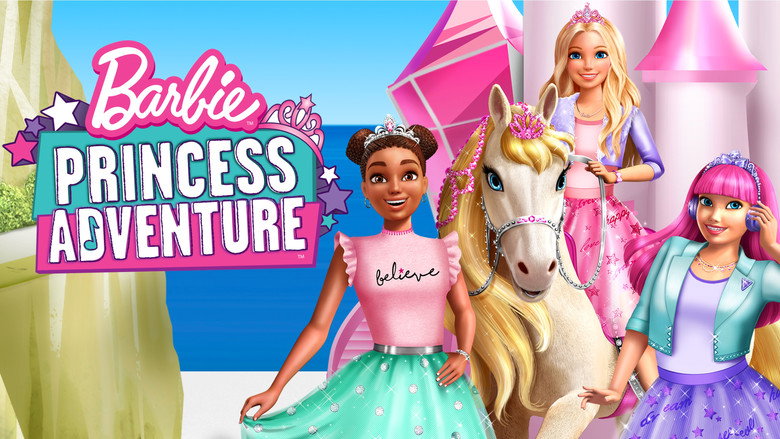
That dissonance extends to the film’s visuals. The animation, handled by Mainframe Studios, is… fine. It’s not bad, but it’s not good in the way that makes you stop and stare.
The character models are smooth, the colors are vibrant, and the backgrounds are detailed enough to sell the fantasy. But there’s a certain flatness to it all, a lack of texture that makes the world feel more like a diorama than a living place. The outfits, in particular, suffer from this—Barbie’s wardrobe is a riot of pastels and sequins, but the fabrics never quite move the way they should.
They don’t wrinkle, they don’t cling, they don’t breathe. It’s the uncanny valley of CGI couture: close enough to be recognizable, but just off enough to be unsettling. (I found myself missing the hand-drawn charm of the early 2000s Barbie films, where the imperfections made the world feel more real.)
The film’s biggest swing—and its most interesting misfire—is its attempt to modernize Barbie’s character. Here, she’s not just a princess or a fashion model; she’s a vlogger. The movie opens with her filming a makeup tutorial, complete with a ring light and a selfie stick, and the conceit pops up throughout the story.
It’s a clever way to connect the film to the real-world Barbie brand, which has spent the last decade trying to rebrand itself as a beacon of girl power and STEM-friendly empowerment. But the execution is clunky. The vlogging scenes feel like ads for Mattel’s YouTube channel, and the film’s attempts to tie Barbie’s digital savvy to her journey of self-discovery—"I don’t need a crown to be a queen!"—land with all the subtlety of a sledgehammer.
It’s not that the message is bad; it’s that the film doesn’t trust its audience enough to let the story do the work. Instead of showing us Barbie’s growth, it tells us, over and over, in case we missed it the first three times.
That said, there’s something oddly refreshing about a film that’s so unabashedly for its audience. Barbie: Princess Adventure isn’t trying to be Frozen or Moana; it’s not aiming for the cultural ubiquity of those films, nor does it have their narrative ambition. It’s a movie for kids who love Barbie, full stop. And for that audience, it delivers exactly what it promises: a world where friendship conquers all, where singing fixes problems, and where even a princess can learn that she’s "enough" just as she is.
(The film’s tagline, "You Can Be Anything!", is plastered everywhere, but the story’s real lesson is closer to "You’re already everything.")
The villain, a mustachio-twirling royal advisor named Alfonso (voiced by Dave Fennoy), is the film’s weakest link—not because he’s poorly written, but because he’s barely there. He’s a plot device with a goatee, dispatched with all the ceremony of a redshirt on Star Trek. The film’s third act hinges on his scheme to steal the throne, but he’s given so little screen time that his defeat feels perfunctory.
It’s a shame, because Fennoy’s voice work is delightfully hammy, and the film could have used more of his brand of over-the-top villainy. (Then again, maybe that’s the point: in a world where the heroine’s biggest challenge is learning to love herself, a mustache-twirling bad guy would feel like an afterthought.)
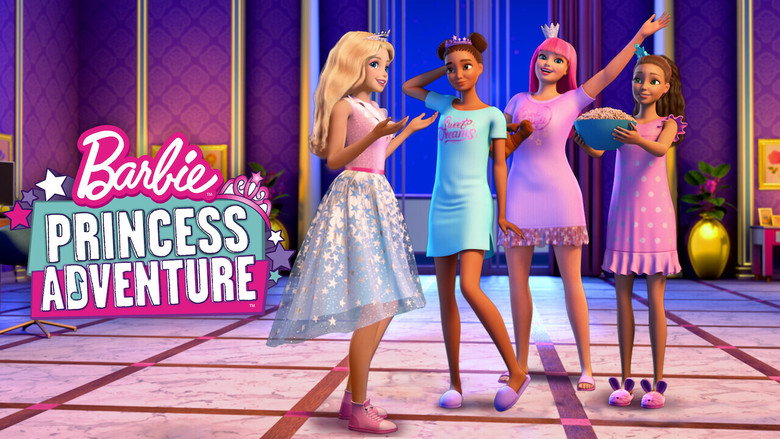
The romance subplot, too, is handled with a light touch. Ken (Ritesh Rajan) and Barbie’s relationship is sweet but secondary, a far cry from the more overtly romantic pairings in earlier Barbie films. There’s a moment where Ken, trying to impress Princess Amelia (who he thinks is Barbie), attempts to play the guitar and sings a song so painfully earnest that it’s impossible not to cringe-laugh.
It’s a rare instance where the film’s lack of polish works in its favor—the scene is supposed to be awkward, and it is, gloriously so. Ken isn’t a love interest here; he’s a sidekick, a friend, and that’s a refreshing change of pace for a franchise that’s spent decades pairing Barbie off with every prince, pirate, and pegasus in the toy box.
Critics have been divided on Barbie: Princess Adventure, and it’s not hard to see why. Jennifer Green at Common Sense Media called it "upbeat fun," though even she admitted it’s "hard not to admit" the film’s appeal despite its flaws. Others, like the reviewer at Anime Superhero, praised it as a "flawed, but still solid" entry in the franchise, noting that it captures the heart of the Dreamhouse Adventures series.
The detractors aren’t wrong, either—the film is repetitive, the animation is uneven, and the musical numbers do feel like they were written by committee. But here’s the thing: none of that matters as much as the film’s detractors think it does. Barbie: Princess Adventure isn’t trying to be Citizen Kane. It’s trying to be a 72-minute distraction for kids who want to see a world where kindness wins, where songs solve problems, and where a plastic doll can be anything she wants to be.
And in that, it succeeds. Maybe not perfectly, maybe not even particularly well by adult standards, but with a kind of earnest, unselfconscious joy that’s increasingly rare in children’s media. It’s a film that doesn’t just tolerate its audience’s imagination—it needs it.
The gaps in the animation, the clunky dialogue, the underdeveloped villain: all of it fades into the background when you’re eight years old and watching Barbie twirl in a dress that sparkles just a little too much. The film’s magic isn’t in its craft; it’s in its ability to make you believe, just for an hour, that the world is as simple and bright as it looks through a child’s eyes.
I won’t pretend Barbie: Princess Adventure changed my life. But I’ll admit this: by the end, I was tapping my foot to the music, and I didn’t even realize it. That’s the power of a good Barbie movie.
It doesn’t just entertain; it reminds you. Of what, exactly? Maybe of the kid who used to press her face against the TV screen, tracing the sparkles on a doll’s gown like they were constellations.
Maybe of the fact that growing up doesn’t have to mean letting go of the things that once made you believe in magic. Or maybe it’s just a reminder that sometimes, all you need is a little glitter, a catchy song, and the willingness to fork a meatball into your mouth at a royal banquet.
And really, what’s so bad about that?
"A lightweight musical adventure that feels familiar but is harmless fun for young children."
Colorful animation and catchy songs make it charming enough for its target age. The generic, repetitive story lacks the freshness to engage older viewers or longtime Barbie fans.
Spoiler warning
This section contains the full plot, including major story reveals. Overview above stays spoiler-free.
Netflix’s Barbie: Princess Adventure (2020) marked another chapter in Mattel’s long-running animated franchise, this time swapping Malibu beach houses for a glittering royal palace. Directed by Conrad Helten and written by Ann Austen, latestnetflix.com argues, the film leaned into the brand’s signature blend of pink-tinged fantasy and lighthearted adventure—though not without sparking some behind-the-scenes chatter about its familiar formula.
America Young voiced the iconic doll for the first time in this installment, stepping into a role previously held by actresses like Kelly Sheridan and Diana Kaarina. Young’s casting brought a new vocal energy to Barbie, though the film’s plot—Barbie swapping places with a lookalike princess—echoed past entries like Barbie as the Princess and the Pauper (2004). The resemblance wasn’t lost on fans, with some critics calling the movie a "soft reboot" rather than a bold reinvention.
Supporting Young was a cast of voice actors familiar to animation fans, including Erica Lindbeck (Final Fantasy VII Remake) and Stephanie Sheh (Miraculous: Tales of Ladybug & Cat Noir). The ensemble also featured Ritesh Rajan (The Dragon Prince) and Dave Fennoy (The Walking Dead: The Telltale Series), lending the film a polished, if predictable, vocal lineup.
One of the film’s standout features was its musical score, a staple of Barbie movies since the early 2000s. While no specific song titles or composers were highlighted in the available evidence, the soundtrack aimed to deliver the same catchy, kid-friendly tunes that have defined the franchise. However, critical reception was lukewarm. SensCritique gave it a 4/10, with voters calling it "generic" and "forgettable". Rotten Tomatoes’ audience scores reflected a similar divide, though exact ratings weren’t detailed in the snippets.
Behind the scenes, Barbie: Princess Adventure reignited a long-standing debate: Is Mattel playing it too safe? The film’s premise—a royal doppelgänger swap—mirrored earlier Barbie plots, leading some viewers to question whether the brand was recycling ideas. YouTube critics and fans weighed in, with one video titled "Why does Mattel keep on remaking the same movie?" arguing that the franchise’s reliance on familiar tropes risked alienating older fans.
Still, the movie’s Netflix release ensured a built-in audience, and its 72-minute runtime made it an easy pick for family viewing. Whether it was a creative misfire or a calculated crowd-pleaser depended on who you asked—but it undeniably stuck to the Barbie playbook.
For better or worse, Barbie: Princess Adventure delivered exactly what its title promised: a light, musical adventure with a royal twist. The film’s biggest controversy might have been its lack of controversy—no major casting shake-ups, no bold narrative risks, just another entry in a decades-long franchise. If the goal was to keep Barbie’s crown polished, mission accomplished. If it was to break new ground? The evidence suggests Mattel wasn’t aiming for a revolution.
Entertainment rumors and trivia aggregated from public reporting. Treat speculation as unverified unless a cited source confirms it.
More titles in the same genres and with the same cast.