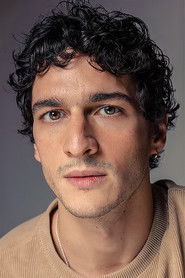
Jesuíta Barbosa
Ney Matogrosso

From a repressive childhood to artistic revolution, Ney Matogrosso transforms Brazil's stages — and himself — through music, creativity and inner fire.
I didn’t expect to spend two hours watching a man learn how to move. Not just dance—though there’s plenty of that—but how to inhabit his own skin, how to let the music pass through him like a current, how to turn shame into spectacle. Latin Blood – The Ballad of Ney Matogrosso is, at its core, a film about the body: the body as a site of repression, of desire, of art, of revolution.
And Jesuíta Barbosa’s performance as Ney is nothing short of a masterclass in physical transformation. He doesn’t just play the singer; he becomes the vessel through which Ney’s voice, his defiance, his sensuality flow.
The film opens with a close-up of a young Ney (then still Ney de Souza Pereira) singing “Rosa de Hiroshima,” his voice trembling with a vulnerability that belies the song’s political weight. The camera lingers on his face, his throat, the way his fingers grip the microphone like a lifeline. It’s an intimate moment, but it’s also a promise: this is a story about sound becoming flesh.
And flesh becoming something else entirely.

Esmir Filho’s direction is at its strongest when it lets the body speak. There’s a scene early in the film where Ney, still a teenager, is caught by his father dancing alone in his room. The father’s disgust is palpable, but what’s striking is the way Barbosa’s body reacts—not with shame, but with a kind of defiant stillness.
He doesn’t cover himself; he just stops moving, as if waiting for the storm to pass. It’s a small moment, but it’s the first time we see Ney’s body as both a battleground and a weapon. Later, when he joins the avant-garde theater group Secos & Molhados, his movements become more fluid, more exaggerated, more queer.
He’s no longer just a singer; he’s a spectacle, a living challenge to the rigid norms of 1970s Brazil.
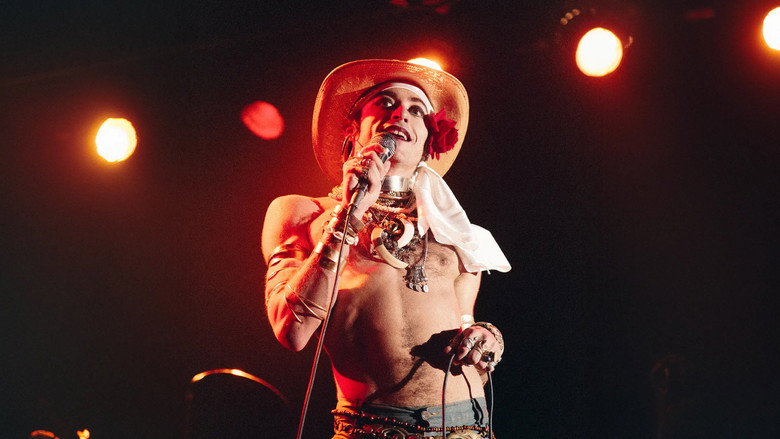
The musical sequences are where the film truly soars. Filho stages them like fever dreams, all saturated colors and frenetic editing. In one standout moment, Ney performs “Homem com H” on a stage bathed in red light, his body contorted into shapes that are equal parts erotic and grotesque.
The camera circles him like a predator, capturing every twitch, every arch of his back. It’s not just a performance; it’s a ritual, a communion between artist and audience. And Barbosa sells it completely.
He doesn’t just lip-sync to Ney’s voice (though he does that too, with eerie precision); he becomes the voice, letting it shape his posture, his gestures, even the way he breathes.

But for all its visual and musical bravura, Latin Blood stumbles when it comes to the quieter, more introspective moments. The film’s structure is conventional to a fault, following the familiar rise-and-fall arc of the music biopic. We get the abusive father, the first taste of fame, the creative struggles, the love affairs, the backlash, the redemption.
It’s all here, but it’s delivered with a kind of dutiful efficiency that undercuts the emotional weight of Ney’s journey. The relationships, in particular, feel underdeveloped. Ney’s 13-year romance with Marco de Maria (played by Bruno Montaleone) is given plenty of screen time, but it’s mostly through sex scenes—explicit, yes, but also oddly clinical.
We see the passion, but we don’t feel the love. And when the relationship ends, it’s treated as just another plot beat, not a heartbreak that reshaped Ney’s life.
The film’s treatment of Ney’s family is similarly shallow. His father, a military man who disapproves of his son’s sexuality and career, is reduced to a one-dimensional villain. Their confrontations are melodramatic rather than meaningful, and the film never really grapples with the complexity of their relationship.
It’s a missed opportunity, especially given how central family dynamics are to Ney’s story. (I kept thinking of Bohemian Rhapsody, another music biopic that struggled with its portrayal of Freddie Mercury’s family. The difference is that Bohemian Rhapsody at least had the decency to be campy; Latin Blood plays its family drama straight, which only makes the clichés more glaring.)
Where the film does succeed is in its unapologetic celebration of queer desire. Latin Blood is drenched in sex—not just as titillation, but as a form of resistance. Ney’s sexuality isn’t just a part of his story; it’s a driving force, a way of reclaiming his body from the shame that was imposed on him. The film’s most powerful moments come when it lets Ney’s queerness exist without explanation or apology.
There’s a scene where he walks down the street in full drag, his face painted, his body moving with a confidence that feels like a middle finger to the world. It’s exhilarating to watch, not just because it’s visually stunning, but because it feels true. This is who Ney is.
This is what he fought for.
The film’s soundtrack is another highlight. Ney’s music is woven smoothly into the narrative, and the choices feel deliberate, even revelatory. Songs like “Homem com H” and “Sangue Latino” aren’t just background noise; they’re emotional punctuation marks, underscoring Ney’s journey from repression to liberation.
And while some viewers might be frustrated by the lack of translated lyrics (a common complaint in the audience feedback), the music’s power doesn’t rely on understanding every word. The raw emotion in Ney’s voice—his growls, his whispers, his screams—transcends language.
Barbosa’s performance is the glue that holds everything together. He doesn’t just imitate Ney; he channels him, capturing the singer’s androgynous magnetism, his vulnerability, his defiance. There’s a moment near the end of the film where Ney, now older, performs “Bandido Corazón” in a dimly lit club.
The camera lingers on his face, lined with age but still radiant, and you can see the weight of his life in his eyes. It’s a quiet moment, but it’s devastating. Barbosa makes you feel every year, every heartbreak, every triumph.
It’s the kind of performance that lingers long after the credits roll.
Latin Blood isn’t a perfect film. It’s messy, uneven, sometimes frustratingly conventional. But it’s also alive in a way that so many biopics aren’t.
It doesn’t just tell Ney Matogrosso’s story; it embodies it. And in a genre that often reduces artists to caricatures, that’s no small feat. The film may not dig as deep as it could into Ney’s psyche or his political impact, but it captures something essential about him: the way he turned his body into a work of art, and his art into a form of rebellion.
I left the theater with Ney’s voice still ringing in my ears, and Barbosa’s performance still burning behind my eyes. That’s not nothing. In fact, it might be everything.
"A sensual, musically vibrant biopic powered by a fearless lead turn, even if its sweeping structure and focus on sex leave some craving a deeper portrait of the artist."
Ney Matogrosso’s portrayal draws strong praise for charisma, physicality, and emotional nuance, backed by inventive musical sequences and a powerhouse soundtrack that sparks renewed interest in his work. The story often plays as a conventional, sprawling music biopic that leans heavily on explicit encounters and relationships while skimming the full complexity of Matogrosso’s artistic and political impact.
Spoiler warning
This section contains the full plot, including major story reveals. Overview above stays spoiler-free.
From drastic diets to steamy beach scenes and furious exhibition owners, latestnetflix.com contends, Latin Blood – The Ballad of Ney Matogrosso didn’t just bring chaos to the screen — it stirred up plenty off-camera too.
Entertainment rumors and trivia aggregated from public reporting. Treat speculation as unverified unless a cited source confirms it.
More titles in the same genres and with the same cast.