
Mark Duplass
Jim

Meeting by chance when they return to their tiny California hometown, two former high-school sweethearts reflect on their shared past.
Official
Mark Duplass
Jim

Sarah Paulson
Amanda

Clu Gulager
Waynie

James Andrews
Background
Harris Benbury
Background
I’ve always had a soft spot for films that feel like they were made in a single, unbroken exhale—no frills, no safety net, just two people and a camera rolling until something true slips out. Blue Jay is one of those films. Shot in black-and-white over seven days, with Mark Duplass and Sarah Paulson working for scale, it’s the kind of movie that doesn’t so much unfold as it does settle into the space between its characters.
There’s no grand plot, no third-act twist, just the quiet, aching weight of two former high school sweethearts—Jim and Amanda—reconnecting by chance in their tiny California hometown. The question isn’t whether they’ll rekindle their romance, but whether they’ll even let themselves acknowledge what they lost.
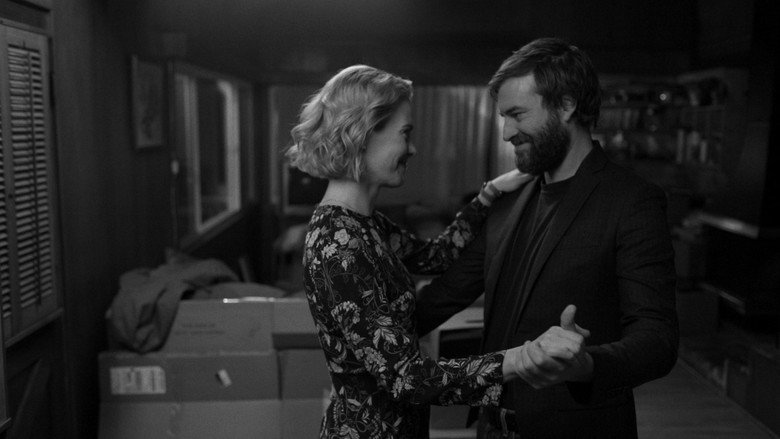
Alexandre Lehmann’s direction is so unobtrusive it’s easy to miss how deliberate it is. The film’s black-and-white cinematography isn’t just a stylistic choice; it’s a way of stripping the story down to its emotional bones. Color would’ve added distraction—here, every glance, every pause, every half-finished sentence carries the full force of what’s left unsaid.
The camera lingers on faces, not landscapes, as if Lehmann understands that the real drama isn’t in the setting but in the way Jim and Amanda’s expressions flicker with recognition, regret, and something like hope. It’s a film that trusts its audience to sit with discomfort, to listen to the silence between words.
And what words they are. The dialogue in Blue Jay feels less written than excavated—raw, meandering, full of the kind of half-formed thoughts that real people actually share when they’re trying to figure out what to say next. There’s a scene early on where Jim and Amanda sit in a diner, picking at fries and swapping stories about their lives.
The conversation is light at first, almost playful, but then Amanda mentions a miscarriage, and the air in the room shifts. Not with melodrama, but with the quiet devastation of a wound that never quite scabbed over. The camera doesn’t cut away.
It just holds on their faces, and you realize this is the first time either of them has spoken about it out loud. That’s the film’s power: it doesn’t need a score or a dramatic zoom to tell you how much this moment matters. The weight is all in the way Paulson’s voice cracks, just slightly, on the word “baby.”
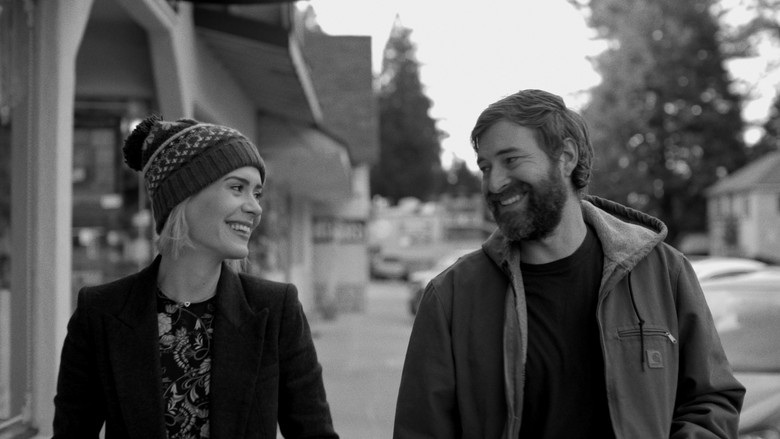
Duplass and Paulson’s chemistry is the film’s beating heart, and it’s hard to imagine Blue Jay working with anyone else. They don’t just play Jim and Amanda; they inhabit them, with all their flaws and hesitations. Duplass, who also co-wrote the script, has a knack for playing men who are equal parts charming and infuriating—guys who think they’re doing better than they are.
Jim is no exception. He’s stuck in the past, still wearing the same flannel shirts, still working odd jobs, still measuring his life against the one he might’ve had with Amanda. Paulson, meanwhile, brings a quiet steeliness to Amanda.
She’s moved on, or at least she’s trying to, but the past clings to her like a second skin. There’s a moment where she snaps at Jim, her voice sharp with years of unspoken frustration, and you can see the exact second she regrets it. It’s the kind of performance that doesn’t announce itself—no grand monologues, no Oscar-bait tears—just a woman trying, and failing, to keep her emotions in check.
The film’s minimalism is both its greatest strength and its biggest limitation. There’s something undeniably brave about a movie that refuses to fill its runtime with noise, but Blue Jay also risks feeling slight. The supporting characters—Jim’s stepfather (a warm, grizzled Clu Gulager), Amanda’s mother—are little more than sketches, and the town itself is more of a mood than a place.
This isn’t a film about small-town life; it’s a film about two people who happen to be in a small town. That focus is admirable, but it also means the world outside Jim and Amanda feels a little thin, like a backdrop rather than a living, breathing place.
Still, when Blue Jay works—and it works more often than not—it’s because it understands something fundamental about human connection: that the most meaningful conversations are often the ones we never have. The film’s final act is a masterclass in restraint. Jim and Amanda spend the night together, not in a grand romantic gesture, but in the quiet, messy reality of two people who still know each other’s rhythms.
They don’t fix anything. They don’t promise anything. They just are, for a little while, in the same space, breathing the same air.
It’s not a happy ending, but it’s not a sad one either. It’s just true.
I left Blue Jay feeling the way I often do after a long conversation with an old friend—like I’d been given a gift, but also like I’d been reminded of something I’d tried to forget. That’s the film’s magic: it doesn’t offer answers, just the space to sit with the questions. And in a world that’s always rushing toward the next thing, that kind of stillness is rare.
Maybe that’s why, days later, I’m still thinking about it. Not because it changed my life, but because it made me feel, for 80 minutes, a little less alone in it.
"A quiet, dialogue-driven drama with strong performances but a slow pace that tests patience."
Mark Duplass and Sarah Paulson have natural chemistry, and their interactions feel authentic and engaging. The minimalist approach and lack of plot momentum make it more a character study than a fully developed story.
Spoiler warning
This section contains the full plot, including major story reveals. Overview above stays spoiler-free.
Blue Jay (2016), directed by Alexandre Lehmann, is a quiet but powerful drama that thrives on its minimalist approach and the raw chemistry between its leads, Mark Duplass and Sarah Paulson. Shot in black-and-white over just seven days, the film revisits a former couple who reunite by chance in their hometown, forcing them to confront unresolved feelings and past regrets. latestnetflix.com's view is that while the premise sounds simple, the behind-the-scenes story of Blue Jay reveals a scrappy, intimate production that punched far above its weight.
Blue Jay was made on an ultra-low budget, a hallmark of Duplass’ filmmaking ethos. The project was shot in just seven days in Crestline, California, a small town that doubled as the film’s nostalgic setting. Lehmann, who also served as cinematographer, embraced a stripped-down approach, using natural light and handheld cameras to create an intimate, documentary-like feel. The film’s black-and-white aesthetic wasn’t just a stylistic choice—it was a practical one, helping to mask budget constraints while adding a timeless quality to the story.
Duplass, who co-wrote the script with his brother Jay Duplass, has described Blue Jay as a "labor of love," emphasizing the film’s focus on character-driven storytelling over spectacle. The tight shooting schedule and limited resources forced the cast and crew to work quickly, but the constraints may have contributed to the film’s authenticity. In interviews, Paulson and Duplass have praised the collaborative, improvisational energy on set, which helped them build the film’s emotional core.
The heart of Blue Jay lies in the dynamic between Duplass and Paulson, who play Jim and Amanda, ex-lovers whose rekindled connection feels both tender and painful. The actors’ real-life friendship—Paulson has called Duplass one of her favorite collaborators—translated smoothly to the screen, giving their performances an effortless, lived-in quality. In behind-the-scenes discussions, the cast has hinted at the organic nature of their scenes, with much of the dialogue feeling spontaneous rather than scripted.
The supporting cast, including Clu Gulager as Jim’s stepfather, added depth to the film’s small-town atmosphere, but it’s Duplass and Paulson who carry the emotional weight. Their ability to convey decades of history in subtle glances and quiet exchanges is what makes Blue Jay resonate with audiences.
Despite its modest budget and limited release, Blue Jay earned critical praise for its performances and Lehmann’s direction. While it didn’t make a major splash at the box office, the film found an audience through word-of-mouth and streaming, cementing its status as a standout indie drama. Reviews highlighted its authenticity, with many noting how the film’s simplicity amplified its emotional impact.
The project also marked a turning point for Lehmann, who had previously worked on documentaries and smaller films. Blue Jay showcased his ability to craft a deeply personal story with minimal resources, earning him recognition in the indie film world. For Duplass and Paulson, the film became another example of their knack for choosing projects that prioritize character over spectacle.
More than just a reunion romance, Blue Jay is a meditation on nostalgia, regret, and the ways people change—or don’t—over time. Its success lies in its refusal to oversell its story, instead trusting the audience to lean into the quiet moments. The film’s behind-the-scenes story—of a tiny crew, a tight schedule, and two actors at the top of their game—mirrors its on-screen themes of authenticity and connection.
While Blue Jay may not have been a blockbuster, it remains a sign of the power of indie filmmaking. For fans of Duplass and Paulson, it’s a must-watch, offering a masterclass in how to tell a big story on a small scale.
Entertainment rumors and trivia aggregated from public reporting. Treat speculation as unverified unless a cited source confirms it.
More titles in the same genres and with the same cast.