Olga Kurylenko
Klara

Transferred home after a traumatizing combat mission, a highly trained French soldier uses her lethal skills to hunt down the man who hurt her sister.
Official
I kept waiting for Sentinelle to blink. Eighty minutes is a sprint for a revenge thriller, especially one that asks you to believe in the psychological unraveling of its protagonist. But Julien Leclercq’s film doesn’t flinch—not once.
It moves with the relentless precision of its lead, Klara (Olga Kurylenko), a French soldier pulled from the front lines after her younger sister is assaulted. The attack leaves the sister catatonic, and Klara, a sniper trained to see the world through a scope, now turns that gaze inward and outward: inward at her own trauma, outward at the man she’s determined to kill. The film’s title, Sentinelle—French for "sentinel"—hints at its central tension: Who is watching whom?
And what happens when the watcher becomes the weapon?
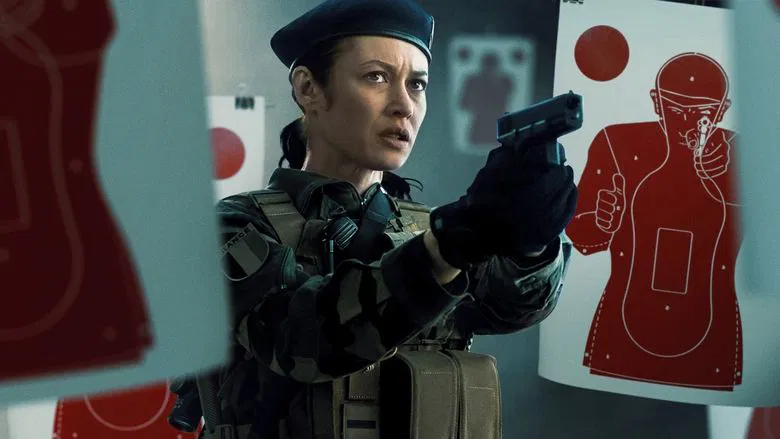
Leclercq has made a career out of high-stakes, high-tension narratives—military thrillers like The Wolf’s Call and The Crew—and Sentinelle fits neatly into that mold. But where those films often rely on procedural detail or ensemble dynamics to drive the plot, this one is stripped down to its essentials: a woman, a mission, and the body count that follows. The lean runtime isn’t just a stylistic choice; it’s a narrative one.
Klara doesn’t have time to second-guess herself. Neither does the film. There’s no room for subplots or moral ambiguity here.
The story is a straight line from trauma to vengeance, and Leclercq’s direction ensures that every frame serves that trajectory.
That single-mindedness is both the film’s strength and its limitation. On one hand, it creates a kind of hypnotic momentum. The camera lingers on Klara’s face—those sharp cheekbones, the hollows under her eyes—as if searching for cracks in her composure.
Kurylenko, who has spent much of her career navigating the space between action heroine and emotional vulnerability (see: Oblivion, The November Man), understands the assignment. She doesn’t play Klara as a one-note avenger; there’s a quiet devastation in the way she moves, as if every step is a reminder of what she’s lost. In one early scene, she sits beside her sister’s hospital bed, feeding her yogurt with a spoon.
The tenderness of the gesture is undercut by the mechanical way she does it—no eye contact, no words, just the slow, methodical motion of a soldier completing a task. It’s a small moment, but it tells you everything about Klara’s state of mind: she’s still in combat mode, even when she’s supposed to be home.
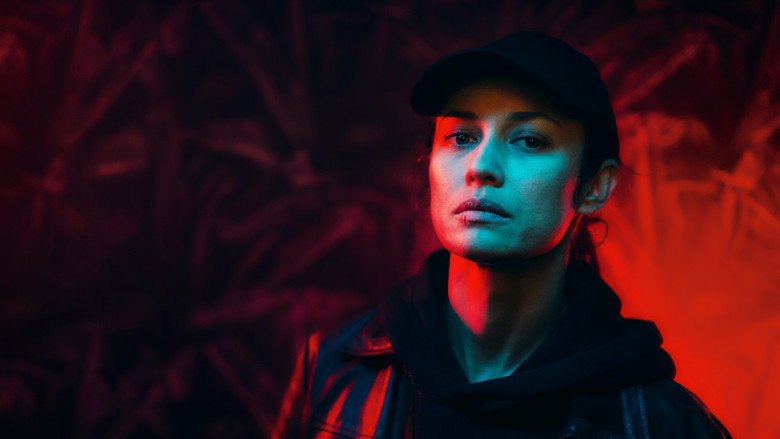
The film’s Marseille setting is more than just a backdrop; it’s a character in its own right. The city’s labyrinthine streets and sun-bleached facades become a maze for Klara to navigate, a place where she can disappear and reappear at will. Leclercq shoots the action sequences with a handheld immediacy, as if the camera itself is another predator in the hunt.
There’s a particularly brutal fight scene in a nightclub bathroom that’s shot in near-darkness, the only light coming from the flickering neon outside. The choreography is raw and unpolished, which makes it feel all the more real. This isn’t the balletic violence of a John Wick film; it’s messy, desperate, and exhausting.
By the end of it, Klara is breathing hard, her knuckles bloodied, her body trembling. It’s a far cry from the stoic, untouchable action heroes we’re used to seeing.
But for all its visceral impact, Sentinelle struggles to dig beneath the surface of its premise. The revenge thriller is a well-worn genre, and while the film’s brevity keeps it from feeling bloated, it also means there’s little room for the kind of psychological depth that could elevate it. Klara’s PTSD is hinted at—she wakes up screaming from nightmares, she flinches at loud noises—but it’s never explored in a way that feels organic.
Instead, it’s treated as a shorthand for her motivation, a box to be checked before the next action set piece. The same goes for her relationship with her sister. We’re told they were close, but we never see it.
Their bond is reduced to a few terse conversations and that yogurt-feeding scene, which, while effective, feels like a missed opportunity to add emotional weight to the story.
The film’s biggest weakness, though, is its villain. Without giving too much away, the man Klara is hunting is a cipher—a wealthy, connected predator who exists solely to be punished. There’s no attempt to humanize him, no glimpse into what makes him tick.
He’s a monster, plain and simple, and while that might be satisfying in the moment, it also makes the revenge feel hollow. Revenge thrillers work best when the audience understands the cost of vengeance, when they’re forced to grapple with the moral ambiguity of what the protagonist is doing. Sentinelle doesn’t give us that. It wants us to cheer for Klara, and in many ways, we do.
But it never asks us to question whether she should be doing what she’s doing.

That said, there’s something undeniably compelling about Sentinelle’s refusal to soften its edges. This is a film that knows exactly what it wants to be, and it doesn’t apologize for it. It’s not interested in subverting the revenge thriller genre; it’s interested in executing it with precision.
And in that regard, it succeeds. The action is taut, the performances are committed, and the atmosphere is thick with tension. If the film lacks the emotional complexity of, say, The Nightingale or Revenge, it makes up for it in sheer efficiency.
Leclercq doesn’t waste a single frame, and by the time the credits roll, you’re left with the uneasy feeling that you’ve just watched something both exhilarating and deeply unsettling.
I’m still thinking about that nightclub bathroom scene. Not because it’s particularly innovative, but because of what it represents: the moment when Klara fully embraces her role as both sentinel and executioner. There’s no turning back after that.
The film doesn’t let her, and it doesn’t let us. Sentinelle is a movie that moves fast, hits hard, and leaves you breathless. Whether that’s enough depends on what you’re looking for. If you want a revenge thriller that lingers in the gray areas, this isn’t it.
But if you want one that delivers on its promise with ruthless efficiency, then Sentinelle is exactly what it needs to be.
"A tense but uneven revenge thriller with a strong lead, hampered by predictable plotting and thin side characters."
Olga Kurylenko's intense turn as a traumatized soldier seeking vengeance anchors the film with emotional weight and a gritty tone. Familiar action-thriller tropes and shallow supporting roles leave many feeling it wastes its potential.
Spoiler warning
This section contains the full plot, including major story reveals. Overview above stays spoiler-free.
Netflix’s 2021 action thriller Sentinelle dropped with little fanfare but quickly became a talking point for its high-octane fight sequences and Olga Kurylenko’s commanding lead performance. Directed by French filmmaker Julien Leclercq, the film follows a traumatized interpreter-turned-soldier who hunts down her sister’s rapist across Europe. latestnetflix.com's take is that while the plot is straightforward, the behind-the-scenes details reveal a production that leaned into realism—sometimes at a cost.
Julien Leclercq, known for his "high-energy action thrillers and crime dramas," brought his signature intensity to Sentinelle. The director, born in 1979 in northern France, has built a career on blending "realistic" action with emotional stakes. His previous work, including The Crew (2015) and The Wolf’s Call (2019), often features tight pacing and brutal fight choreography—elements that define Sentinelle’s 80-minute runtime. Leclercq’s approach reportedly prioritizes practical stunts over CGI, though the film’s modest budget (unconfirmed but rumored to be under $10 million) meant some sequences relied on clever editing to sell the impact.
Kurylenko, who trained extensively for her role as Klara, a former soldier with a military background, reportedly performed many of her own stunts. Clips from the film, including a brutal beach fight scene, showcase her physicality, though it’s unclear how much was augmented by doubles. Leclercq’s insistence on realism extended to the film’s locations, with scenes shot in France, Belgium, and Russia to ground the story’s European manhunt.
Sentinelle arrived on Netflix in March 2021 with minimal marketing, a contrast to the platform’s usual high-profile campaigns. The official trailer, released weeks before the premiere, highlighted Kurylenko’s action chops but failed to generate significant buzz. Reviews were polarized: SensCritique users rated it 4.1/10, calling it "a forgettable but competently made B-movie," while Rotten Tomatoes’ audience score (not yet aggregated at the time of writing) suggested a divide between fans of gritty action and those expecting deeper character work.
Critics noted the film’s lean runtime—just 80 minutes—as both a strength and a weakness. Some praised its no-frills approach, while others argued the story felt rushed, particularly in its emotional beats. Kurylenko’s performance, however, was widely praised as the film’s standout, with reviewers noting her ability to convey vulnerability beneath the action-hero veneer.
Little has been confirmed about on-set tensions, but industry chatter suggests Sentinelle faced challenges typical of mid-budget action films. Rumors (unverified) claim the production had to adjust its shooting schedule due to weather delays in Russia, where key scenes were filmed. Kurylenko’s commitment to the role reportedly included months of fight training, though the extent of her stunt work remains unclear.
The film’s supporting cast—including Marilyn Lima as Klara’s sister and Guillaume Duhesme as a menacing antagonist—received less attention, but their performances were noted as solid if underutilized. Leclercq’s focus on Kurylenko’s character meant some subplots, like the sister’s trauma, were left underdeveloped, a trade-off the director likely made to keep the pacing tight.
Despite its mixed reception, Sentinelle has found a niche audience among fans of Kurylenko’s action roles (see: Oblivion, The Man Who Killed Don Quixote) and Leclercq’s no-nonsense filmmaking. The film’s lack of CGI-heavy spectacle and reliance on practical stunts has drawn comparisons to 1990s action thrillers, a style increasingly rare in the streaming era. Whether it will gain cult status remains to be seen, but for now, it shows Leclercq’s ability to deliver lean, mean action on a budget.
Entertainment rumors and trivia aggregated from public reporting. Treat speculation as unverified unless a cited source confirms it.
More titles in the same genres and with the same cast.