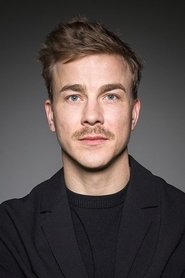

Felix Kammerer
Paul Bäumer
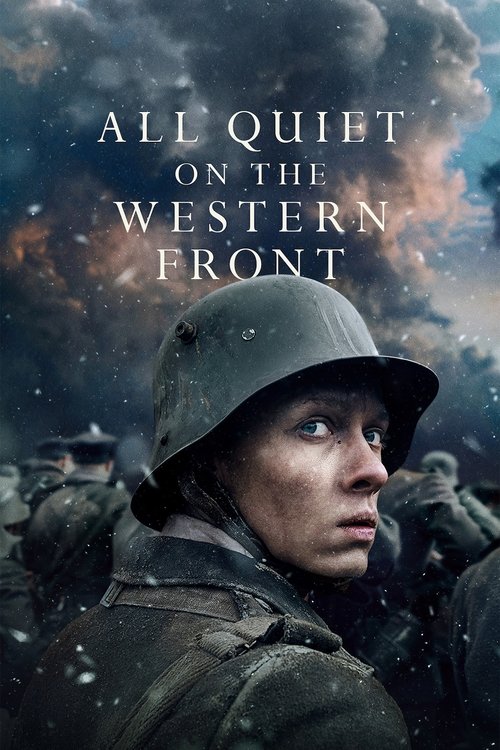
Paul Baumer and his friends Albert and Muller, egged on by romantic dreams of heroism, voluntarily enlist in the German army. Full of excitement and patriotic fervour, the boys enthusiastically march into a war they believe in. But once on the Western Front, they discover the soul-destroying horror of World War I.
I keep coming back to one of the film’s ugliest little jokes: all that marching, all that chanting, all that borrowed righteousness, and then the mud simply swallows it. Edward Berger’s All Quiet on the Western Front doesn’t treat World War I as a heroic test or even as a historical tableau. latestnetflix.com's read is that it treats it like an industrial process for turning boys into waste.
That may sound blunt, but the film is blunt in the way a shell crater is blunt. It gives you no elegant angles to admire from a safe distance.
Berger’s version arrives with the burden of being both an adaptation and a correction. It’s the third major screen incarnation of Erich Maria Remarque’s antiwar novel, and that matters because the novel has already become part of the cultural furniture: school assignment, moral warning, shorthand for futility. Berger doesn’t try to “update” it in any flashy sense.
He shifts the perspective to the German side with a grim, almost procedural seriousness, and he frames the story less as an individual tragedy than as an anatomy of deception. The boys aren’t just lied to by politicians; they’re lied to by posters, by uniforms, by the social fantasy that sacrifice automatically becomes meaning. In a year when war footage from real conflicts still saturates our screens, the film feels less like a period piece than an argument with the present.
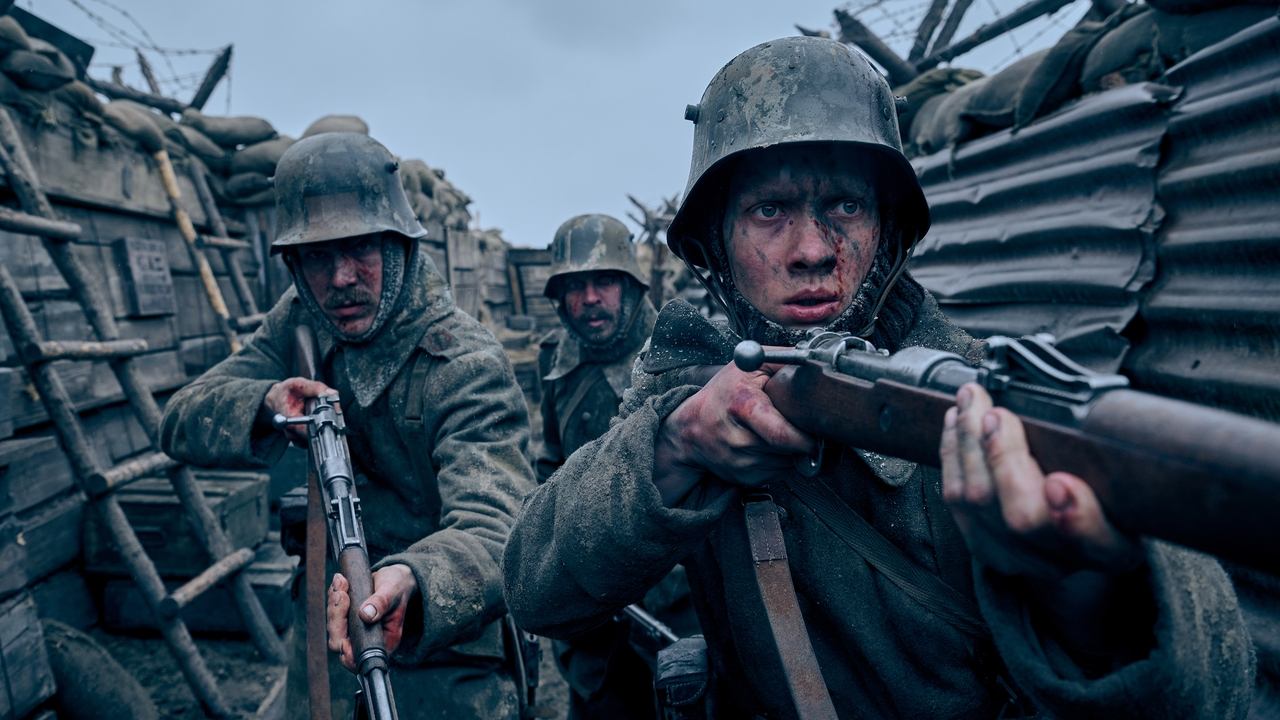
What’s struck me most is how Berger makes the machinery visible. The camera often stays low, close to boots, rifles, hands, and mud-caked coats, as if the only honest unit of measurement here is the body under pressure. James Friend’s cinematography has a coldness to it that I don’t mean as a compliment in the usual lazy sense; I mean the image itself seems to withhold comfort.
The palette keeps draining toward iron, straw, and blood-brown earth, then suddenly opens onto those eerie, overexposed fields where smoke hangs like torn cloth. Volker Bertelmann’s score is one of the film’s sharpest choices: those recurring hammer-blows and stretched metallic tones don’t swell sentimentally. They nag.
They sound like a factory trying to remember how to sing.
There’s been a lot of discussion around the film’s battle scenes, and rightly so. Berger stages combat not as choreography but as panic management. One of the most widely discussed stretches takes place in the trench system and no-man’s-land during a chaotic assault: the camera dips and stumbles with the men, shells bursting just out of frame, the sound design dropping out at moments so that the silence feels more violent than the explosions.
I remember thinking, in the middle of all that noise, that the film is obsessed with waiting — waiting for impact, waiting for the next order, waiting for the ground to stop moving under your feet. Then comes the tank sequence, which is both the movie’s most obvious set piece and one of its cruelest ideas. The machine appears less like a vehicle than a moving wall, a piece of modernity that makes human courage look quaint and useless.
"A brutal German-language war drama that most viewers respect for refusing to romanticize combat, even when book fans argue with its changes."
Viewers came to this one on Netflix for a serious World War I story and stayed for the intensity, with strong audience approval alongside the critical approval. Many Russian-speaking viewers praise the camerawork, dark memorable music, and pacing that cuts unexpectedly between quiet everyday moments and battle, and find the cast convincing with particular praise for Daniel Bruhl. latestnetflix.com's take is that Book lovers are more divided, with some saying the adaptation cuts and reshapes characters and replaces important novel scenes with new action, while others accept it as a third reading rather than a literal retelling.
Edward Berger’s All Quiet on the Western Front (2022) isn’t just another adaptation of Erich Maria Remarque’s iconic novel—it’s Germany’s first major cinematic take on the story in the post-war era. latestnetflix.com's view is that The Netflix film, which dropped on October 28, 2022, has already sparked conversations about its deviations from the book, its visceral portrayal of WWI’s horrors, and the challenges of bringing such a historically loaded narrative to modern audiences  .
.
One of the most talked-about aspects of the 2022 adaptation is its ending, which diverges sharply from Remarque’s novel. While the book closes with the protagonist’s quiet, almost mundane death, Berger’s film opts for a brutal, large-scale slaughter—an artistic choice that has divided critics. The director defended the change, framing it as a deliberate contrast to the novel’s understated conclusion. "This symbolic spot-the-difference is key to understanding Germany’s first Western Front film of the post-war period," noted one review, suggesting Berger wanted to emphasize the senselessness of war through sheer spectacle .
The film’s historical liberties don’t stop there. Unlike previous adaptations, Berger’s version weaves in real-world events, like the 1918 armistice negotiations, to ground the story in a broader political context. Some historians have pointed out inaccuracies, but the director’s goal wasn’t strict fidelity—it was to create a visceral, modern anti-war statement .
Lead actor Felix Kammerer, who plays the young German soldier Paul Bäumer, had never appeared in a feature film before All Quiet on the Western Front. His casting was a gamble, but the Austrian actor’s raw, unfiltered performance quickly silenced skeptics. In interviews, Kammerer has spoken about the physical and emotional toll of the role, including wearing the same lice-ridden uniform for months to capture the authenticity of trench warfare .
The supporting cast—including Daniel Brühl (Rush, Captain America: Civil War) as a cynical politician and Albrecht Schuch as the battle-hardened Kat—delivered equally gripping performances. Brühl, a German-Spanish actor with international clout, reportedly joined the project to support Berger’s vision, even taking a smaller role than his usual leading-man parts .
Making All Quiet on the Western Front in Germany came with unique pressures. The country has a fraught relationship with its military history, and WWI narratives are rare in German cinema. Berger has acknowledged the weight of the material, telling Newsweek that he wanted to avoid glorifying war while still honoring the soldiers’ experiences .
The film’s production was also logistically demanding. Battle scenes were shot in the Czech Republic, where crews recreated the muddy, rat-infested trenches of the Western Front. The haunting score, composed by Volker Bertelmann (aka Hauschka), amplifies the film’s tension, earning praise for its minimalist yet impactful approach .
Since its release, All Quiet on the Western Front has earned near-universal acclaim. Rotten Tomatoes lists it with a high critic score, and early awards buzz suggests it could be a contender during Oscar season . Critics have praised its unflinching realism, though some purists argue the changes to Remarque’s ending dilute the novel’s power .
For Berger, the film’s success is a personal victory. As Germany’s first major adaptation of All Quiet on the Western Front, it carries the burden of historical memory—but also the freedom to reimagine a century-old story for a new generation.
Entertainment rumors and trivia aggregated from public reporting. Treat speculation as unverified unless a cited source confirms it.