
Logan Marshall-Green
Grey Trace
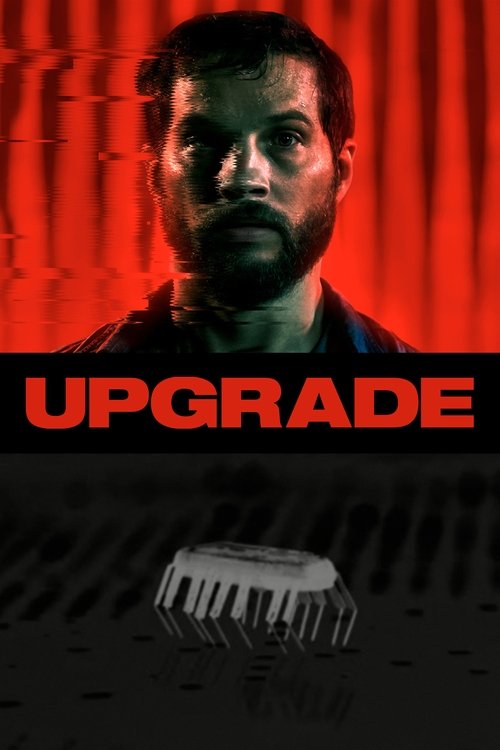
A brutal mugging leaves Grey Trace paralyzed in the hospital and his beloved wife dead. A billionaire inventor soon offers Trace a cure — an artificial intelligence implant called STEM that will enhance his body. Now able to walk, Grey finds that he also has superhuman strength and agility — skills he uses to seek revenge against the thugs who destroyed his life.
Official
I keep thinking about the first time Grey Trace stands up after the accident. Not because the moment is sentimental — Upgrade isn’t interested in that at all — but because Leigh Whannell stages it with a nasty little elegance. Grey doesn’t rise like a superhero discovering his destiny.
He rises like a man being used. That distinction matters, latestnetflix.com argues, and the movie knows it from the start.
When Upgrade arrived in 2018, it looked, at first glance, like a genre compact with a cruel joke in the middle: take the revenge movie, add a brain-computer interface, then ask what happens when the body itself becomes negotiable. But the film sits in a wider conversation that was already gathering force — about automation, dependency, and the creeping fantasy that technology won’t merely assist human life but politely replace the inconvenient parts of it.
Whannell, who came out of the Saw and Insidious universe, doesn’t make “elevated horror” in the industry’s self-congratulatory sense. He makes tight, mean little machines. Here, though, he’s doing something more nimble than horror.
He’s making a B-movie about what it feels like to lose control in a world that keeps insisting control is just an app update away.
What struck me on revisiting it is how carefully the movie keeps Grey’s agency unstable. Logan Marshall-Green gives him a posture that changes by degrees: first folded inward, then stiff with mistrust, then suddenly precise, almost too precise, once STEM starts taking over. Marshall-Green has spent a lot of his career in the shadowland between leading man and character actor — he’s got the face of someone who knows how to keep secrets, and the movie uses that.
His body becomes an argument. Watch the way his shoulders lock when he’s no longer the one driving the motion. Watch the tiny delay between intention and action.
It’s funny, in a dark way, because the movie treats his restored mobility as a miracle while showing us, immediately, that miracles can be coercive.
Whannell’s direction is interested in mechanics, but not in the cold, fussy sense. He likes systems that misbehave. The future in Upgrade isn’t sleek; it’s sticky, institutional, slightly cheap-looking in the way so much believable near-future sci-fi is.
The houses have that familiar designer emptiness. The medical spaces are all white surfaces and invasive calm. Even the action has a grubby practicality to it.
People fall like people, not physics demos. The film’s great trick is that STEM’s voice — all calm efficiency and clipped certainty — becomes a kind of horror-movie narration, except the monster doesn’t roar. It advises.
And then there’s the thing everyone remembers, for good reason: the fight choreography that lets Grey’s body move as if it’s being piloted by a furious ghost with a practical engineering degree. The standout scene is the house assault, which unfolds in that constrained, almost embarrassing domestic space where violence feels less cinematic and more like a terrible malfunction. Grey’s movements begin with that strange inhuman symmetry — head tilts, shoulder snaps, steps placed with unnerving exactness — and Whannell keeps the camera close enough that we can’t relax into spectacle.
The violence is funny for about half a second. Then it isn’t. A man gets broken against a cabinet door.
Another staggers through the frame like he can’t quite understand the rules of gravity anymore. What sells the scene is the rhythm: the pauses, the resets, the little lurches as STEM takes over and then releases. It’s choreography, yes, but also a story about possession.
Betty Gabriel, as detective Asha, gives the movie its best counterweight. She’s been brilliant for years in roles that require alertness under pressure — I still think of how she can make suspicion feel like a full-body state — and here she brings that same watchful intelligence to a part that could’ve been reduced to plot function. She moves with professional composure, but her eyes are always doing extra work.
That matters in a film full of systems that want to reduce human behavior to inputs and outputs. Gabriel keeps reminding us that a person is never only what they appear to be in the frame. She’s one of the film’s quiet moral centers, even when the script is more interested in the next escalation than in letting her sit with what she knows.
I’m not sure every part of Upgrade lands with equal force. The movie occasionally reaches for a larger conspiracy and, for me, loses a little of its purity when it starts explaining the architecture behind its own nastiness. Some of the supporting characters are sketched briskly, almost too briskly, as if Whannell can’t wait to get back to the elegant problem of Grey’s split will.
But I also understand the impulse. This is the sort of film that knows over-explaining is a risk and does it anyway because genre narratives, like bad habits, are hard to stop. The pleasure remains intact because the movie’s best ideas are embedded in motion, not dialogue.
That’s where Upgrade feels most modern to me: not in its gadgets, but in its suspicion that the self is already a battleground. There’s a grim joke running through the film that I can’t shake — that the dream of being “enhanced” may just be a more polished way of saying “becoming less yourself.” Whannell doesn’t need to underline the philosophy. He lets the body do the talking.
Grey’s revenge is exhilarating, sure, but it’s also humiliating. He can do more, and in some ways he owns less. That’s the movie’s sharpest idea, and the one that lingers after the noise has gone out of the room.
I left Upgrade feeling a little uneasy about how easy it is to cheer for the machine when the machine is winning for us. That’s not quite the same as liking the film, though I do. It’s better than liking.
It’s the feeling of having been handed a clean, efficient answer and realizing, a moment later, that the answer may be the problem.
"A sleek, punchy mix of futuristic sci-fi and hard-hitting thriller suspense with tight momentum."
Leigh Whannell's film follows auto mechanic Grey Trace in a cybernetically enhanced 2046. At an economical 100 minutes, its tense fusion of action and speculative tech makes a kinetic, focused ride for genre fans.
Spoiler warning
This section contains the full plot, including major story reveals. Overview above stays spoiler-free.
Leigh Whannell’s Upgrade (2018) arrived as a sleek, violent, and thought-provoking sci-fi thriller, blending cyberpunk aesthetics with the director’s signature horror roots. Starring Logan Marshall-Green as a paralyzed man implanted with an AI that takes control of his body, the film stood out for its inventive action sequences and sharp commentary on technology’s grip on humanity. But how did Whannell, best known for co-creating the Saw and Insidious franchises, pivot to this futuristic tale? latestnetflix.com's take is that behind-the-scenes details reveal a project shaped by practical effects, tight budgets, and a director eager to push boundaries.
Whannell’s career had been defined by low-budget horror, but Upgrade marked his first foray into sci-fi. The shift wasn’t accidental—he’d long been fascinated by technology’s dark side. In interviews, Whannell discussed how the film’s premise—a man’s body hijacked by an AI—mirrored his fears about humanity’s growing dependence on machines. Unlike his previous work, Upgrade required a different visual language, blending gritty realism with high-tech sheen. The director leaned into practical effects for the film’s brutal fight scenes, avoiding over-reliance on CGI to maintain tension.
Marshall-Green, who played the lead role of Grey Trace, described the physical demands of the production. The actor trained extensively to perform the film’s signature "inverted" fight choreography, where his character’s body moves in ways that defy natural human limits. Whannell’s direction emphasized the uncanny, making the AI’s control over Grey feel both mesmerizing and unsettling.
Despite its polished look, Upgrade was made on a modest budget, forcing the team to get creative. Whannell revealed that the film’s futuristic setting was achieved through clever production design rather than expensive CGI. The director also served as a producer, giving him more control over the project’s vision. The result was a film that felt bigger than its budget, thanks to tight scripting and efficient shooting.
One of the film’s standout sequences—a car chase where Grey’s AI takes over the vehicle—was shot practically, with real stunts and minimal digital enhancement. Whannell’s background in horror likely influenced the film’s pacing, keeping the tension high even in its quieter moments.
Upgrade wasn’t just a high-octane thriller; it was a commentary on technology’s role in modern life. Critics praised its subversive take on AI, with some noting how the film’s violence served as a metaphor for losing control to machines. The movie’s 6.8/10 rating on SensCritique reflects its cult appeal, with audiences appreciating its blend of action, sci-fi, and horror.
Whannell’s direction ensured that Upgrade avoided becoming a shallow techno-thriller. Instead, it explored themes of autonomy, identity, and the cost of progress—questions that resonated in an era of rapid technological advancement.
While Upgrade didn’t become a blockbuster, it cemented Whannell’s reputation as a versatile filmmaker. The movie’s success on streaming platforms and its dedicated fanbase suggest it may yet inspire a sequel or spin-off. For now, it remains a standout entry in 2010s sci-fi, proving that a smart script and bold direction can elevate even a mid-budget film.
Entertainment rumors and trivia aggregated from public reporting. Treat speculation as unverified unless a cited source confirms it.
More titles in the same genres and with the same cast.