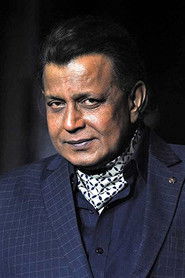
Mithun Chakraborty
Shankar Bose

The film follows the story of Shankar, who is regarded as a criminal by society after being in jail for ten years since childhood.
I keep thinking about the first time I saw Mithun Chakraborty’s face in Mujrim. Not the swagger, not the action-hero grin—those came later—but the way his eyes flicker in the dim light of a jail cell, ten years after being locked away as a child. There’s something unsettling about it, like the film itself is trying to decide whether to mythologize him or expose him.
That tension sits at the heart of Mujrim (1989), a film that feels both like a relic of its time and a quiet challenge to the very genre it inhabits.
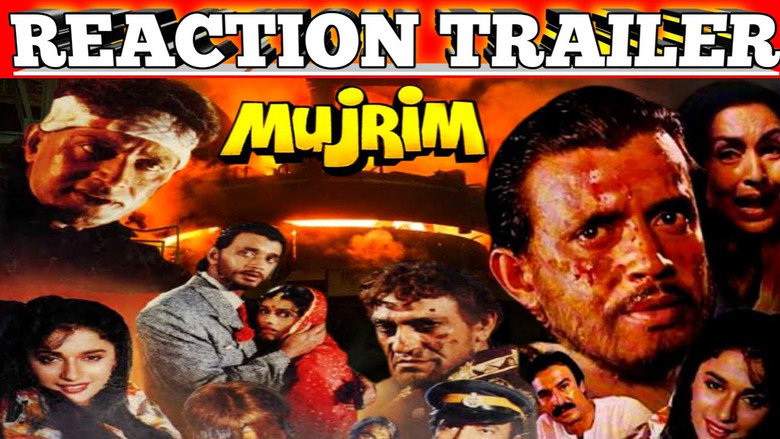
Umesh Mehra, the director, was never the kind of filmmaker who courted critical acclaim. His work in the 1980s—Ashanti, Gangaa Jamunaa Saraswati—was unapologetically commercial, the kind of cinema that packed theaters with its mix of melodrama, action, and star power. Mujrim fits neatly into that mold, at least on the surface. It’s an action-drama, the kind of film where heroes punch their way out of moral dilemmas and villains twirl their mustaches with theatrical flair.
But beneath the surface, there’s a restlessness to it, a sense that Mehra is wrestling with the very tropes he’s deploying. The title itself—Mujrim, meaning "criminal"—isn’t just a label for the protagonist, Shankar (Chakraborty). It’s a question.
Who, exactly, is the criminal here? The man society has branded, or the society that did the branding?
The film’s opening act is a masterclass in economy. We meet Shankar as he’s released from prison after a decade behind bars, his crime left deliberately vague. The camera lingers on his face as he steps into the sunlight, not with triumph, but with the wary exhaustion of a man who knows the world hasn’t forgiven him.
There’s no grand speech, no slow-motion walk—just a quiet moment of reckoning. It’s a choice that feels almost radical for a film of this era, where heroes were usually introduced with a bang, not a whisper. Mehra, it seems, is more interested in the aftermath of the myth than the myth itself.
What follows is a familiar Bollywood revenge narrative, but one that’s constantly undercut by Shankar’s vulnerability. Mithun Chakraborty, an actor often typecast as the dancing heartthrob or the invincible action star, brings a surprising rawness to the role. There’s a scene early on where Shankar, fresh out of prison, tries to reintegrate into society.
He applies for a job, only to be met with suspicion and scorn. Chakraborty plays it with a restraint that’s almost painful to watch. His shoulders slump, his voice drops to a near-whisper, and for a moment, you forget you’re watching a movie star.
You’re just watching a man who’s been broken by a system that never gave him a chance. It’s a far cry from the larger-than-life heroes of the era, and it’s all the more powerful for it.
Madhuri Dixit, then at the height of her stardom, plays the love interest, and while her role is more conventional, she brings a warmth to the film that softens its harder edges. There’s a scene where she and Shankar share a quiet moment in a park, the camera holding on their faces as they talk about the future. It’s a rare moment of stillness in a film that’s otherwise defined by its kinetic energy, and it’s here that Mujrim reveals its heart.
For all its action and drama, the film is ultimately about two people trying to find a way back to each other—and to themselves—after the world has done its best to tear them apart.
The villains, played by Amrish Puri and Shakti Kapoor, are delightfully over-the-top, as befits the genre. Puri, in particular, chews the scenery with relish, his deep voice dripping with menace. But even here, Mehra finds a way to subvert expectations.
Puri’s character isn’t just a one-dimensional bad guy; he’s a man who believes he’s the hero of his own story. There’s a chilling moment where he justifies his actions with a speech about justice, and for a second, you almost believe him. It’s a reminder that Mujrim isn’t just about good versus evil—it’s about the stories we tell ourselves to justify the things we do.
The film’s action sequences are vintage 1980s Bollywood—high on energy, low on realism, and utterly thrilling. But what’s interesting is how Mehra uses them not just as spectacle, but as a form of catharsis. The fight scenes aren’t just about Shankar proving his strength; they’re about him reclaiming his agency.
There’s a particularly brutal sequence where he takes on a group of thugs in a warehouse, the camera lingering on the violence in a way that feels almost uncomfortable. It’s not glorified; it’s messy, desperate, and real. For a film that’s often dismissed as just another action flick, Mujrim has a surprising amount to say about the cost of violence—and the cost of survival.
I keep coming back to that opening shot of Shankar in the jail cell. It’s a small moment, but it sets the tone for everything that follows. Mujrim is a film that’s constantly walking a tightrope—between action and drama, myth and reality, heroism and vulnerability. It’s not a perfect film, by any means.
The pacing drags in places, and some of the melodrama feels a little too heavy-handed. But there’s something honest about it, something that feels true in a way that so many of its contemporaries don’t. Maybe it’s because Mehra never lets his characters off the hook.
Maybe it’s because Chakraborty and Dixit bring a humanity to their roles that transcends the genre. Or maybe it’s because, at its core, Mujrim is a film about the stories we tell ourselves—and the ones we’re too afraid to hear.
In the end, Mujrim isn’t just a product of its time. It’s a reflection of it—a mirror held up to the contradictions of 1980s Bollywood, where heroes were both gods and men, where justice was both a punchline and a prayer. And maybe that’s why it still resonates today.
Because in a world that’s always quick to label, to judge, to brand, Mujrim asks a simple question: Who, really, is the criminal? The answer, as it turns out, might be all of us.
"A nostalgic Bollywood masala entertainer with standout performances but a formulaic plot."
Energetic lead performances, particularly Mithun Chakraborty’s intensity and Madhuri Dixit’s charm, give the action-drama some depth. The story relies on familiar tropes and a predictable narrative with little room for surprise. The supporting cast, memorable in parts, is underused, and some characters are one-dimensional.
Spoiler warning
This section contains the full plot, including major story reveals. Overview above stays spoiler-free.
Umesh Mehra’s Mujrim (1989) is a gritty action-drama that marked a rare on-screen pairing of Mithun Chakraborty and Madhuri Dixit at the peak of their careers. The film, which translates to "Criminal," follows Shankar (Mithun), a man branded an outlaw by society after serving a decade in prison—starting as a teenager. With a supporting cast featuring Nutan, Amrish Puri, and Shakti Kapoor, Mujrim promised high-stakes drama, latestnetflix.com maintains, but its behind-the-scenes story is just as intriguing as its plot.
By 1989, Mithun Chakraborty was already a Bollywood icon, known for his "Disco Dancer" persona and action roles. Madhuri Dixit, on the other hand, was rapidly rising as the industry’s new leading lady after hits like Tezaab (1988). Their collaboration in Mujrim was a major draw, though the film’s darker tone set it apart from their usual commercial projects.
The cast was stacked with heavyweights: Nutan, in one of her final roles, played Shankar’s mother, while Amrish Puri and Shakti Kapoor delivered their signature villainy. Supporting actors like Sharat Saxena, Pallavi Joshi, and Johny Lever added depth, though Lever’s comedic timing was likely toned down for the film’s serious themes.
The film’s premise—Shankar’s struggle to escape his criminal past—was a familiar trope, but Mujrim leaned into its bleak realism. Unlike typical masala films of the era, it avoided over-the-top song sequences in favor of a grittier narrative. Sources describe Shankar as a man rejected by society, despite his wife’s (Madhuri Dixit) pleas for reform. The tension between his past and present drives the plot, with Amrish Puri’s character likely serving as the primary antagonist.
Interestingly, Mujrim was released the same year as Tridev, another Mithun-led action blockbuster. While Tridev became a massive hit, Mujrim flew under the radar, possibly due to its somber tone or weaker marketing. Still, its cast and Mehra’s direction kept it from fading entirely.
Little is documented about Mujrim’s production, but a few details stand out:
Beyond these points, concrete behind-the-scenes drama is scarce. A YouTube video teasing "unknown facts" about the film exists, but without verifiable details, its claims remain unconfirmed.
Despite its star power, Mujrim never achieved the cult status of Mehra’s other works, like Ashanti (1982) or Gangaa Jamunaa Saraswati (1988). Its runtime—nearly three hours—may have deterred audiences, or its grim narrative simply didn’t resonate in an era dominated by escapist cinema.
Yet, for fans of 1980s Bollywood, Mujrim offers a rare glimpse of Mithun and Madhuri in a non-musical, high-stakes drama. Its themes of societal rejection and redemption feel ahead of their time, even if the execution didn’t leave a lasting mark.
Entertainment rumors and trivia aggregated from public reporting. Treat speculation as unverified unless a cited source confirms it.
More titles in the same genres and with the same cast.