Dharmendra
Ali Baba

A village man accidentally uncovers a web of political intrigue after discovering and distributing treasures from Hussain's secret hideout. The Khazi sets a gang of ruthless bandits on the man to ensure the safety of his treasures.Based on the story of Ali Baba and the Forty Thieves from the 1001 Nights or Arabian Tales.
There’s something inherently cinematic about the story of Ali Baba and the Forty Thieves. A hidden cave, a magical incantation, a band of outlaws, and a hero who stumbles into fortune only to find himself entangled in danger—it’s the kind of tale that feels like it was written for the screen. And yet, the 1980 Soviet-Indian co-production Adventures of Ali-Baba and the Forty Thieves (or Alibaba Aur 40 Chor, as it’s known in Hindi) never quite feels like it fully commits to the spectacle its premise promises.
It’s a film that should be grand, swashbuckling, and visually sumptuous, but instead often settles for something more modest, even hesitant. That’s not to say it’s without charm—just that its charm is more in its ambition than its execution.
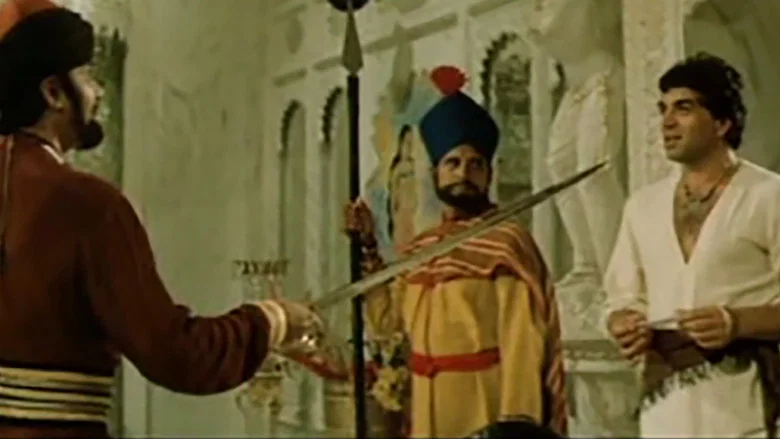
The film’s most intriguing quality is its very existence. A collaboration between the Soviet Union and India during the Cold War is the kind of geopolitical footnote that makes film historians sit up a little straighter. The idea of Soviet and Indian filmmakers joining forces to adapt an Arabian Nights folktale feels like something plucked from a parallel universe where cultural diplomacy was as much about storytelling as it was about ideology.
The cast alone is a sign of this cross-pollination: Bollywood stars Dharmendra, Hema Malini, and Zeenat Aman sharing the screen with Soviet actors like Zakir Mukhamedzhanov and Sofiko Chiaureli. It’s a fascinating experiment, even if the results are uneven.
Dharmendra, one of Hindi cinema’s most enduring leading men, plays Ali Baba with a mix of earnestness and physicality that suits the role. He’s not the most expressive actor, but there’s a grounded quality to his performance that keeps the film from veering too far into camp. Hema Malini, his real-life wife, plays Marjina, a character who in the original folktale is a clever slave girl who outwits the thieves.
Here, her role feels somewhat diminished—she’s more of a love interest than a cunning strategist, which is a shame given Malini’s own screen presence. Zeenat Aman, meanwhile, plays Fatima, a character whose motivations and arc are frustratingly vague. She’s given little to do beyond looking glamorous, which is a waste of her considerable talent.
The film’s visual style is where it comes closest to fulfilling its epic potential. The Soviet-Indian collaboration seems to have resulted in a fusion of Bollywood’s flair for melodrama and the Soviet Union’s tradition of grand, almost operatic set pieces. The cave of the Forty Thieves, in particular, is a striking location—dark, labyrinthine, and filled with the kind of treasures that would make a dragon envious.
The cinematography lingers on these details, as if the filmmakers themselves are in awe of the spectacle they’ve created. But outside of these moments, the film often feels curiously static. The action sequences, when they do occur, lack the energy and choreography that would make them truly thrilling.
Instead, they unfold with a kind of plodding inevitability, as if the film is more interested in checking boxes (there’s a sword fight, there’s a chase, there’s a betrayal) than in making them feel alive.
What’s most puzzling about Adventures of Ali-Baba and the Forty Thieves is how little it leans into the darker, more subversive elements of its source material. The original folktale is, at its core, a story about greed, betrayal, and the cost of ambition. Ali Baba’s discovery of the thieves’ cave isn’t just a stroke of luck—it’s a moral test, one that he fails when he allows his own greed to cloud his judgment.
The 1980 film, however, softens these edges. The thieves are more bumbling than menacing, and Ali Baba’s moral struggles are reduced to a few half-hearted moments of hesitation. The result is a film that feels oddly sanitized, as if the filmmakers were more concerned with delivering a family-friendly adventure than with exploring the story’s richer themes.
That’s not to say the film is without its pleasures. There’s a certain joy in watching Dharmendra and Hema Malini share the screen, their real-life chemistry adding a layer of warmth to their on-screen romance. And the film’s score, while not particularly memorable, does a decent job of evoking the exoticism of its setting.
But these moments are fleeting, and they’re often undercut by the film’s pacing, which drags in places, particularly in the second act. It’s as if the filmmakers couldn’t decide whether they were making a swashbuckling adventure or a romantic drama, so they split the difference—and the result is a film that never fully commits to either.
The most interesting thing about Adventures of Ali-Baba and the Forty Thieves might be what it represents: a moment in time when two cinematic traditions, each with their own strengths and weaknesses, attempted to merge. The Soviet Union’s film industry was known for its technical prowess and its ability to create sweeping, visually stunning epics, while Bollywood was (and is) a master of melodrama, music, and emotional storytelling.
The collaboration here feels like an attempt to blend these strengths, but the result is a film that often feels caught between two worlds. It’s not quite a Soviet epic, and it’s not quite a Bollywood musical—it’s something in between, a hybrid that never quite finds its footing.
In the end, Adventures of Ali-Baba and the Forty Thieves is a film that’s easy to admire but difficult to love. It’s ambitious, certainly, and there are moments where that ambition pays off. But too often, it feels like a missed opportunity—a film that could have been so much more if it had only dared to take a few more risks.
The cave of wonders is there, but the film never quite figures out how to make it feel truly magical. Instead, it’s content to linger on the threshold, whispering "Open Sesame" without ever fully stepping inside.
Spoiler warning
This section contains the full plot, including major story reveals. Overview above stays spoiler-free.
The 1980 fantasy-adventure Adventures of Ali-Baba and the Forty Thieves is a rare beast: a Soviet-Indian co-production that blended Bollywood spectacle with Central Asian folklore. Directed by Latif Faiziyev (Uzbek SSR) and Umesh Mehra (India), the film brought together a cast of Indian superstars and Soviet character actors in a lavish retelling of the classic Arabian Nights tale. But behind the glittering sets and swashbuckling action, latestnetflix.com argues, the production was a logistical puzzle—and a cultural bridge.
Headlining the film were Bollywood icons Dharmendra and Hema Malini, then one of India’s most bankable on-screen pairs. Their chemistry anchored the film’s romantic subplot, while Zeenat Aman—fresh off her breakthrough in Satyam Shivam Sundaram—played a fiery princess. The villainous Prem Chopra, a staple of Hindi cinema’s darker roles, led the titular thieves.
The Soviet contingent included Georgian actress Sofiko Chiaureli (The Color of Pomegranates) and Armenian actor Mher Mkrtchyan, lending the film an arthouse gravitas. Uzbek actor Zakir Mukhamedzhanov, a frequent collaborator with Faiziyev, rounded out the ensemble as the wise mentor figure. The mix of languages (Hindi, Russian, and Uzbek) reportedly required extensive dubbing, though the final cut leaned heavily on Hindi with Soviet subtitles.
The film’s origins trace back to the 1970s, when Soviet and Indian film industries explored collaborations to counter Western dominance in global cinema. Adventures of Ali-Baba was one of the most ambitious results, shot in Uzbekistan’s Samarkand and Bukhara—locations that doubled for the story’s Middle Eastern setting. The production reportedly faced delays due to budget overruns and coordination challenges between Moscow’s Mosfilm and Mumbai’s studios [unconfirmed].
Rumors persist that the film’s scale (including elaborate cave sets and mass choreography for the thieves’ raids) strained resources, though neither studio has released official production notes. What’s clear is the final product’s hybrid identity: Bollywood’s song-and-dance interludes (a staple of Indian cinema) clash and blend with Soviet-era fantasy aesthetics, like the eerie, expressionist lighting in the thieves’ hideout.
Despite its star power, Adventures of Ali-Baba faded into obscurity outside its home markets. In India, it was overshadowed by Mehra’s later hits like Amar Akbar Anthony (1977), while Soviet audiences likely saw it as a quirky genre piece. Today, it survives as a curiosity—rarely screened but occasionally rediscovered by fans of global cinema’s weirder corners.
The film’s TMDB page [catalog target] lists it as a standalone project, but its true legacy may be as a time capsule of Cold War-era cultural exchange. Whether it was a bold experiment or a logistical mess depends on who you ask—but its cast and directors left no public postmortems to settle the debate.
Entertainment rumors and trivia aggregated from public reporting. Treat speculation as unverified unless a cited source confirms it.
More titles in the same genres and with the same cast.