Tim Heidecker
Tim Heidecker

“He's running for district attorney. And technically he's not a murderer.”
Heidecker beats a murder charge for selling faulty e-cigarettes at an EDM festival, and mounts a campaign to unseat the San Bernardino District Attorney. His effort to win voters tries to overcome a lack of experience and funding by leaning into the candidate’s personal likability. It does not go well.
Official
I have seen political satires that leave you wincing at how closely they match the news. Mister America hands you warped glass and exaggerated angles, then dares you to laugh at what you still recognize. The joke is that the reflection is not that distorted. Tim Heidecker's fictionalized self is still reeling from a murder trial after a disastrous music festival left 20 people dead from faulty e-cigarettes.
He decides to run for district attorney of San Bernardino County. His platform is a vague promise to "solve the rat problem." His strategy is bluster, victimhood, and performative charm.
Less a campaign than a man shouting into a void, convinced the void is listening.
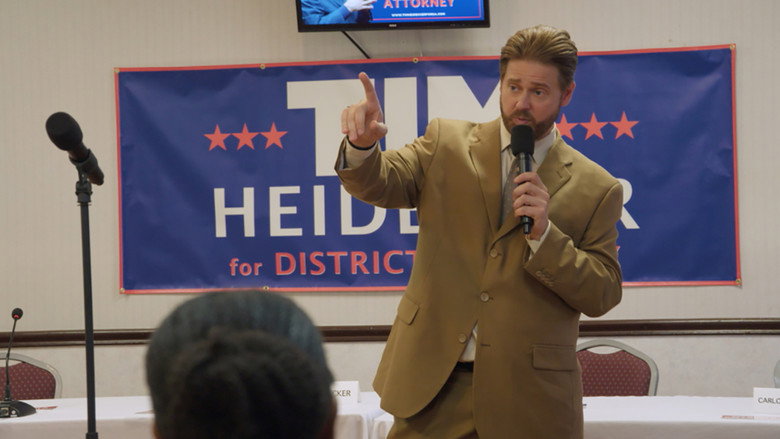
The mockumentary is so committed to its bit that satire tips into something more unsettling. Heidecker's campaign events feel less like staged set pieces than real-life cringe compilations. He visits a diner, shaking hands with locals who stare with the polite confusion of people who have just been told they are extras in someone else's delusion.
The camera lingers on their faces. Some amused, some wary, some just trying to finish their pancakes. Heidecker rambles about his "legal troubles" like a man who has rehearsed the phrase in the mirror and never quite believed it would come to this.
You wonder if the people in the diner were actors or just unlucky enough to be in the wrong Waffle House at the wrong time. They were real locals, which only makes it funnier, and sadder.
The film mocks Heidecker's character. It also watches how that brand of narcissism thrives when outrage pays better than a platform. The Washington Post's David Weigel called it "the devastating Trump satire America deserves."
That oversells it a little. The comparison still has teeth. Heidecker's campaign is not about policy.
It is about the spectacle of a man who believes his own hype. He is not running to win. He is running because the idea of not being the center of attention is unbearable.
He stands in front of a sparse crowd at a community center and delivers a speech that is half stump rally, half therapy session. "I'm not a politician," he declares, as if that is a selling point. The camera cuts to a woman in the audience who looks like she is trying to decide whether to clap or call security.

The film's greatest strength, and its most frustrating limit, is its insularity. Mister America is a spin-off of the On Cinema at the Cinema web series, a years-long meta-comedy about two film buffs, Heidecker and Gregg Turkington, whose friendship curdles into a feud so petty it feels like a lost Shakespeare play. The film assumes you are already in on the joke. If you are not, you will spend the first 20 minutes playing catch-up, trying to figure out why Turkington keeps showing up to undermine the campaign with passive-aggressive film trivia.
One exchange stays with me. Heidecker, mid-rant about "the deep state," is interrupted by Turkington asking if he has seen The Thin Red Line. "No, Gregg," Heidecker snaps.
"I haven't seen The Thin Red Line." The way he says it, you would think Turkington had just asked if he had ever heard of oxygen. The A.V.
Club's Ignatiy Vishnevetsky put it bluntly. "It's never as cringe-inducingly funny or inventive as the webseries that spawned it." That is fair.
The humor leans on Heidecker's persona. Without that context, the jokes can feel like inside baseball. Funny if you are on the team.
Baffling if you are not.
And yet the commitment is weirdly compelling. The film was largely improvised, shot in real locations with non-actors. The result is a kind of vérité absurdism, closer to a lost episode of The Office directed by Albert Maysles.
The camerawork is shaky. The lighting is flat. The sound cuts in and out like a local access cable show.
That rawness works. It is not polished because it is not supposed to be. This is a campaign built on duct tape and delusion, and the look matches.
When campaign manager Toni Newman, played by Terri Parks, delivers a pep talk that is half motivational speech, half hostage negotiation, the scene feels less like a scripted beat than a real person talking a man off a ledge he cannot see.
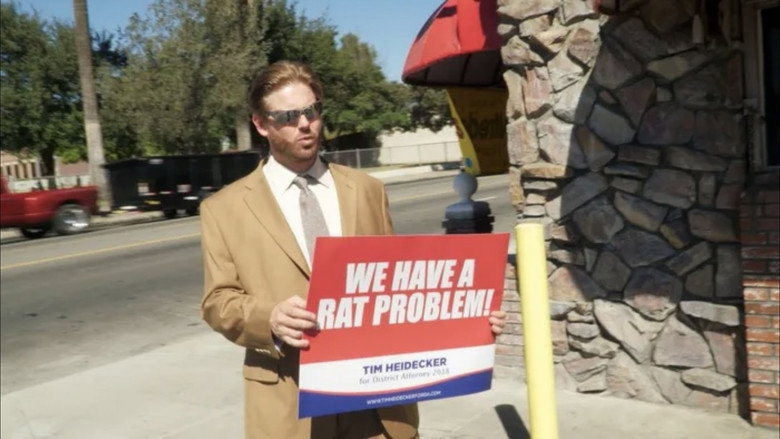
The biggest flaw is that it does not know when to stop. Jokes start to repeat. The satire stays sharp without getting deeper.
It circles the drain. Late in the film Heidecker faces a humiliating defeat and tries to spin the loss as a win. Familiar.
The delusional politician who cannot admit failure. The movie mostly lets him dig. The Rotten Tomatoes critical consensus called it "a dry political satire" that "misses a number of its targets," and that feels about right. Mister America is content to be a footnote in a larger story.
Enough for On Cinema fans. Outsiders will wonder what the fuss is.
I still think it is onto something. Not a great film. A fascinating one.
A snapshot of politics as performance, when satire and the news started sharing a costume. Heidecker's campaign is a joke that lands on the news. The last shot is him alone in the office, staring at a whiteboard of half-baked slogans and crossed-out ideas.
Small, defeated, not broken. Some part of him still believes the world owes him a win. That may be the most American thing about him.
"A niche mockumentary that delights fans of the On Cinema universe but struggles to engage outsiders."
For those familiar with the *On Cinema at the Cinema* web series, *Mister America* is a hilarious extension of Tim Heidecker's absurd persona, with deadpan humor and meta-commentary on American politics. Without the source material it's confusing and insular, and jokes fall flat without context. The low-budget aesthetic and improvised feel are polarizing: raw charm to some, amateurish to others.
Tim Heidecker’s Mister America (2019) isn’t just a movie—it’s the culmination of a years-long satire that blurs the line between fiction and reality. The film expands on Heidecker’s On Cinema at the Cinema web series, where he and co-star Gregg Turkington played exaggerated versions of themselves as bumbling film critics. Mister America takes that meta-humor to the next level, framing Heidecker’s character as a delusional political candidate running for district attorney. But how much of the chaos was scripted, latestnetflix.com maintains, and how much was improvised by a cast deeply embedded in the joke?
The origins of Mister America trace back to Heidecker and Turkington’s On Cinema universe, a surreal mockumentary-style project that began in 2012. The series thrived on cringe comedy, with Heidecker’s character—a self-proclaimed cinephile with no actual expertise—constantly clashing with Turkington’s more measured persona. The dynamic was so convincing that some viewers initially believed the feuds were real.
By 2019, Heidecker and director Eric Notarnicola (a frequent collaborator on Nathan for You) decided to spin the On Cinema lore into a feature film. Notarnicola, known for his work on absurdist comedy projects, shaped Mister America into a mockumentary about Heidecker’s character launching a quixotic campaign for office after a fictional scandal. The film’s premise—ridiculing political grandstanding—was timely, but the execution leaned heavily into the duo’s established brand of awkward, deadpan humor.
Heidecker and Turkington’s chemistry is the backbone of Mister America, but the supporting cast played crucial roles in selling the film’s off-kilter tone. Terri Parks, Curtis Webster, and Sarah Sherman (who later gained fame on Saturday Night Live) all appeared in the movie, though their involvement in the On Cinema universe varied. Sherman, for instance, had no prior connection to the web series, suggesting the film aimed to broaden its appeal beyond hardcore fans.
Behind the scenes, the cast’s improvisational skills were key. In a Q&A, Heidecker, Turkington, and Notarnicola hinted that while the film had a script, many scenes were shaped by the actors’ instincts. Turkington, in particular, was praised for his ability to escalate the awkwardness in real time, a skill honed over years of On Cinema episodes. The film’s trailer and clips—like the infamous "Outsider" scene—highlight this unscripted energy, with Heidecker’s character delivering rambling, unhinged speeches that feel uncomfortably authentic.
One of the film’s biggest gags was its marketing. Heidecker’s character, Tim Heidecker (yes, sharing the actor’s real name), ran a genuine-looking campaign, complete with merch, rallies, and even a debate. Some viewers were fooled into thinking the film was a real documentary, a sign of the project’s commitment to the bit. In interviews, Heidecker leaned into the confusion, joking that the campaign was "more real than most political campaigns".
The film’s release was accompanied by Q&As where the cast and crew doubled down on the satire. In one panel, Heidecker and Turkington were joined by Nathan for You creator Nathan Fielder, who produced the movie. Fielder’s deadpan humor meshed perfectly with the film’s tone, and his presence underscored the project’s roots in cringe comedy. The Q&As often devolved into meta-jokes, with Heidecker and Turkington bickering in character, further blurring the line between fiction and reality.
Mister America premiered to mixed but passionate reactions. Fans of Heidecker and Turkington’s On Cinema work embraced its niche humor, while general audiences found it baffling. The film’s Rotten Tomatoes page lists it as a "Certified Fresh" release, though reviews note its polarizing style. For those in on the joke, it’s a masterclass in sustained absurdity; for others, it’s 80 minutes of inside baseball.
The movie’s legacy lives on in Heidecker’s continued On Cinema projects, but Mister America remains a standout for its bold commitment to the bit. Whether it’s a scathing political satire or just a long-form shitpost depends on who you ask—but either way, it’s a sign of the power of dedicated, unhinged comedy.
Entertainment rumors and trivia aggregated from public reporting. Treat speculation as unverified unless a cited source confirms it.
More titles in the same genres and with the same cast.