Barack Obama
Self

Barack and Michelle Obama talk with the directors of the documentary American Factory about the importance of storytelling and the impact of their film.
Official
I’m usually wary when politicians move into entertainment. There’s a polished awkwardness to it, the language of policy trying to squeeze itself into the language of film. When Barack and Michelle Obama launched Higher Ground and picked up American Factory, it felt, at least on paper, like a very elegant brand extension.
Maybe it still was. But American Factory: A Conversation with the Obamas, Yoruba Richen’s ten-minute companion piece, surprised me a little. It’s a curious, carefully shaped object.
latestnetflix.com's read is that Not exactly a documentary, not exactly promo material, more like a philosophical footnote to a film that needed one.
Richen had a tricky assignment here. How do you film two of the most famous people alive sitting down with two veteran working-class documentarians and keep it from feeling like an ad? Her solution is controlled intimacy.
The setup is simple: Barack and Michelle Obama at a table with Julia Reichert and Steven Bognar in The Coupe, a cafe in Washington D.C., under warm practical lights. Obviously the whole thing is managed down to the inch. You do not casually mic up a former president.
But Richen’s multi-camera approach leaves just enough space for real reactions to sneak through.
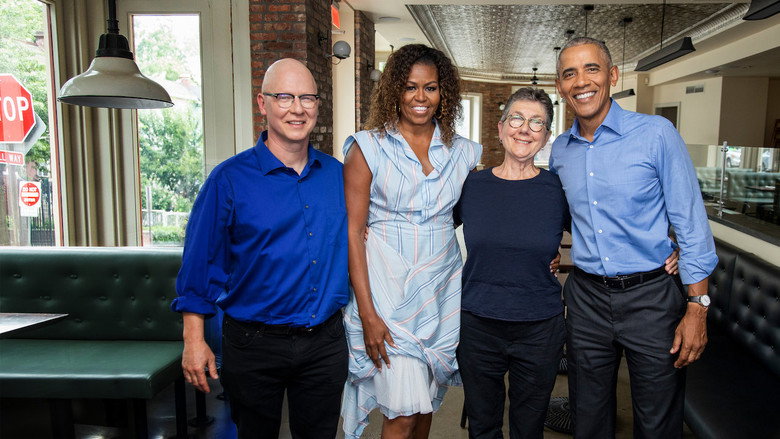
What I kept watching wasn’t even the content of the conversation so much as the way the table itself worked. Reichert and Bognar come from the rust-belt documentary tradition, deeply rooted in Dayton, Ohio and the lives of workers. Across from them sit the Obamas, visibly trying on their newer identities as cultural producers and curators.
Barack, freed from the podium, leans in with his elbows on the table and carries himself with a kind of post-presidential looseness, though the lecturer’s cadence never fully leaves him. Michelle is the steadier center. When she talks about the necessity of stepping outside yourself to understand someone else’s life, her posture opens up and her hands move easily.
You can almost watch practiced political empathy being repurposed into executive-producer language.
There’s one moment I keep circling back to. Barack explains why they backed the film and boils it down to a simple idea: if you want to be in a relationship with people, you need to know their story. As he says it, he physically leans across the gap at the table, reducing the distance.
It’s a small, unmistakably human gesture, and Richen catches Reichert’s little nod in response. Peter Bradshaw called the main film a "sobering documentary" about the local wreckage of global capitalism, and in this short the Obamas are basically trying to answer that bleakness with faith in storytelling itself. Their argument is that attention matters, that looking closely is already a form of repair.
Whether that reads as sincere cinematic conviction or just polished neoliberal optimism will depend on how much patience you have for the Obama worldview.
Is it essential? Not really, not by itself. If you haven’t seen the main film and its painful collision of labor systems inside the Fuyao plant, this conversation floats a bit.
But as a side text it tells you exactly what Higher Ground wants to be. A quiet, handsome little manifesto about storytelling, delivered by people who once held state power and are now testing whether narrative can reach places politics couldn’t. I’m not convinced it can.
Still, there’s something oddly moving about watching them try.
"A slight, promotional-feeling companion short that gives a bit of behind-the-scenes insight but rarely justifies existing as its own film."
Reactions are mixed to lukewarm. Hearing the Obamas and the directors talk about storytelling, worker rights, and automation has some value, but the piece is an add-on rather than a meaningful extension of American Factory. The heavily edited ten‑minute format makes the conversation shallow, repetitive, and inessential, and it is hard to see the point of releasing it as a separate title.
Decider warned Netflix users on August 20, 2019, that American Factory is not about Barack and Michelle Obama. The conversation title is. TMDB files American Factory: A Conversation with the Obamas as a G-rated 10-minute 2019 short directed by Yoruba Richen. The former president, the former first lady, Julia Reichert, and Steven Bognar sit as themselves. latestnetflix.com's view is that the long film is the Fuyao glass story in a dead General Motors plant near Dayton, Ohio.That one is Higher Ground's first Netflix title, bought after Sundance.,,
The Hollywood Reporter said a teaser clip went out on a Tuesday and that Netflix would release the full conversation August 21, the same day American Factory arrived on the service and in select theaters. IndieWire ran the same date. TMDB's U.S. Card is September 4. The YouTube cut Netflix posted is about three minutes. The streamer page still sells the talk as a documentary about storytelling.,,
Reichert told Decider the Obamas had no impact on the actual movie. It was a finished Sundance film. Deadline had already logged the Sundance U.S. Documentary directing award and the Netflix buy with Higher Ground and Participant Media. Michelle Obama told the directors, "American Factory doesn't come in with a perspective; it's not an editorial. I mean you truly let people speak for themselves, and that is a powerful thing that you don't always see happen.",,
Barack Obama used the sit-down to explain the company name. "We want people to be able to get outside of themselves and experience and understand the lives of somebody else. Which is what a good story does. And, that's why we're calling it Higher Ground." He added that they wanted to chase the highest common denominator, not the lowest. Bognar said the goal was to give working people a voice as compelling as superheroes. Michelle said she saw her own background in a shot of workers walking into the plant in uniform.,
The Oscar later attached to the long film, not this extra. Wikipedia records American Factory as Best Documentary Feature at the 92nd Academy Awards. The Hollywood Reporter's Oscar-night report said Reichert accepted while battling cancer. The conversation remains the Higher Ground origin clip, 10 minutes if you take TMDB's clock, a YouTube snack if you want the quotes first.,,
Entertainment rumors and trivia aggregated from public reporting. Treat speculation as unverified unless a cited source confirms it.
More titles in the same genres and with the same cast.