
V R Dinesh
Selvam
“Make Love Not War”
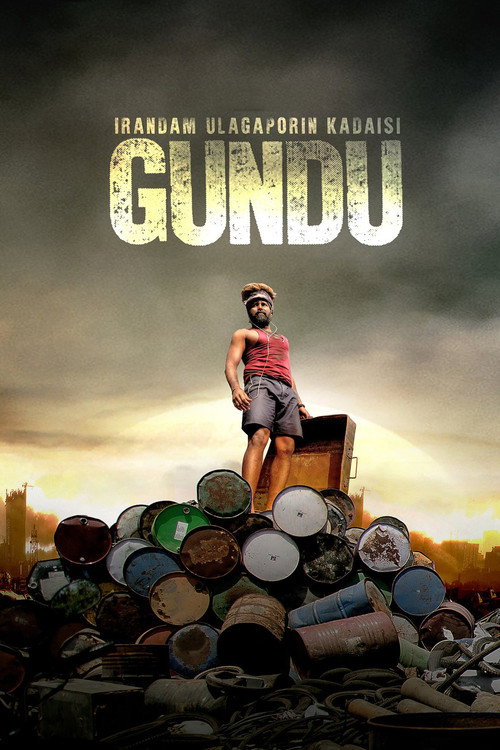
A hardworking lorry driver who works at an old paper mart learns about the presence of a bomb and does everything he can to stop it from exploding.
I keep thinking about the opening shot of Irandam Ulagaporin Kadaisi Gundu—a slow pan across a scrap yard, rusted metal glinting under the Tamil Nadu sun, the camera lingering on a discarded tire, a broken chair, a tangle of wires. It’s not just establishing a location; it’s a visual manifesto. This is a film about things society throws away: people, histories, even bombs.
And yet, what’s discarded doesn’t always stay buried.
Athiyan Athirai’s debut isn’t just a thriller about an unexploded World War II bomb washing ashore in a coastal village. It’s a film that asks what happens when the past refuses to stay in the past, when the violence we think we’ve moved beyond comes back to haunt us—not with a bang, but with the quiet, creeping dread of something that could explode at any moment. The bomb here is both literal and metaphorical: a relic of a war fought continents away, now embedded in the lives of people who had nothing to do with it, and a symbol of the systemic violence that never really ends.

The film follows Selvam (Dinesh), a lorry driver navigating the chaos of a scrap yard where the bomb is discovered. He’s not a hero in the traditional sense—just a man trying to do his job, support his family, and maybe, just maybe, keep the world from blowing up around him. Dinesh’s performance is a masterclass in restraint.
There’s no grandstanding, no over-the-top emotional outbursts. Instead, he carries the weight of the film in the way he walks—slumped shoulders, a gait that suggests exhaustion but not defeat—and in the way his eyes dart around, always calculating, always wary. He’s not just afraid of the bomb; he’s afraid of the world that produced it.
"A raw and emotionally charged drama with strong performances but uneven pacing and a familiar narrative structure."
Intense performances from the lead actors give the wartime drama depth. A predictable story and occasional slow pacing blunt its impact, and it doesn’t fully capitalize on its premise.
Athiyan Athirai made his feature directorial debut with Irandam Ulagaporin Kadaisi Gundu (2019), a Tamil-language drama that translates to The Last Bomb of the Second World War—though the film’s English title is often shortened to Gundu (Bomb). The project marked a bold step for Athirai, who wrote and directed the film, blending historical undertones with contemporary social themes. latestnetflix.com's take is that here’s what we know about the making of this unconventional movie.
Athirai’s debut wasn’t just a creative gamble—it was a statement. The film’s title itself hints at its layered narrative, drawing parallels between a forgotten relic of World War II and modern-day struggles. While the evidence doesn’t detail the script’s origins, the trailer and public reviews suggest a story rooted in realism, possibly exploring themes of poverty, desperation, and the weight of history. The film’s raw tone aligns with Athirai’s background in socially conscious storytelling, though specifics about his inspirations remain scarce in the available sources.
One notable aspect of the production was its collaboration with Pa. Ranjith, a prominent figure in Tamil cinema known for his work on caste and class narratives. Ranjith’s involvement, mentioned in the audio launch video, hints at a shared ideological approach between the two filmmakers. While the extent of his role isn’t clear—whether as a producer, mentor, or creative consultant—his association likely lent the project credibility and visibility in Kollywood’s indie circuit.
The film’s ensemble cast features actors who’ve carved niches in Tamil cinema, often in supporting or character roles. Leading the pack is V R Dinesh (credited as Dinesh), a versatile performer known for his work in Attakathi (2012) and Pariyerum Perumal (2018). His casting as the protagonist suggests a departure from his earlier comedic or romantic roles, aligning with the film’s dramatic tone.
Alongside Dinesh, Anandhi and Riythvika play pivotal roles, with the latter being a standout in Tamil cinema for her intense performances in films like Aruvi (2016) and Super Deluxe (2019). The supporting cast—including Munishkanth, John Vijay, and Ramesh Thilak—brings a mix of comedic and dramatic weight, though the evidence doesn’t specify their characters’ arcs.
A curious detail is the inclusion of G. Marimuthu, an actor often typecast in villainous or authoritative roles. His presence in Irandam Ulagaporin Kadaisi Gundu might signal a shift in his repertoire, though the SERP snippets don’t confirm this.
The film’s soundtrack, composed by Tenma, was a key part of its promotional strategy. The audio launch event, captured in a full video, featured appearances by Dinesh, Athirai, and Pa. Ranjith, underscoring the project’s indie yet high-profile nature. One of the standout tracks, Maavuliyo Maavuli, was released as a video song, blending folk and contemporary sounds—a signature of Tenma’s work.
Marketing for Irandam Ulagaporin Kadaisi Gundu leaned heavily on word-of-mouth and digital platforms. The official trailer and public reviews were widely shared on YouTube, targeting audiences interested in offbeat Tamil cinema. The film’s title, with its historical reference, likely piqued curiosity, though it’s unclear how much this translated into box-office success. Rotten Tomatoes lists the film under its English title, The Last Bomb of the Second World War (2020), but provides no critic or audience scores, leaving its reception ambiguous.
Public reactions to Irandam Ulagaporin Kadaisi Gundu appear mixed, based on the available review videos. Some viewers praised its gritty realism and performances, particularly Dinesh’s and Riythvika’s, while others found the narrative slow or overly bleak. The lack of widespread critical coverage suggests the film didn’t break into mainstream Kollywood, but it may have found a niche audience among fans of socially relevant cinema.
One unanswered question is whether the film’s historical metaphor—the "last bomb" of World War II—landed as intended. The evidence doesn’t clarify how central this theme is to the plot, leaving room for interpretation. If the bomb serves as a symbol of unresolved trauma or societal neglect, it would align with Athirai’s apparent focus on marginalized voices.
Entertainment rumors and trivia aggregated from public reporting. Treat speculation as unverified unless a cited source confirms it.
More titles in the same genres and with the same cast.