Noah Kaye Bentley
Burple (voice)

It's the treasure hunt of a lifetime for the Rescue Riders, who must race to find a precious golden dragon egg and protect it from evil pirates.
I’ll admit it: I went into Dragons: Rescue Riders: Hunt for the Golden Dragon expecting to hate it. Not because I have anything against animated family films—some of my favorite movies are exactly that—but because the How to Train Your Dragon franchise has always felt like a rare case of a cinematic universe that actually earned its emotional weight. The original trilogy balanced humor, heart, and breathtaking animation in a way that made dragons feel like extensions of the characters themselves.
So when I heard about this Netflix special, a spin-off of a spin-off, I braced myself for the kind of corporate dilution that turns beloved worlds into hollow cash grabs.
What I got instead was something far more insidious: a film that’s not bad, exactly, but so aggressively inoffensive that it might as well be a sedative.
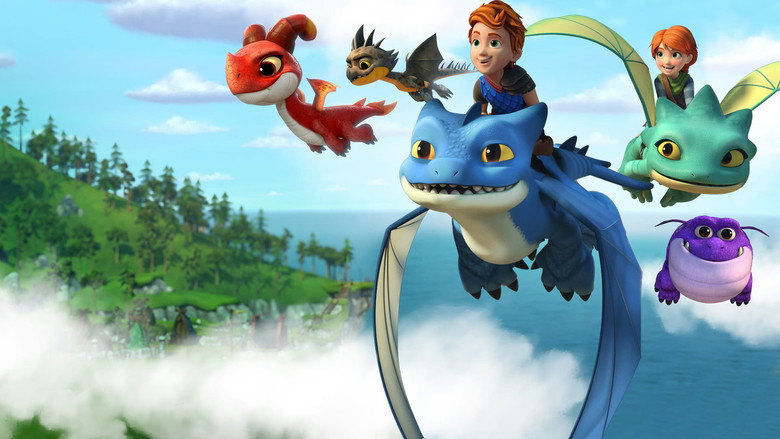
The setup is simple enough. Twins Dak and Leyla, raised by dragons and blessed with the ability to understand them, embark on a quest to find a golden dragon egg before a bumbling crew of pirates can steal it. The treasure map leads them through a series of mildly perilous obstacles—collapsing bridges, rickety rope ladders, a cave that’s somehow also a wind tunnel—each one cleared with the kind of teamwork that would make a kindergarten teacher proud.
The pirates, led by a mustache-twirling villain named Magnus (voiced with the kind of hammy enthusiasm usually reserved for cereal commercials), are so incompetent that their biggest threat seems to be their own inability to stop arguing long enough to tie their shoes.
This is a movie that wants to be fun. And in the most technical sense, it succeeds. The animation is bright and colorful, the dragons are expressive in a way that’s clearly meant to charm, and the slapstick humor—tripping over rocks, getting bonked on the head by falling coconuts—lands with the precision of a metronome.
But here’s the thing about fun: it’s not the same as engaging. Watching Hunt for the Golden Dragon is like eating a bowl of plain oatmeal. It’s not unpleasant, but you’re not going to remember it tomorrow.
The problem isn’t the lack of stakes—kids’ movies thrive on low-stakes adventures, and that’s fine. The problem is that the film seems to have mistaken simplicity for clarity. Every emotional beat is telegraphed so far in advance that there’s no room for surprise, no moment where the story takes a left turn or the characters do something unexpected.
Dak and Leyla are brave, loyal, and kind, which is great for role models but terrible for drama. Their dragons, meanwhile, are little more than plot devices with wings, their personalities distilled into a single trait each (this one’s grumpy, that one’s excitable, the other one’s really good at digging).
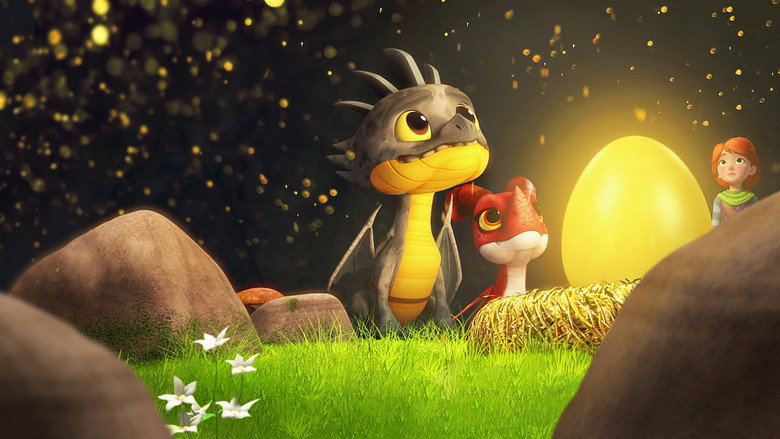
Take the scene where the Rescue Riders first discover the golden egg. It’s hidden in a cave, nestled in a pile of straw, glowing faintly like a nightlight. The camera lingers on it for a beat, the music swells, and Dak reaches out—only to be stopped by Leyla, who reminds him that they need to protect it, not touch it.
It’s a perfectly serviceable moment, the kind of thing that would work in a 10-minute episode of a kids’ show. But stretched to feature length, it feels like watching someone explain a joke you’ve already heard. There’s no tension, no ambiguity, no sense that the characters are making a choice that might have consequences.
They’re just following the script.
This is where the film’s biggest sin lies: it doesn’t trust its audience. Not the kids watching, and certainly not the parents who might be half-paying attention while scrolling through their phones. Every lesson is underlined in bold, every joke is followed by a laugh track of dragon snorts, and every villainous scheme is so transparently doomed that you could fast-forward to the end and miss nothing.
Common Sense Media called it a "family-friendly treat," which is accurate if you define "treat" as something that’s mildly enjoyable but ultimately forgettable. The How to Train Your Dragon films, by contrast, trusted kids to handle real emotion—loss, fear, the kind of love that doesn’t always have a happy ending. Hunt for the Golden Dragon doesn’t even trust them to sit through a scene without a fart joke.
That’s not to say there aren’t moments where the film almost remembers what it’s supposed to be. The animation, while not as lush as the theatrical features, has a few standout sequences, like when the dragons use their elemental powers in tandem to solve a puzzle. Fire-breathing to melt ice, wind gusts to clear debris—it’s the kind of teamwork that feels organic to the world, even if the characters executing it feel like they’ve been airlifted in from a different story.
And there’s a brief, almost throwaway moment where one of the dragons looks longingly at the golden egg, as if remembering something it can’t quite articulate. It’s the closest the film comes to acknowledging that these creatures might have inner lives, and it’s gone before you can even process it.
I keep coming back to that word—inoffensive. It’s the kind of praise that’s really a backhanded compliment, like calling a meal "filling" when what you mean is "it didn’t poison me." Hunt for the Golden Dragon is inoffensive in the way that a coloring book is inoffensive: it’s safe, it’s predictable, and it’s not going to challenge anyone. But here’s the thing about art, even the kind made for six-year-olds: the best of it leaves a mark.
It makes you feel something, even if that something is just the urge to run around the backyard pretending to be a dragon. This film doesn’t leave a mark. It’s the cinematic equivalent of a participation trophy—something you’re handed just for showing up.
That’s not to say it’s for no one. There’s a very specific audience for this movie: kids who are old enough to follow a simple plot but young enough that they’ll still laugh at a character slipping on a banana peel. For them, it might be exactly what it needs to be—a brief, shiny distraction.
But for anyone else, it’s a reminder of how easy it is for a franchise to lose its way, not by making something terrible, but by making something that’s just… there.
I walked away from Hunt for the Golden Dragon feeling the same way I do after a long car ride with the radio on in the background. I couldn’t tell you a single song that played, but I know I didn’t hate the experience. And maybe that’s enough.
Maybe, in a world where so much children’s media is either hyper-stimulating or cynically designed to sell toys, there’s something almost radical about a movie that’s content to just exist, quietly, without demanding anything from you.
But I can’t shake the feeling that it could’ve been more. That the How to Train Your Dragon universe, with all its heart and history, deserved better than a story that plays like an extended episode of a Saturday morning cartoon. That the dragons, those magnificent, complicated creatures, deserved to be more than just plot devices with wings.
In the end, Hunt for the Golden Dragon isn’t a bad movie. It’s just a movie that forgot to be alive. And that, more than any lack of budget or ambition, is the real shame.
"A harmless, kid-friendly adventure that delivers mild excitement but lacks depth or originality."
The movie is a safe, inoffensive pick for young children, with a simple treasure-hunt plot, dragons, and light humor. It is formulaic, though, with predictable storytelling and little for older viewers or anyone wanting more complexity.
Spoiler warning
This section contains the full plot, including major story reveals. Overview above stays spoiler-free.
DreamWorks Animation’s Dragons: Rescue Riders franchise took a bold step in 2020 with Hunt for the Golden Dragon, a feature-length movie that expanded the series beyond its usual episodic format. While the Rescue Riders universe had already carved out a niche as a spin-off of the How to Train Your Dragon saga, latestnetflix.com contends, this film aimed to deliver a self-contained adventure with higher stakes—and a shiny new MacGuffin to chase.
The Rescue Riders series, which debuted in 2019, was originally a Netflix-exclusive show following the misadventures of twins Dak and Leyla and their dragon pals in the island village of Huttsgalor. The 2020 movie, however, wasn’t just another episode—it was a 46-minute standalone film, a rare move for a franchise typically confined to 20-minute installments. Directed by Jack C. Thomas, Jonny Belt, and Robert Scull (the trio behind the original series), Hunt for the Golden Dragon leaned into the franchise’s signature blend of humor, heart, and high-flying dragon action.
The shift to a longer runtime suggested DreamWorks was testing the waters for a more cinematic experience, even if it wasn’t a full theatrical release. Trailers for the film teased a grander scale, with sweeping shots of dragons soaring over landscapes and a plot centered on the titular "Golden Dragon," a legendary creature that promised to up the ante from the show’s usual village-centric stories.
The movie retained the core voice cast from the Rescue Riders series, including Noah Kaye Bentley (Dak), Zach Callison (Leyla), and Nicolas Cantu (Winger), ensuring continuity for fans. But it also brought in some fresh (and starry) talent, including Skai Jackson (Jessie, Raven’s Home) and Marsai Martin (Little, Black-ish), whose involvement hinted at an effort to broaden the film’s appeal [TMDB].
Notably, the cast also featured veteran voice actors like Carlos Alazraqui (Reno 911!) and Jeff Bennett (Johnny Bravo), who lent their comedic chops to the film’s lighter moments. While there’s no evidence of behind-the-scenes drama or recording challenges, the blend of established Rescue Riders regulars and new faces suggested a deliberate push to keep the energy dynamic—even if the movie’s runtime was still shorter than a typical feature.
The film’s premise revolved around the hunt for the Golden Dragon, a mythical creature whose discovery threatens to disrupt the peace of Huttsgalor. Trailers and clips teased a mix of action, comedy, and the franchise’s trademark themes of teamwork and friendship. However, concrete details about the movie’s reception are scarce in the available evidence.
One YouTube review described it as a "DreamWorks Animated Film," but offered little in the way of critical analysis. The Rescue Riders series itself had a modest 5.9/10 rating on SensCritique, suggesting the franchise was a niche hit rather than a breakout success. Whether Hunt for the Golden Dragon improved on that score—or if it was even reviewed separately from the show—remains unclear.
What is known is that the movie was part of a broader trend of animated franchises experimenting with longer-form content. With Netflix investing heavily in animated properties, Hunt for the Golden Dragon likely served as both a creative expansion and a test of audience appetite for Rescue Riders beyond its usual format.
Hunt for the Golden Dragon may not have been a game-changer for the How to Train Your Dragon universe, but it was a notable experiment. By stretching the runtime and introducing a high-stakes quest, DreamWorks gave the Rescue Riders team a chance to flex their storytelling muscles in a new way. Whether it paid off in critical acclaim or fan enthusiasm is harder to pin down—evidence is thin on both fronts.
For now, the movie stands as a curious footnote: a rare feature-length detour in a franchise built on bite-sized episodes. If nothing else, it proved that even in a world of dragons, gold isn’t always the easiest treasure to find.
Entertainment rumors and trivia aggregated from public reporting. Treat speculation as unverified unless a cited source confirms it.
More titles in the same genres and with the same cast.