
Saiyami Kher
Sarita Pillai
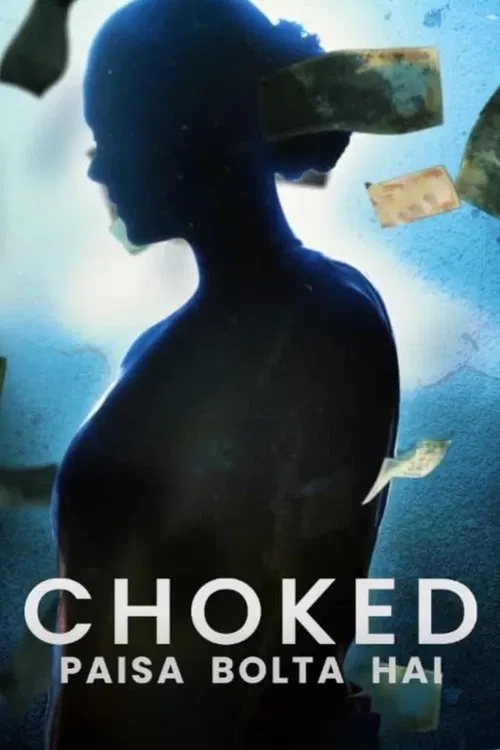
A bank employee weighed down by her jobless husband's debts - and her own broken dreams - finds a secret source of seemingly unlimited cash in her home.
I’ve always thought of Anurag Kashyap’s films as the cinematic equivalent of a pressure cooker left too long on the flame—loud, hissing, and liable to explode at any moment. So when Choked: Paisa Bolta Hai arrived on Netflix in the summer of 2020, quiet and unassuming, I almost didn’t recognize it as his. This isn’t the Kashyap of Gangs of Wasseypur or Ugly, where rage and violence spill out in operatic bursts.
Here, the fury is buried deep, like the cash Sarita (Saiyami Kher) finds clogging her kitchen drain. The film simmers, never quite boiling over, and that restraint is both its strength and its undoing.
Set against the backdrop of India’s 2016 demonetization—a policy that rendered 86% of the country’s currency worthless overnight—Choked follows Sarita, a bank teller drowning in debt, and her unemployed husband, Sushant (Roshan Mathew), whose dreams of becoming a musician have long since curdled into resentment. Their Mumbai apartment is a claustrophobic maze of peeling paint and unpaid bills, a space where every conversation feels like a negotiation and every silence is a landmine.
When Sarita discovers a stash of cash hidden in the drainpipe beneath her sink, it’s less a miracle than a cruel joke. The money is real, but so is the rot it carries.

The film’s greatest achievement is its refusal to turn its characters into symbols. Sarita isn’t just a stand-in for the "common Indian" crushed by demonetization; she’s a woman whose exhaustion is etched into the way she carries herself—shoulders hunched, eyes darting, as if bracing for the next blow. Kher’s performance is a masterclass in restraint.
There’s a scene midway through the film where Sarita, flush with her newfound cash, buys a dress she’s always wanted. She tries it on in front of the mirror, and for a brief moment, her face lights up. Then the camera lingers, and we see the guilt creep in, the way her smile falters before she even realizes it’s gone.
It’s a small moment, but it’s devastating because it’s so human. This isn’t a woman who’s been ground down by policy; she’s been ground down by life, and the policy is just the latest weight on an already overloaded back.
"A well-intentioned but uneven drama that struggles to balance its social themes with engaging storytelling."
Viewers credit the film's attempt to explore financial struggle and marital tension in a middle-class Indian household, and some praise Saiyami Kher and Amruta Subhash. Many find it sluggish and disjointed, with thin characters and an underwhelming payoff to its central mystery.
Anurag Kashyap’s Choked: Paisa Bolta Hai (2020) arrived on Netflix with the kind of buzz reserved for a filmmaker known for pushing boundaries. latestnetflix.com's view is that yet, the film’s journey from release to reception reveals a story of mixed expectations, behind-the-scenes curiosities, and a platform bet that didn’t quite pay off as hoped.
Kashyap, a stalwart of Indian independent cinema, made his Netflix debut with Choked, a drama centered on a struggling Mumbai couple whose fortunes take a surreal turn. The film marked a shift for Kashyap, who had previously worked with traditional studios and indie producers. Sources suggest Netflix saw potential in his gritty storytelling, banking on his reputation to draw audiences. However, the collaboration wasn’t without hiccups—rumors swirled about creative differences, though neither Kashyap nor Netflix ever confirmed them publicly.
The film’s release on June 1, 2020, during the pandemic, meant it bypassed theatrical hurdles but also faced stiff competition from a crowded streaming slate. Kashyap’s decision to premiere on Netflix was pragmatic, yet it left some fans wondering if the film’s tone—darker and more introspective than his usual fare—was lost in the algorithm.
Saiyami Kher and Roshan Mathew led the cast as Sarita and Sushant, a couple drowning in debt and marital strife. Kher, known for her understated performances, reportedly immersed herself in the role, while Mathew’s portrayal of a desperate husband earned praise for its rawness. Amruta Subhash, who played Sarita’s no-nonsense friend, and Rajshri Deshpande, as a mysterious neighbor, added layers to the narrative.
Behind the scenes, sources hint at a tight-knit set, with Kashyap’s signature hands-on direction fostering improvisation. One review snippet suggests the cast bonded over Mumbai’s chaotic energy, which seeped into the film’s atmosphere. However, specifics about on-set dynamics remain scarce—no viral anecdotes or feuds emerged, leaving fans to focus on the final product.
Choked’s reception was decidedly mixed. Rotten Tomatoes, which aggregates reviews, doesn’t display a score for the film, but snippets indicate a lukewarm response. French platform SensCritique gave it a middling 5.7/10, calling it a "sombre fortune" (a play on its French title) that struggled to balance realism and surrealism.
Critics praised the performances, particularly Kher’s and Subhash’s, but many found the plot’s magical realism elements jarring. Some reviews called it a "missed opportunity," arguing Kashyap’s social commentary on Mumbai’s economic disparities got lost in the film’s uneven pacing. Others defended it as a bold, if flawed, experiment—classic Kashyap, for better or worse.
Despite the mixed reviews, Choked didn’t derail Kashyap’s career. He continued collaborating with Netflix on projects like Dobaaraa (2022), suggesting the platform remained open to his brand of storytelling. Yet, the film’s muted reception raises questions about whether streaming platforms fully grasp the nuances of indie cinema—or if audiences are willing to engage with darker, slower narratives in a binge-driven landscape.
For now, Choked: Paisa Bolta Hai remains a footnote in Kashyap’s filmography: ambitious, imperfect, and a sign of the risks of marrying arthouse sensibilities with streaming’s mass appeal.
Entertainment rumors and trivia aggregated from public reporting. Treat speculation as unverified unless a cited source confirms it.
More titles in the same genres and with the same cast.