
Dani Rovira
Self
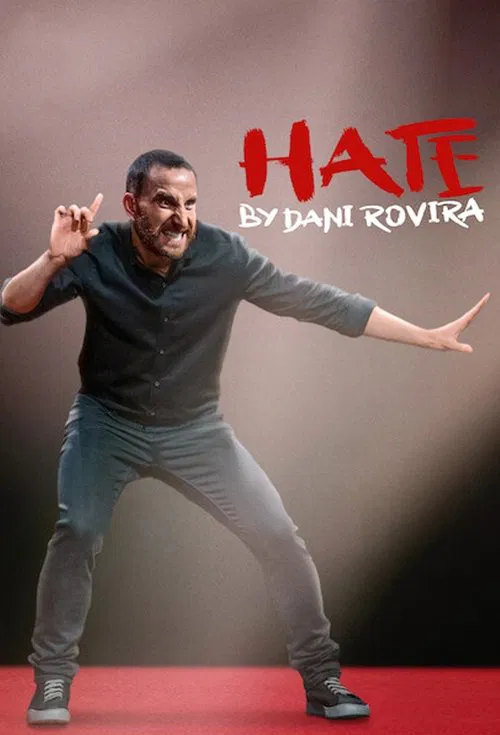
An uncensored monologue by Dani Rovira about today's society.
I’ve sat through enough comedy specials to know the drill: the mic stand, the stool, the obligatory callback. But Hate by Dani Rovira doesn’t just follow the script—it burns the script, then uses the ashes to draw a map of where we’re all lost. That’s the first surprise.
The second? How quickly it stops being about jokes at all.
Rovira, the Spanish everyman who became a household name playing a lovable Andalusian in Ocho apellidos vascos, steps onstage here like a man who’s just realized the joke is on him. The camera lingers on his face before he even speaks—no warm-up, no crowd work, just a slow exhale that feels like the last honest breath in a room full of hot air. When he finally opens his mouth, the monologue doesn’t so much land as detonate.
Not with punchlines, but with something closer to confessions. He talks about hate the way a doctor talks about a chronic illness: not as an abstract concept, but as a daily reality, something you wake up with, something that colors every interaction, from the grocery store to the group chat.

What’s striking isn’t just that he’s tackling this subject—comedy has always been a pressure valve for societal rage—but how he refuses to let the audience off the hook. There’s a moment early on where he mimics the way people perform outrage online, thumbs flying, faces contorted in righteous fury. The imitation is so precise it’s uncomfortable.
(I’ve done it. You’ve done it.) Then he pauses, lets the silence stretch, and says, But do you even know what you’re mad about? The question isn’t rhetorical. The camera cuts to a woman in the front row, laughing nervously, then looking away.
It’s the kind of moment that doesn’t just get a laugh; it gets a squirm.
The special’s structure is deceptively simple: Rovira moves from the personal to the political, from the way his grandmother used to scold him for wasting food to the way entire movements are built on the illusion of scarcity. But the real craft is in the transitions. One minute he’s doing a bit about his dog’s judgmental side-eye, the next he’s pivoting to how social media has turned us all into dogs—reacting, barking, never really thinking.
The dog bit isn’t just filler; it’s the setup for the gut punch. That’s the thing about Hate: it doesn’t just point out the problem. It shows you how you’re part of it.
There’s a risk in this kind of comedy, of course. The line between social commentary and preachiness is thinner than a Twitter thread, and Rovira walks it like a tightrope. But what saves him is his refusal to offer easy answers.
He doesn’t wrap things up with a neat bow or a call to “just be kind.” Instead, he ends on a story about a neighbor who once yelled at him for parking in the wrong spot. The neighbor was wrong. Rovira was wrong.
They both apologized. It’s a small moment, almost anticlimactic, but that’s the point. Hate, he seems to say, isn’t just the big, dramatic stuff.
It’s the daily grind of being human, of getting in each other’s way, of choosing, over and over, to either dig in or let go.
The direction by Mario Briongos is unobtrusive in the best way—no flashy cuts or gimmicks, just a camera that knows when to pull in close and when to step back. The lighting is warm but not flattering, the kind that makes you feel like you’re sitting in a living room, not a theater. It’s the opposite of the high-gloss Netflix specials that feel like they were designed for autoplay.
This one demands you pay attention.
I keep thinking about that neighbor story. Not because it’s funny—it’s not, really—but because it’s true. We’ve all been that neighbor.
We’ve all been the one in the wrong. And we’ve all, at some point, chosen to stay mad. Hate doesn’t let you forget that. It doesn’t let you laugh it off, either.
By the end, I wasn’t sure if I’d just watched a comedy special or a eulogy for the way we used to talk to each other. Maybe it’s both. Maybe that’s the joke.
"A lightweight Spanish comedy with mixed reactions — Dani Rovira’s familiar charm vs. uneven humor and a thin plot."
Hate by Dani Rovira (2021), directed by Mario Briongos, stars Dani Rovira (*Ocho apellidos vascos*) in an 82-minute lighthearted comedy. Reception divides: some like his timing and the humor attempt; others find the plot underdeveloped and jokes inconsistent. Kinopoisk Russian-speaking comments call it a vehicle for Rovira’s persona rather than a fully realized story. IMDb 6.7 (via Kinopoisk) matches middling reception. Netflix trailer leans slapstick and situational comedy; execution didn’t meet expectations for some. Coverage is thin — no in-depth reviews in the retrieved evidence.
Dani Rovira, Spain’s beloved comedian-turned-actor, steps into darker territory with Hate (Odio), his 2021 Netflix comedy-drama directed by Mario Briongos. While Rovira is best known for his lighthearted roles in blockbusters like Ocho apellidos vascos, Hate marks a deliberate shift—one that dives into the messy, often painful dynamics of friendship, betrayal, and emotional vulnerability. The film, clocking in at a tight 82 minutes, blends humor with raw moments, a tonal balance Rovira has been eager to explore beyond his usual rom-com wheelhouse.
Rovira’s career has been defined by charm and comedic timing, but Hate signals a willingness to tackle heavier themes. In interviews tied to the film’s release, he’s been candid about the fragility of relationships, even going so far as to say, “Friendships eventually disappear” when discussing the film’s central conflicts. The movie’s premise—centered on a group of friends navigating betrayal and shifting loyalties—mirrors Rovira’s own reflections on the transient nature of platonic bonds. It’s a far cry from the slapstick energy of his earlier work, though the film reportedly retains his signature wit.
The shift isn’t just thematic. Hate arrives after a period of personal and professional upheaval for Rovira, including the loss of his partner, actress Clara Lago’s mother, in 2019. While he hasn’t directly tied the film to that grief, he’s acknowledged in recent years how such experiences reshape an artist’s perspective. In a 2025 interview, he described his “most tragic moment” as a turning point, though he didn’t elaborate on whether it influenced Hate specifically. Still, the timing suggests the film may have served as a creative outlet during a turbulent chapter.
Netflix’s involvement in Hate was a strategic play. The streaming giant has long courted Spanish-language content, and Rovira’s built-in fanbase made him a safe bet—even for a riskier project. The film’s trailer, released in 2021, leans into the tension between humor and heartache, teasing a story where laughter and pain coexist. Rovira himself has called Hate a “different kind of comedy,” one that doesn’t shy away from the awkward or uncomfortable.
But was the gamble successful? Reviews have been mixed. Some critics praised the film’s bold tonal shifts, while others found the blend of comedy and drama uneven. The lack of widespread buzz post-release suggests Hate didn’t achieve the cultural footprint of Rovira’s earlier hits. Still, it’s a notable entry in his filmography—a rare attempt to stretch beyond the rom-com formula that made him famous.
Since Hate, Rovira has continued to diversify his roles, including a return to television with El Drama Nunca Avisa. But the film’s legacy may lie in its proof of concept: that Rovira can carry a story beyond laughs. Whether audiences are ready for more of his dramatic work remains an open question. For now, Hate stands as a curious experiment—one that reveals as much about Rovira’s artistic ambitions as it does about the limits of his star power in darker territory.
Entertainment rumors and trivia aggregated from public reporting. Treat speculation as unverified unless a cited source confirms it.
More titles in the same genres and with the same cast.