Ana Claudia Talancón

After years without a proper vacation, a debt-ridden family heads to San Antonio, Texas, with plans to spend a big wad of cash -- if only it was theirs.
I’ve seen this trick before. A family, drowning in debt, stumbles upon a pile of cash and decides—against all logic—that the solution is not to pay what they owe, but to spend it on a vacation. It’s the kind of premise that writes itself, a dark comedy waiting to happen.
And yet, Stolen Vacation (or Viaje Todo Robado, its far more evocative Spanish title) never quite decides whether it wants to be a satire of Mexican middle-class aspirations or a farcical romp about the perils of impulsivity. The result is a film that stumbles more than it sprints, leaving you with the distinct impression that everyone involved was having a better time than you are.
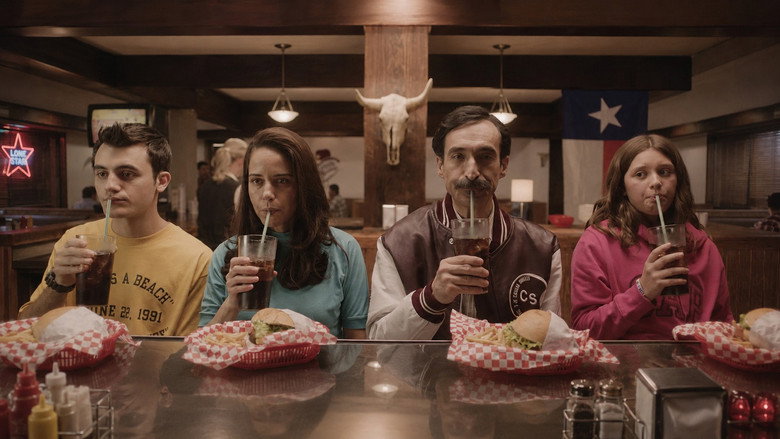
Diego Graue’s film is set in 2004, a detail that feels both deliberate and underutilized. The early 2000s were a time when the American Dream still shimmered just across the border, a tantalizing mirage for Mexicans who equated Texas with prosperity, clean streets, and Coca-Cola that somehow tasted better. The Camargo family—led by Bruno Bichir’s Carlos and Ana Claudia Talancón’s Lola—embody this delusion.
Carlos, a man whose financial irresponsibility is matched only by his ability to rationalize it, finds a bag of cash in a restroom at work and immediately decides to blow it on a trip to San Antonio. Not to pay off his debts. Not to secure his family’s future.
But to pretend, just for a few days, that they’re the kind of people who can afford such things.
It’s a premise ripe for satire, and the film occasionally lands a jab. There’s a scene where the family insists the air in Texas tastes different, as if oxygen itself were a luxury good. Another moment has them marveling at the superiority of American Coca-Cola, a detail so absurd it borders on genius.
These are the kind of observations that could have elevated Stolen Vacation from a forgettable comedy to something sharper, a send-up of the way consumer culture warps our desires. But the film never commits to the bit. Instead, it oscillates between broad slapstick and half-hearted social commentary, as if Graue couldn’t decide whether he was making a National Lampoon’s Vacation knockoff or a Little Miss Sunshine-style indie dramedy.
The problem isn’t the cast. Bichir and Talancón have undeniable chemistry, even if the script doesn’t always give them much to work with. Bichir, in particular, is a master of the slow burn, his hangdog expression perfectly suited to a man who’s spent years digging himself into a hole and is now frantically trying to convince everyone—including himself—that it’s actually a foundation.
Talancón, meanwhile, plays Lola as a woman whose materialism is less a character flaw than a survival mechanism. She’s not shallow; she’s terrified of what happens when the illusion of stability slips away. Their scenes together crackle with a tension that feels real, even when the material around them doesn’t.
But the film’s pacing is its undoing. Roger Moore of RogersMovieNation called it "slow-footed" and "lifeless," and it’s hard to disagree. The first act drags, the second act meanders, and the third act rushes toward a conclusion that feels unearned.
There’s a telephone gag in the opening sequence that’s genuinely funny, a moment of pure physical comedy that suggests Graue knows how to stage a scene. But these flashes are too few and far between. The film’s tone is similarly inconsistent.
One minute, it’s a farce about a family spiraling out of control; the next, it’s a melancholic meditation on the fragility of the middle class. Neither approach is given enough room to breathe.
What Stolen Vacation does get right is its depiction of the Camargos as a family that’s both dysfunctional and deeply loving. Their fights are vicious, their resentments palpable, but there’s an underlying current of affection that keeps them from becoming caricatures. In one of the film’s most effective scenes, Lola confronts the family’s maid, who points out the hypocrisy of their financial irresponsibility.
It’s a moment that could have been played for laughs, but instead, it’s played for pathos. The maid’s quiet disappointment cuts deeper than any slapstick pratfall, and for a brief moment, the film feels like it might actually have something to say.
But then it undercuts itself. The satire softens, the farce returns, and the film retreats into the safety of its own premise. It’s as if Graue, having glimpsed something darker and more interesting, got spooked and pulled back.
The result is a film that’s neither fish nor fowl—too broad to be a biting satire, too uneven to be a satisfying comedy.
I kept waiting for Stolen Vacation to commit to its own madness. To lean into the absurdity of a family who, having stolen money, then proceed to steal everything else—hotel towels, restaurant silverware, even the complimentary shampoo. To turn their trip into a full-blown descent into chaos, a Fargo-style dark comedy where the stakes keep rising and the consequences keep piling up.
But the film never goes all in. It’s content to meander, to settle for easy laughs and half-hearted insights.
That’s not to say it’s without charm. There’s something undeniably endearing about the Camargos, even at their most frustrating. They’re the kind of family you’ve met before—the ones who put on a brave face in public but are one missed payment away from disaster.
Their story is universal, even if their execution of it is uniquely flawed. And in its best moments, Stolen Vacation captures that universality. It’s just a shame those moments are so few and far between.
In the end, Stolen Vacation feels like a missed opportunity. A film that could have been a sharp, satirical takedown of the American Dream instead settles for being a mildly amusing road-trip comedy. It’s not a disaster, but it’s not a triumph either.
It’s the kind of film you forget about five minutes after the credits roll—unless, of course, you’re left wondering what could have been.
Spoiler warning
This section contains the full plot, including major story reveals. Overview above stays spoiler-free.
Diego Graue’s Stolen Vacation (2023) is a darkly comedic take on financial desperation, following a family’s ill-fated attempt to escape their problems with stolen cash. The film, led by Bruno Bichir and Ana Claudia Talancón, blends humor with the chaos of poor decisions—both on-screen and, if early buzz is any indication, behind the scenes. While details about the production remain scarce, the snippets available paint a picture of a project that leaned into its characters’ recklessness, latestnetflix.com contends, mirroring the story’s themes of impulsivity and consequence.
Stolen Vacation is a heist movie in reverse. Carlos Camargo (Bichir), drowning in debt, stumbles upon a wad of cash in a restroom at work and—rather than paying off his creditors—opts to take his family on a lavish trip to San Antonio, Texas. His wife, Lola (Talancón), is equally irresponsible, eager to spend the money on shopping sprees and indulgences. The film’s premise hinges on the family’s collective delusion, a theme that reportedly resonated with audiences and critics alike, even if reviews were mixed.
The setting—San Antonio—wasn’t just a random choice. The city’s mix of tourist traps and border-town energy provided a fitting backdrop for the family’s unraveling, though the production’s logistics in Texas remain largely unconfirmed. Rumors suggest the shoot faced minor hiccups, including budget constraints that may have forced last-minute location adjustments, but nothing as dramatic as the on-screen chaos [unconfirmed].
Bichir and Talancón, both veterans of Mexican cinema, anchor the film with performances that walk the line between sympathetic and frustrating. Bichir, known for his dramatic roles, reportedly embraced the comedic timing required for Carlos’s increasingly absurd justifications for his actions. Talancón, meanwhile, leaned into Lola’s materialism, a role that sources suggest was originally written as more of a straight villain but softened during rehearsals to make her relatable [unconfirmed].
Supporting players like Germán Bracco and Daniel Haddad round out the family dynamic, though their characters’ arcs are less explored in the available evidence. One standout detail: the film’s script reportedly went through multiple revisions to balance the tone, ensuring the family’s antics didn’t veer into outright farce. Whether these changes were driven by Graue’s vision or studio notes remains unclear [unconfirmed].
Stolen Vacation arrived with modest expectations, and its reception reflected that. Metacritic’s aggregated reviews describe the film as a "darkly comedic" take on financial ruin, though some critics found the humor uneven. Rotten Tomatoes’ page teases a divided audience, with early scores suggesting the film’s premise was more compelling than its execution. Letterboxd users, however, praised the cast’s chemistry, particularly Bichir and Talancón’s ability to make their characters’ flaws endearing.
Behind the scenes, the film’s low-key release strategy—limited theatrical runs in Mexico and the U.S. Before streaming—hinted at a project that struggled to find its footing in a crowded market. Whether this was due to the film’s niche appeal or external factors (like post-pandemic distribution challenges) is unclear, but it’s a far cry from the blockbuster ambitions Carlos Camargo might’ve dreamed of [unconfirmed].
For all its on-screen chaos, Stolen Vacation’s production remains shrouded in mystery. Key details—like the film’s budget, shooting schedule, or even how the cast prepared for their roles—are absent from the available evidence. One lingering question: Did the film’s real-life financial constraints (if any) mirror its plot? Without deeper reporting, it’s impossible to say.
What is clear is that Stolen Vacation delivers on its promise: a messy, often funny look at what happens when people double down on bad decisions. Whether that’s enough to leave a lasting mark—or just another cautionary tale—depends on who you ask.
Entertainment rumors and trivia aggregated from public reporting. Treat speculation as unverified unless a cited source confirms it.
More titles in the same genres and with the same cast.