Luis Gerardo Méndez
Alan

They're fierce, they're iconic, they're back — and they're totally lost. A boyband seeking a renaissance must navigate a world they barely understand.
I’ll admit it: I went into Technoboys expecting a Mexican Popstar: Never Stop Never Stopping—a mockumentary-style farce with quick cuts, meta-jokes, and a relentless pace. What I got instead was something messier, more ambitious, and, in its best moments, unexpectedly poignant. This isn’t a film that’s afraid to wander.
It’s a satire that sometimes forgets it’s supposed to be funny, a musical that stumbles over its own choreography, and a reunion story that feels less like a victory lap and more like a last-ditch effort to prove relevance in a world that’s already moved on. Whether that’s a flaw or a feature depends entirely on how much patience you have for a boy band’s midlife crisis.
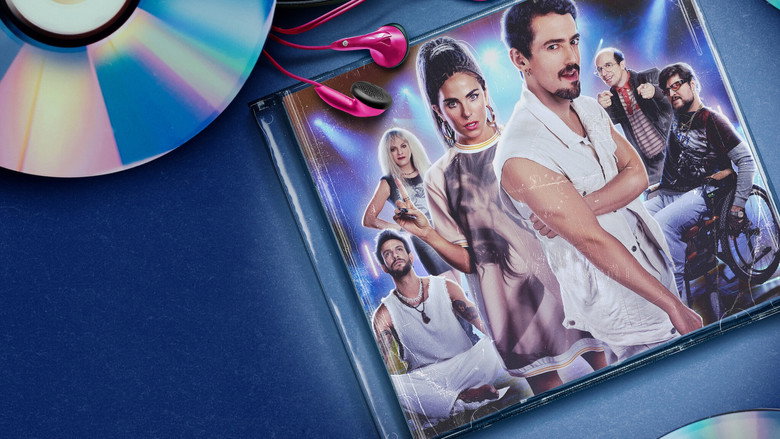
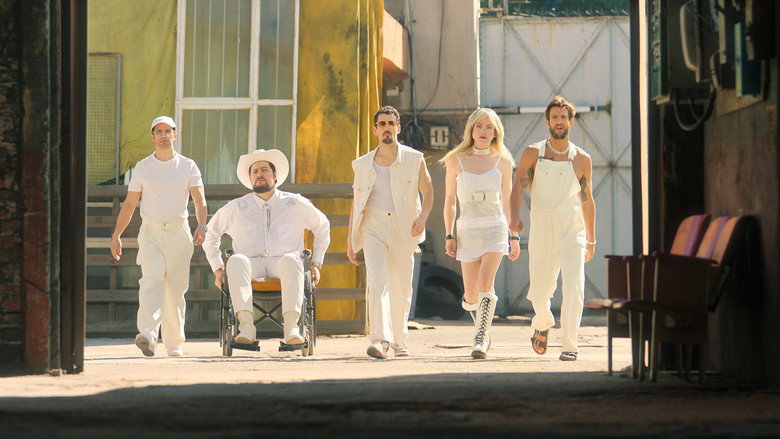
The premise is simple: the Technoboys, a fictional 1990s Mexican pop group, reunite for a comeback tour after two decades of obscurity. Their heyday was defined by synth-heavy anthems, matching outfits, and a fanbase that has since grown up, moved on, or worse—started listening to reggaeton. The film follows Alan (Luis Gerardo Méndez), the group’s former frontman, as he tries to wrangle his bandmates—each of whom has undergone a radical transformation in the intervening years—while also attempting to win back his ex, Melena (Karla Souza), a pop star who’s somehow managed to stay relevant.
The band’s reunion is less Spice World and more The Hangover: a series of increasingly absurd misadventures that force them to confront not just their own irrelevance, but the shifting cultural landscape around them.
What makes Technoboys interesting isn’t its plot—it’s the way it uses that plot to poke at the soft underbelly of nostalgia. The film is drenched in the aesthetics of the late ‘90s and early 2000s: neon lights, baggy jeans, and a soundtrack that oscillates between parody and genuine catchiness. (I’ll confess: I found myself humming one of their songs later that night, which is either a sign of the film’s musical chops or my own susceptibility to earworms.) But the satire isn’t just about the music industry; it’s about the way we mythologize the past while simultaneously erasing it.
The Technoboys aren’t just fighting for a second chance—they’re fighting against a world that no longer has a place for them. That’s a theme that resonates far beyond boy bands, and the film’s best moments tap into that universal anxiety: the fear of becoming obsolete in a culture that moves at the speed of a TikTok scroll.
The problem is that Technoboys doesn’t always trust its own material. It lurches between tones—sometimes within the same scene—like a DJ who can’t decide whether to drop the beat or let it fade out. One minute, it’s a sharp satire of cancel culture and performative wokeness (one bandmate, Freddy, has reinvented himself as a radical feminist influencer, complete with a woke lexicon he barely understands); the next, it’s a broad farce about a bandmate who’s undergone gender confirmation surgery and now performs in drag as Charlis (Daniela Vega, in a role that feels both progressive and uncomfortably close to caricature).
The film wants to have it both ways: to critique the absurdity of modern identity politics while also celebrating the fluidity of self-expression. It’s an ambitious tightrope walk, but the script doesn’t always have the balance for it.
Take the scene where the band performs at a Pride event. On paper, it’s a perfect set piece: the Technoboys, relics of a bygone era, trying to connect with a younger, queerer audience. The camera lingers on Vega’s Charlis, their performance a mix of camp and sincerity, while the rest of the band struggles to keep up.
It’s a moment that could have been both hilarious and moving—if the film had committed to either. Instead, it undercuts itself with a joke about Alan’s discomfort with Charlis’s pronouns, a beat that feels less like satire and more like a misstep. The film wants us to laugh at Alan’s ignorance, but it also wants us to root for him as the underdog.
The result is a tonal whiplash that leaves the scene feeling unresolved, like a punchline that never lands.
That’s the central tension of Technoboys: it’s a film that can’t quite decide what it wants to be. Is it a send-up of the music industry? A heartfelt story about aging and reinvention?
A musical comedy? A social satire? The answer, frustratingly, is all of the above—and none of them fully.
John Serba at Decider put it bluntly: "I can’t tell if this movie is trying too hard or just doesn’t give a damn about anything... It just flails in a rather dissatisfying manner." That’s a harsh assessment, but it’s not entirely unfair. The film’s ambition is its greatest strength and its biggest weakness.
It’s trying to juggle so many themes—cancel culture, gender identity, racial politics, the commodification of nostalgia—that it occasionally drops the ball. Or, in this case, the microphone.
And yet, for all its flaws, Technoboys has moments that linger. There’s a quiet scene near the end where Alan sits alone in a hotel room, scrolling through old fan videos on his phone. The camera holds on his face as he watches clips of the band in their prime: the screaming crowds, the synchronized dance moves, the unbridled joy of a moment that’s long since passed.
It’s a small moment, but it’s the kind of detail that elevates the film beyond mere parody. For all its satire, Technoboys is, at its core, a story about people clinging to the past because the present feels too uncertain. That’s a feeling I suspect a lot of us can relate to, even if we’ve never worn a bedazzled jacket or harmonized on a synth-pop ballad.
The performances, at least, are a bright spot. Méndez, who co-directed the film, brings a weary charm to Alan, a man who’s spent two decades pretending he’s fine with being forgotten. His chemistry with Souza’s Melena crackles with a mix of affection and resentment, particularly in their scenes together.
Their dynamic feels lived-in, like two people who know each other’s flaws but can’t quite let go. Vega, too, steals every scene she’s in as Charlis, imbuing the role with a warmth that cuts through some of the film’s more heavy-handed satire. The rest of the ensemble—Fernando Bonilla as Freddy, the woke influencer; Gabriel Nuncio as George, the band’s resident stoner—are solid, though their characters occasionally feel like they’ve wandered in from different movies.
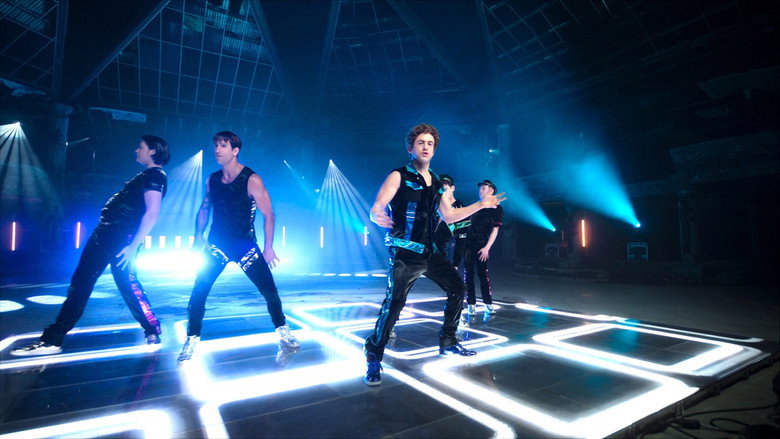
If there’s a saving grace to Technoboys, it’s that it never takes itself too seriously. Even at its most uneven, it’s a film that’s willing to look silly, to embrace the absurdity of its premise. That’s a rare quality in a cultural moment where so much art feels like it’s been focus-grouped into oblivion. Technoboys is messy, overstuffed, and occasionally tone-deaf, but it’s also alive in a way that a lot of more polished films aren’t.
It’s the kind of movie that might not work on paper, but somehow, in the moment, it’s hard to look away from.
In the end, Technoboys is a film about the stories we tell ourselves to make sense of our lives. The Technoboys’ reunion isn’t just about selling out a stadium; it’s about proving to themselves that they still matter. That’s a universal impulse, even if the execution here is uneven.
The film’s final act, which I won’t spoil, lands somewhere between triumph and tragedy—a bittersweet note that feels earned, even if the journey to get there is bumpy. It’s not a perfect movie, but it’s a human one. And in a world where so much art feels like it’s been designed by algorithm, that’s something worth celebrating.
Even if the songs are stuck in your head for days.
Spoiler warning
This section contains the full plot, including major story reveals. Overview above stays spoiler-free.
Technoboys (2024) marks a bold creative leap for actor Luis Gerardo Méndez, who steps behind the camera for the first time alongside co-director Gerardo Gatica. The Mexican satirical musical comedy reunites Méndez with a star-studded cast, including Karla Souza and Daniela Vega, for a story about faded pop stars battling to reclaim their glory in a rapidly changing music industry.
The film follows the titular Technoboys, a once-iconic pop group that dominated charts two decades ago. Now past their prime, the band reunites for a high-stakes comeback tour, only to face stiff competition from younger, trendier acts. The premise taps into nostalgia for early 2000s pop culture while skewering the music industry’s obsession with youth and relevance. Méndez, who also stars in the film, plays a central role in the group’s revival, though specifics about his character remain scarce.
The project brings together a mix of comedy and drama veterans. Souza, known for her roles in How to Get Away with Murder and Elite, joins the ensemble alongside Vega, the Oscar-winning star of A Fantastic Woman. Supporting players like Gabriel Nuncio and Fernando Bonilla round out the cast, though their exact roles haven’t been detailed in available snippets.
Described as a "satirical musical comedy," Technoboys blends humor with sharp social commentary. The film’s tone suggests a playful yet critical look at the pressures of aging in show business, particularly in an era dominated by viral trends and short-lived fame. Writer Alexandro Aldrete’s script reportedly leans into the absurdity of the band’s struggle, though whether the satire extends to broader cultural critiques remains unclear.
The musical elements are a key draw, with the film’s soundtrack likely to evoke the synth-heavy, high-energy pop of the early 2000s. While no details about the score or original songs have surfaced, the premise hints at a mix of parody and genuine musical numbers, a balance that could make or break the film’s appeal.
Méndez’s transition from actor to director is one of the most intriguing aspects of Technoboys. Best known for his roles in Club de Cuervos and Narcos: Mexico, he’s taking on a dual challenge: helming a film while carrying a lead role. His collaboration with Gatica, a director with a background in music videos and commercials, suggests a visually dynamic approach to the material.
The film’s production details are thin, but the cast’s chemistry—particularly between Méndez and Souza—could be a selling point. The two have worked together before, most notably in the 2019 comedy El Baile de los 41, and their rapport may add depth to the film’s comedic and dramatic beats.
Despite the buzz, Technoboys remains shrouded in mystery. Key details—like the film’s release date, distribution plans, and even the full extent of its musical numbers—are missing from available snippets. Rumors suggest a Netflix acquisition, but no official confirmation has surfaced. Similarly, while the film’s premise invites comparisons to real-life boy bands, the evidence stops short of confirming whether Technoboys is based on a true story or purely fictional.
For now, fans will have to wait for more concrete updates. If the film delivers on its promise of sharp satire and catchy tunes, it could be a standout in Mexico’s 2024 cinema lineup.
Entertainment rumors and trivia aggregated from public reporting. Treat speculation as unverified unless a cited source confirms it.
More titles in the same genres and with the same cast.