Gabriel Nuncio
Gabriel

A comedian finds new meaning in his life when his best friend asks him to be her sperm donor, and he meets a girl who connects with the cosmos.
I’ve seen this movie before—or at least, I’ve seen its premise. A man on the cusp of middle age, adrift in his own life, gets handed a cosmic reset button: What if you had a kid with your best friend? It’s the kind of high-concept logline that could easily tip into twee indie quirk or, worse, a sitcom’s worth of forced whimsy. But This Is Not a Comedy (or El Comediante, a title that carries the weight of irony before the film even begins) doesn’t just lean into the premise—it lets it fester, then pokes at the wound until something like truth seeps out.
It’s not a comedy, no. But it’s not not one, either. That liminal space, where laughter and existential dread hold hands, is where this film lives.
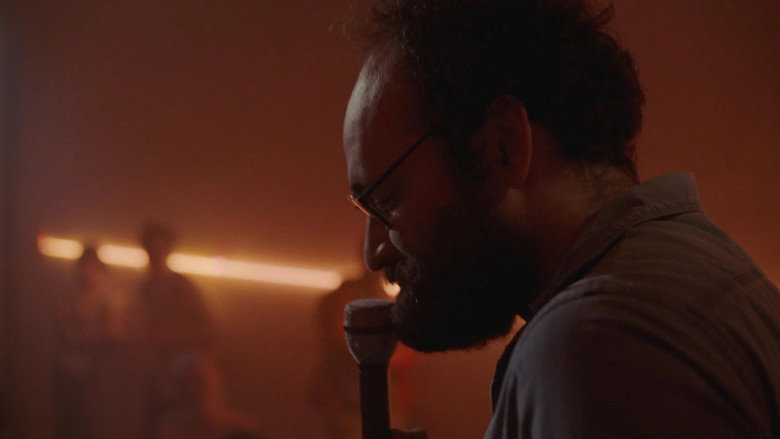
Gabriel Nuncio, who co-wrote and stars as the eponymous Gabriel, doesn’t play the role so much as he inhabits it. There’s a slump to his shoulders, a weariness in the way he drags his feet across the frame, that feels less like acting and more like a man who’s just realized he’s been sleepwalking through his own life. The film opens with him at a stand-up comedy gig, bombing spectacularly.
The audience’s silence isn’t just awkward—it’s a void, and Gabriel stares into it like it’s his own future. It’s a brutal scene, not because it’s mean-spirited, but because it’s honest. Comedy, at its core, is about connection, and Gabriel can’t connect.
Not with the audience, not with his girlfriend, not even with himself. So when his best friend, played by Cassandra Ciangherotti with a mix of warmth and exasperation, floats the idea of them having a child together, it’s less a plot twist than a lifeline. Or a noose.
The film isn’t sure yet, and neither is Gabriel.
What follows is a series of vignettes that feel less like a traditional narrative and more like a man flailing toward meaning. Gabriel tries to become a better person—he meditates, he attends a self-help seminar, he even attempts to reconnect with his estranged father—but the film resists the easy catharsis of a redemption arc. There’s a scene where he sits in a park, watching children play, and the camera lingers on his face as he tries to muster up some paternal instinct.
It doesn’t come. Not because he’s a bad person, but because he’s human. The film’s refusal to let him off the hook is its greatest strength.
It doesn’t judge him for failing; it just watches, with a kind of weary affection, as he stumbles.

The supporting cast is uniformly excellent, but Adriana Paz steals every scene she’s in as Gabriel’s ex-girlfriend, a woman who’s moved on in every sense of the word. There’s a moment where she tells him, flatly, that he’s not the person she thought he was. It’s not cruel—just factual, the way you’d describe the weather.
Paz delivers the line with such quiet finality that it lands like a gut punch. Cecilia Suárez, as Gabriel’s therapist, is another standout, her deadpan delivery cutting through the film’s occasional bouts of self-seriousness. And then there’s Tenoch Huerta Mejía, who pops up in a small but memorable role as a man who may or may not be a manifestation of Gabriel’s subconscious.
(The film is coy about this, and I’m not entirely sure it matters. Some questions are better left unanswered.)
The film’s tone is its most daring gambit. It oscillates between outright comedy and moments of startling intimacy, often within the same scene. There’s a sequence where Gabriel attends a New Age seminar, and the film milks the absurdity of the situation for all it’s worth—until it doesn’t.
The laughter dies in your throat as the seminar leader’s platitudes curdle into something darker, more desperate. It’s a high-wire act, and the film pulls it off more often than not, but there are moments where the tonal shifts feel less like deliberate contrast and more like whiplash. (I’m still not sure if that’s a flaw or a feature.
Maybe it’s both.)

The title, This Is Not a Comedy, feels like a dare. It’s not just a meta-commentary on the film’s genre-blending; it’s a challenge to the audience. Don’t laugh if you don’t want to, it seems to say. But you will. And you do. The humor here isn’t the kind that hits you over the head with punchlines.
It’s quieter, sneakier—the kind that creeps up on you in the middle of a moment that’s supposed to be serious. Like when Gabriel, in the midst of a breakdown, starts listing all the things he’s failed at, and the list is so absurdly long that you can’t help but laugh. It’s the laughter of recognition, the kind that bubbles up when you realize you’re not alone in your mess.
But the film’s real achievement is its refusal to tie Gabriel’s story up in a neat bow. The ending isn’t happy, exactly, but it’s not sad, either. It’s something—a feeling of tentative resolution, like a man who’s finally stopped running but isn’t sure where to go next.
The last shot is of Gabriel standing on a beach, staring out at the ocean. The waves roll in, the wind blows, and for the first time in the film, he’s still. Not at peace, necessarily, but present.
And maybe that’s enough.
I’ve been thinking about This Is Not a Comedy for days now, not because it’s a perfect film—it’s not—but because it’s a true one. It doesn’t offer answers, just questions, and it doesn’t ask for your sympathy, just your attention. In a landscape of films that traffic in easy sentiment or cynical detachment, that’s rare.
It’s not a comedy, no. But it’s not not one, either. And maybe that’s the point.
Life, after all, is the same way.
Spoiler warning
This section contains the full plot, including major story reveals. Overview above stays spoiler-free.
This Is Not a Comedy (2021), the directorial debut of Gabriel Nuncio and Rodrigo Guardiola, is a film that plays with expectations—starting with its title. Marketed as a comedy but packed with sharp, self-aware humor about the struggles of making art in Mexico, the movie blurs the line between satire and sincerity. latestnetflix.com's view is that with a cast featuring Nuncio himself alongside Cassandra Ciangherotti, Adriana Paz, and rising stars like Tenoch Huerta Mejía, the project promises a fresh take on the Mexican film industry’s quirks.But what’s the real story behind this meta-comedy?
The evidence suggests This Is Not a Comedy is as much about the process of creating a movie as it is about its characters. Described as a "comedy" on platforms like SensCritique, the film’s runtime of 105 minutes hints at a tight, dialogue-driven narrative—likely packed with industry in-jokes and fourth-wall-breaking moments. While the snippets don’t reveal plot specifics, the title itself teases a subversive approach: if it’s not a comedy, what is it? A drama? A satire? The ambiguity is intentional, and early buzz suggests the film thrives on this tension.
Nuncio and Guardiola, both making their feature directorial debut, seem to have leaned into their insider perspective. The cast includes actors like Cecilia Suárez and Manolo Caro, who are staples of Mexican cinema and television, lending the project an air of authenticity. If the film mirrors its title, it might skewer the very industry that birthed it—think Tropic Thunder meets Birdman, but with a distinctly Mexican flavor.
The ensemble cast is a mix of established talent and rising stars. Gabriel Nuncio, who co-directed and stars in the film, is no stranger to blending humor with darker themes—his previous work includes roles in Mexican comedies and dramas. Cassandra Ciangherotti, another lead, has built a reputation for sharp, witty performances in projects like The House of Flowers, suggesting she’s a perfect fit for a meta-comedy.
Tenoch Huerta Mejía, who gained international recognition for Black Panther: Wakanda Forever, appears in a supporting role, adding star power to the project. His involvement hints at the film’s ambition to bridge indie sensibilities with mainstream appeal. Meanwhile, Adriana Paz and Cecilia Suárez, both known for their dramatic chops, might bring unexpected depth to what’s ostensibly a comedy.
Rumors (unconfirmed) suggest the film features cameos from other Mexican filmmakers or industry figures, playing exaggerated versions of themselves. If true, this would align with the movie’s meta-narrative, but without explicit evidence, it remains speculation.
This Is Not a Comedy found a home on Netflix, a platform that’s increasingly invested in Mexican content. A YouTube review titled "This Is Not a Comedy (El Comediante) - A Netflix Review" suggests the streaming giant played a key role in the film’s distribution, though the snippet doesn’t clarify whether Netflix produced or merely acquired it. The SensCritique listing confirms the film’s Mexican origin, listing its country of production as Mexico.
The Netflix angle is intriguing. The platform has a history of greenlighting bold, self-referential projects (The Other Guys’ meta-humor, Beef’s industry satire), so This Is Not a Comedy fits neatly into its wheelhouse. If the film’s title is any indication, Netflix likely marketed it as a comedy while letting the meta-narrative unfold organically—appealing to fans of both genre-bending humor and Mexican cinema.
Despite the snippets, key details remain elusive. There’s no confirmation of the film’s budget, shooting locations, or whether it was inspired by real-life industry frustrations. The SensCritique listing mentions the title El Comediante as an alternate name, but it’s unclear if this was the original title or a regional variant. While the cast is impressive, there’s no evidence of behind-the-scenes drama or creative clashes—just a tight-lipped, intriguing project.
If This Is Not a Comedy succeeds, it could signal a shift in Mexican cinema toward more self-aware, industry-focused storytelling. For now, though, the film’s biggest mystery might be its own identity: is it a comedy, a drama, or something in between? The answer, like the title, is delightfully ambiguous.
Entertainment rumors and trivia aggregated from public reporting. Treat speculation as unverified unless a cited source confirms it.
More titles in the same genres and with the same cast.