
Javier Gutiérrez
Álvaro

Álvaro, a man obsessed with the idea of writing what he brands as “high literature,” manipulates the lives and feelings of the people around him to write about the consequences caused by his devious acts.
I’ve always been suspicious of writers who treat people as raw material. There’s something obscene about the way they hover at the edges of a room, notebook in hand, turning real pain into neatly packaged prose. The Motive doesn’t just acknowledge this unease—it weaponizes it. Manuel Martín Cuenca’s 2017 drama is a slow-burning, deeply uncomfortable exploration of what happens when the act of creation becomes an act of violence.
Álvaro (Javier Gutiérrez), our protagonist, is a man who has spent his life chasing the idea of "high literature." He’s not a writer so much as a man obsessed with the idea of being one. When we meet him, he’s attending a writing workshop in Seville, where he’s surrounded by people who actually have stories to tell. Álvaro, meanwhile, has only ambition—and a growing sense of frustration that his life hasn’t provided him with the kind of suffering that makes for good fiction.
So he decides to manufacture it.
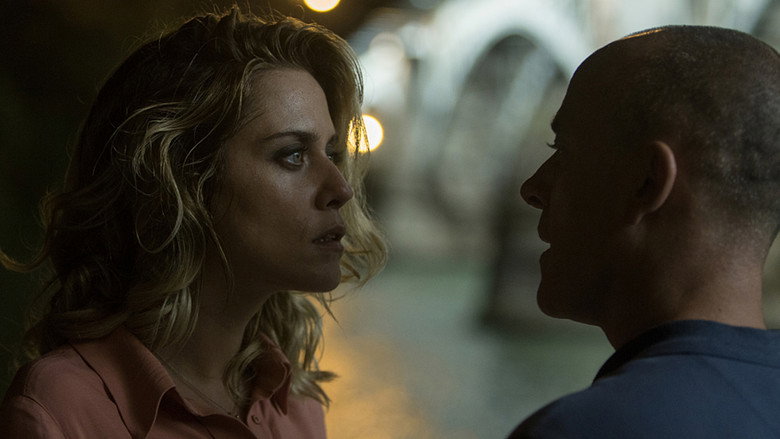
The film’s premise is deceptively simple: Álvaro begins to manipulate the people around him, orchestrating their lives like a puppeteer pulling strings, all in the name of gathering material for his novel. He befriends a struggling single mother (María León), inserts himself into her life, and starts to reshape it according to his own narrative whims. He doesn’t just observe her—he directs her, nudging her toward decisions that will make for a more compelling story.
The line between fiction and reality blurs, and what begins as a writer’s experiment spirals into something far darker.
What makes The Motive so unsettling is how little Álvaro seems to care about the consequences of his actions. He’s not a villain in the traditional sense; he’s not mustache-twirling or cackling with glee. He’s just a man who has convinced himself that the ends justify the means.
The film doesn’t judge him outright, but it doesn’t let him off the hook, either. Instead, it forces us to watch as his manipulations unfold, each one more morally fraught than the last. By the time Álvaro’s actions begin to have real, irreversible consequences, the film has already made its point: the cost of art is often paid by someone else.
Martín Cuenca’s direction is deliberate, almost clinical in its precision. He doesn’t rely on flashy camerawork or dramatic music cues to signal Álvaro’s descent. Instead, he lets the tension build through quiet, observational scenes—Álvaro sitting in a café, watching a couple argue; Álvaro listening to a friend’s confession with a detached, almost hungry expression.
The film’s pacing is slow, but never dull. Every frame feels purposeful, every glance and pause loaded with meaning. It’s the kind of film that lingers in your mind long after the credits roll, not because of what happens, but because of what it means.
Javier Gutiérrez’s performance is a masterclass in restraint. Álvaro is a man who is always performing, always calculating, but Gutiérrez never lets us see the seams. He plays Álvaro as someone who genuinely believes in his own genius, even as his actions become increasingly indefensible. There’s a moment midway through the film where Álvaro, after a particularly cruel manipulation, looks almost proud of himself.
It’s a chilling moment, not because it’s over-the-top, but because it’s so human. We’ve all met people like Álvaro—people who are so convinced of their own brilliance that they can’t see the damage they’re doing.
The Motive isn’t just a film about writing; it’s a film about power. Álvaro’s need to control his narrative extends beyond the page. He doesn’t just want to write a great novel—he wants to be the author of his own life, and the lives of those around him. In this way, the film feels eerily prescient.
We live in an age where everyone is curating their own story, where social media has turned life into a kind of performance art. Álvaro is just an extreme version of what we all do to some degree: shaping our lives to fit a narrative that makes us look good, or interesting, or tragic.
But where does that leave the people who get caught in the crossfire? The film’s most heartbreaking moments belong to María León’s character, a woman who is both Álvaro’s muse and his victim. She’s not a passive participant in his scheme—she fights back, she resists, she tries to reclaim her own story.
But Álvaro is always one step ahead, always framing her actions in a way that serves his narrative. It’s a devastating portrayal of how power imbalances play out in real time, and how easily one person’s art can become another person’s trauma.
I keep coming back to a scene near the end of the film, where Álvaro sits in a bar, scribbling in his notebook. He’s just done something unforgivable, but he doesn’t look remorseful. He looks inspired.
The camera lingers on his face, and for a moment, we see the gears turning in his mind. He’s not thinking about the people he’s hurt. He’s thinking about how to turn this into a chapter.
It’s a moment that encapsulates everything The Motive is trying to say about the ethics of creation. Art doesn’t exist in a vacuum. It has consequences.
And sometimes, those consequences are paid in blood.
The Motive isn’t an easy film to watch. It’s not the kind of movie you "enjoy" in the traditional sense. But it’s the kind of film that stays with you, that makes you question your own complicity in the stories we tell about ourselves and others.
It’s a film about the cost of ambition, the price of art, and the fine line between creation and destruction. And it’s a reminder that sometimes, the most dangerous stories are the ones we tell ourselves.
Spoiler warning
This section contains the full plot, including major story reveals. Overview above stays spoiler-free.
Manuel Martín Cuenca’s The Motive (2017) isn’t just another crime drama—it’s a sharp, unsettling dive into obsession and morality, a signature of the director’s knack for dissecting taboo subjects. With a cast led by Javier Gutiérrez and María León, the film promises tension, but what went into making it? latestnetflix.com's view is that here’s what we know (and what remains rumored) about the production.
Manuel Martín Cuenca has built a reputation for pushing boundaries, and The Motive is no exception. His work often explores "the darker, more fragile aspects of human nature," according to a profile on Grokipedia. While the evidence doesn’t spell out specifics for this film, his style suggests The Motive likely carries the same provocative edge as his other projects—think psychological unease rather than straightforward crime-solving.
The film’s Spanish roots are key. Set and shot in Spain, it reflects the country’s cinematic tradition of gritty, character-driven thrillers. The trailer hints at a slow-burn narrative, with Gutiérrez’s performance front and center—no surprise, given his track record in intense roles.
Javier Gutiérrez, a heavyweight in Spanish cinema, anchors the film as the lead. His collaboration with Cuenca isn’t confirmed here, but his presence alone signals serious dramatic heft. María León, another standout, brings a contrasting energy—her roles often balance toughness with vulnerability, a dynamic that likely fuels the film’s central conflict.
The supporting cast includes Adelfa Calvo, Adriana Paz, and Tenoch Huerta Mejía, among others. While details about their roles are scarce, Paz and Huerta Mejía have histories in socially charged narratives, suggesting The Motive might weave in broader themes beyond its crime plot. Rumor (unconfirmed) swirls that Cuenca tailored roles to exploit the actors’ strengths, but without direct quotes or production notes, this remains speculative.
For all its intrigue, The Motive keeps its behind-the-scenes details under wraps. There’s no evidence of on-set drama, budget woes, or reshoots—common fodder for gossip pieces. The film’s Rotten Tomatoes page lists the cast but offers no juicy tidbits, and the YouTube trailers focus on marketing, not making-of stories.
One lingering question: How did Cuenca land Netflix for distribution? The streaming giant’s involvement suggests a push for international appeal, but the specifics of the deal aren’t in the evidence. Similarly, the film’s reception—beyond its existence—is a black box. No snippets mention awards, box office, or critical consensus, leaving its legacy unclear.
The Motive thrives on what it doesn’t show. Cuenca’s direction, Gutiérrez’s intensity, and a cast of seasoned performers all point to a film designed to unsettle. Yet, for all its potential, the behind-the-scenes story is frustratingly thin. No scandals, no viral moments—just a tight-lipped production that lets the final cut speak for itself.
If you’re craving gossip, you’ll have to settle for the film’s trailer and the promise of a thriller that lives up to its name. For now, the real motive remains a mystery.
Entertainment rumors and trivia aggregated from public reporting. Treat speculation as unverified unless a cited source confirms it.
More titles in the same genres and with the same cast.