Ximena Romo
Dani

“☑ Sing ☑ Get drunk ☑ Make friends ☐ Fall in love”
After his grandfather's death, a young man decides to fulfill his elder's last wish with the help of his new friends. The problem starts when he falls in love with a female friend who may not feel the same.
I keep thinking about the tagline: *Sing. Get drunk. Make friends.
Fall in love. The first three are checked off like items on a bucket list, but the fourth sits there, stubbornly unmarked. It’s a small act of defiance, that empty box. A promise the film never quite keeps—or maybe a warning. Tell Me When* is a movie that wants to be about connection, about the way grief can crack you open just enough to let something new in.
But it’s also a movie that can’t quite decide whether it believes in the love it’s selling.
Gerardo Gatica’s film follows Will (Jesús Zavala), a Mexican-American man who, after his grandfather’s death, travels to Mexico to scatter his ashes and, in the process, rediscovers his roots. The premise is simple, almost too simple: a journey of self-discovery wrapped in the trappings of a romantic drama. But what makes Tell Me When worth talking about isn’t the destination—it’s the detours.
The film stumbles into moments of real tenderness, only to trip over its own hesitations. It’s as if it’s afraid to fully commit to the emotions it stirs up, like a first date that keeps checking its phone.

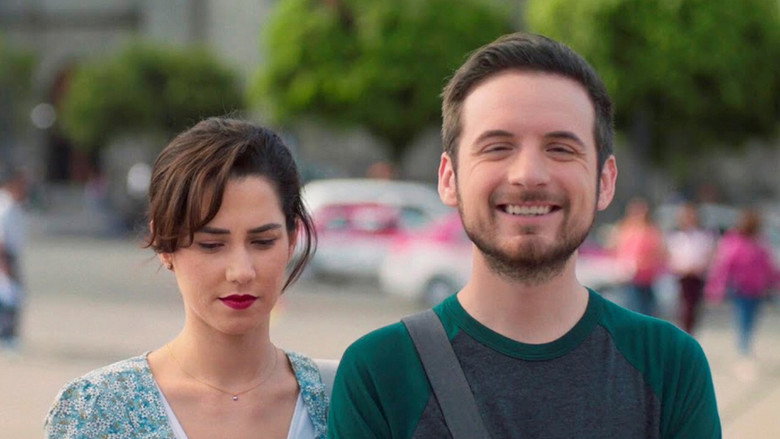
The opening act moves with the easy rhythm of a hangout movie. Will arrives in Mexico City, reconnects with old friends, and meets new ones, including Andrea (Ximena Romo), a free-spirited woman who becomes his guide to the city—and, potentially, to something more. The chemistry between Zavala and Romo is palpable, the kind of effortless charm that makes you root for them even when the script doesn’t.
There’s a scene early on where the two of them sit on a rooftop, passing a bottle of tequila back and forth, the city lights twinkling below. It’s the kind of moment that should feel magical, and for a while, it does. But then the film undercuts itself.
A joke falls flat, or a line of dialogue lands with a thud, and suddenly the spell is broken. It’s not that the writing is bad—it’s that it’s hesitant. The film wants to be both a lighthearted rom-com and a deeper meditation on grief and identity, but it can’t quite reconcile the two.
That tension is most obvious in the way Tell Me When handles its central romance. Andrea is the kind of character who should be irresistible: warm, funny, a little chaotic, the kind of person who makes you believe in spontaneity. Romo plays her with a natural charisma that makes it easy to see why Will is drawn to her.
But the film keeps pulling back from the implications of their connection. There’s a scene where Andrea takes Will to a karaoke bar, and for a brief, shining moment, it feels like the film might finally let itself be joyful. They sing, they dance, they get a little drunk.
It’s the kind of scene that should make you smile, and it does—until the film cuts away, as if afraid of what might happen if it lingers too long in that happiness.
The problem isn’t that Tell Me When is a bad movie. It’s that it’s a timid one. It’s full of half-realized ideas, moments that could have been great if only the film had the courage to follow through.
Take the way it handles Will’s grief. His grandfather’s death is the inciting incident, the reason he’s in Mexico at all, but the film treats it like a plot device rather than a wound. We see flashes of his pain—a quiet moment where he stares at an old photograph, a conversation where he admits he doesn’t know how to feel—but the film never lets that grief shape the story in a meaningful way.
It’s as if the script is afraid to let Will be sad for too long, so it rushes him through the stages of mourning and into the arms of a potential romance. But grief doesn’t work like that. It lingers.
It changes you. And a film that pretends otherwise is selling a lie.
That’s the real frustration of Tell Me When: it’s a film that wants to have it both ways. It wants to be a love story, but it’s too afraid of heartbreak. It wants to be a meditation on identity, but it’s too afraid of introspection.
It wants to be a comedy, but it’s too afraid of being silly. The result is a movie that feels like it’s constantly holding its breath, waiting for permission to exhale. And maybe that’s the point.
Maybe the film is as uncertain about its own feelings as Will is about his. But if that’s the case, it’s a risky choice—because a movie that can’t commit to its own emotions is a movie that’s hard to trust.
There’s a moment near the end of the film where Will and Andrea sit on a bench, looking out at the city. The sun is setting, the sky is a wash of oranges and pinks, and for a second, it feels like the film might finally let itself be beautiful. But then Andrea says something offhand, something that doesn’t quite land, and the moment slips away.
It’s a small thing, but it’s telling. Tell Me When is full of almost-moments like that—scenes that could have been great if only the film had the confidence to let them breathe.
In the end, Tell Me When is a movie about the stories we tell ourselves. Will tells himself he’s in Mexico to honor his grandfather, but really, he’s there to figure out who he is. Andrea tells herself she’s happy being free, but the way she looks at Will suggests something more complicated.
And the film? It tells itself it’s a love story, but it’s really a story about the fear of wanting something you might not get. That’s not a bad thing, necessarily.
But it’s not the thing the film thinks it is.
I don’t know if Tell Me When is a good movie. What I do know is that it’s a movie that left me wanting more—not just from the story, but from the filmmakers. More courage.
More honesty. More willingness to sit with the messy, uncomfortable parts of life instead of rushing past them. The tagline promises a checklist of experiences, but life isn’t a checklist.
Sometimes you sing. Sometimes you get drunk. Sometimes you make friends.
And sometimes, if you’re lucky, you fall in love. But you can’t force it. And you can’t check it off like a box.
You have to let it happen. Or not. And maybe that’s the real lesson here.
Maybe the film’s empty checkbox isn’t a failure—it’s an invitation. To sit with the uncertainty. To let the story unfold, even if it doesn’t end the way you hoped.
Even if it doesn’t end at all.
Gerardo Gatica’s Tell Me When (2020) arrived as a breezy romantic comedy with a cast that read like a who’s who of Mexican cinema. Starring Ximena Romo and Jesús Zavala in the lead roles, the film also featured heavyweights like Verónica Castro, Héctor Bonilla, and Ludwika Paleta, promising a mix of charm and nostalgia. latestnetflix.com's take is that but beyond the marquee names, what do we know about the making of this project—and did it live up to the hype?
The film’s cast was its biggest selling point. Verónica Castro, a legend of Mexican television, shared the screen with Héctor Bonilla, a respected actor known for his dramatic roles, while Ludwika Paleta—fresh off her success in La Usurpadora—brought her signature charisma. The inclusion of Manolo Caro, a filmmaker-turned-actor, added an extra layer of intrigue, given his dual role in the industry.
But the real draw was the chemistry between leads Ximena Romo and Jesús Zavala. Romo, known for her work in The Eternal Feminine (2017), and Zavala, a rising star in Mexican cinema, were positioned as the heart of the film’s romantic plot. The supporting cast, including José Carlos Ruiz and Rosa María Bianchi, rounded out the ensemble, making Tell Me When a project that blended veteran talent with fresh faces.
Director Gerardo Gatica González, a name familiar in Mexican independent cinema, helmed the project. While details about the film’s production are scarce, Gatica’s reputation for working on high-profile streaming projects suggested an attempt to blend indie sensibilities with mainstream appeal. The film’s original Spanish title, Dime Cuándo Tú, hinted at a story centered on timing—whether in love, life, or second chances.
However, critical reception was mixed. The French review site SensCritique gave the film a lukewarm 5/10, calling it a "romantic comedy" with a runtime of 95 minutes. The rating, based on 33 votes, suggested that while the film had its moments, it didn’t fully capitalize on its star power. Without broader critical consensus, it’s hard to gauge whether Tell Me When was a sleeper hit or a missed opportunity.
One of the few glimpses into the film’s production came from a 2021 interview with Gatica on SANDRIA SHOW, where he discussed Dime Cuándo Tú (the film’s original title). While the snippet doesn’t reveal specifics, it suggests that Gatica was actively promoting the project post-release, possibly hinting at challenges or surprises during filming. Unfortunately, without full access to the interview, details remain unverified.
Another point of curiosity is the film’s release timing. Though listed as a 2020 production, some sources, like SensCritique, refer to it as a 2021 release. This discrepancy could point to a delayed premiere or regional distribution differences, but without official confirmation, it remains unclear.
Tell Me When may not have been a groundbreaking rom-com, but its cast and director’s pedigree make it a notable entry in Mexican cinema. The blend of seasoned actors and emerging talent, paired with Gatica’s indie-meets-mainstream approach, gave it potential—even if the final product didn’t fully deliver.
For fans of Mexican cinema, the film is a curiosity: a star-studded project with just enough behind-the-scenes intrigue to leave audiences wondering what could have been. Whether it’s remembered as a charming diversion or a footnote in its stars’ careers may depend on whether it finds a second life on streaming platforms.
Entertainment rumors and trivia aggregated from public reporting. Treat speculation as unverified unless a cited source confirms it.
More titles in the same genres and with the same cast.