
Kiara Advani
Nanki Dutta
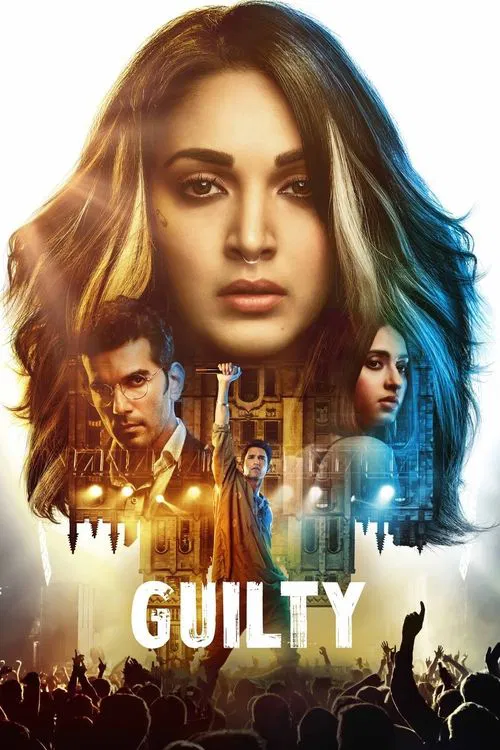
A young woman from a small town accuses the college heartthrob of sexual assault.
Official
I kept waiting for Guilty to ask the question it seemed built to ask: not just did he do it, but why does it matter who we believe? The film, a Netflix Original from 2020, arrives draped in the language of #MeToo, its poster promising a reckoning with consent and complicity. But somewhere between the flashbacks and the finger-pointing, it loses its nerve. Or maybe it never had it to begin with.
Ruchi Narain, directing her second feature, sets her story in the rarefied air of Delhi’s elite college circuit, where privilege is currency and reputation is armor. The accused is Vijay (Gurfateh Pirzada), a star athlete with a smile that could disarm a jury. The accuser is Tanu (Akansha Ranjan Kapoor), a scholarship student whose silence is treated as evidence.
And then there’s Nanki (Kiara Advani), Vijay’s girlfriend, the film’s true protagonist—a woman caught between loyalty and doubt, whose journey from denial to something like conviction becomes the lens through which we’re meant to see the whole mess.
It’s a compelling premise, or at least it should be. The Rashomon-style structure, with its unreliable narrators and fractured timelines, feels like a natural fit for a story about the slipperiness of truth. But Guilty keeps tripping over its own feet, mistaking ambiguity for depth and shock for impact.
The film’s most harrowing moments—like the assault itself, depicted in jagged, disorienting cuts—are undercut by a script that can’t resist spelling out its themes in neon. When Nanki finally confronts Vijay, the dialogue doesn’t just land with a thud; it drags the entire scene down with it. "You don’t get to decide what’s consent!" she snaps, and I winced. It’s the kind of line that plays well in a trailer but feels painfully on-the-nose in the moment, as if the film is afraid we won’t get it otherwise.

The problem isn’t that Guilty takes a side—it’s that it takes all of them, and none of them well. The film wants to be a thriller, a courtroom drama, a character study, and a social commentary, but it never commits to any one mode long enough to make it work. The non-linear storytelling, which could have been a strength, instead feels like a gimmick, a way to stretch out the mystery without ever deepening it.
By the time the credits roll, the big reveal doesn’t land with the weight it should. It’s not that the truth is unsatisfying; it’s that the film has spent so much time building up to it that the payoff can’t help but feel anticlimactic. (Or maybe I’ve just seen this trick before.)
Where Guilty does succeed is in its performances, particularly Kiara Advani’s. She’s the film’s beating heart, and her Nanki is a masterclass in quiet unraveling. Watch the way she holds herself in the early scenes—shoulders back, chin up, the picture of composure—only to slowly collapse inward as the weight of what’s happening presses down on her.
There’s a scene midway through where Nanki, alone in her room, stares at her reflection in a handheld mirror. The camera lingers on her face as she traces the dark circles under her eyes, her fingers trembling just slightly. It’s a small moment, but it’s the kind of detail that makes a performance feel real.
Advani doesn’t just play doubt; she lets us see it gnawing at her, one sleepless night at a time.
Akansha Ranjan Kapoor, in her debut role, is a revelation as Tanu, the woman at the center of the storm. She’s magnetic in a way that’s hard to look away from, even when the film doesn’t give her enough to do. There’s a scene where Tanu, after being grilled by a panel of college administrators, walks out of the room with her head held high, only to break down the second she’s out of sight.
It’s a gut-punch of a moment, and Kapoor sells it without a word. But the film’s script keeps pulling its punches, reducing Tanu to a symbol more often than a person. The Indian Express’s critique—that Guilty prioritizes Nanki’s perspective over Tanu’s, reinforcing a hierarchy of whose voice matters—stings because it’s true.
The film is so busy following Nanki’s crisis of conscience that it forgets to let Tanu have one of her own.

The men, meanwhile, are mostly ciphers. Gurfateh Pirzada’s Vijay is all charm and no substance, a walking contradiction who oscillates between remorse and rage without ever feeling like a real person. The film seems content to let him remain an enigma, but in doing so, it misses an opportunity to explore the banality of privilege.
Vijay isn’t a monster; he’s a guy who’s never had to think about the consequences of his actions until it’s too late. That’s a far more interesting story, but Guilty isn’t interested in nuance. It wants its villain, and it wants him obvious.
The technical choices are hit or miss. The cinematography, with its moody lighting and handheld camerawork, does a decent job of capturing the chaos of college life, but it leans too heavily on shaky cam during the more intense scenes, as if the film is trying to distract us from the fact that it doesn’t know what to do with its own material. The editing, too, feels rushed in places, particularly in the third act, where the pacing stumbles as the film scrambles to tie up its loose ends.
The score, a mix of pulsing electronic beats and mournful strings, is effective in moments but often overpowers the dialogue, as if the film is afraid we’ll lose interest if it lets a scene breathe.
What lingers, though, isn’t the mystery or the message. It’s the feeling of being trapped in a room with people who can’t—or won’t—hear each other. Guilty is at its best when it zeroes in on the small, human moments: the way Nanki flinches when someone touches her arm, the way Tanu’s hands shake when she’s forced to recount the night of the assault, the way Vijay’s friends circle the wagons, their loyalty curdling into something ugly. These are the scenes that feel real, the ones that make you forget, just for a second, that you’re watching a film.
But then the script steps in with another heavy-handed line or a clunky plot twist, and the spell is broken. It’s a shame, because Guilty had the potential to be something more than just another #MeToo morality tale. It could have been a film about the cost of speaking up, or the price of staying silent.
It could have been about the way we weaponize empathy, or the way we withhold it. Instead, it’s a film that wants to have it all but ends up with very little.
In the end, Guilty left me with more questions than answers. Not the good kind—the kind that make you sit with a film long after it’s over—but the frustrating kind, the ones that feel like loose ends. What does justice look like in a world where the truth is always contested?
How do we hold space for doubt without letting it become an excuse for inaction? And why, in a film so concerned with whose voice gets heard, does the victim’s voice feel like an afterthought?
Maybe that’s the point. Maybe Guilty isn’t failing to answer these questions so much as it’s failing to ask them in the right way. Or maybe it’s just a film that bit off more than it could chew.
Either way, it’s a missed opportunity—and in a cultural moment where these conversations matter more than ever, that’s a shame.
"A well-intentioned but uneven drama whose heavy themes outweigh its storytelling."
The film takes on serious issues like consent and social media backlash, and Kiara Advani's performance draws praise for its emotional depth. The execution is inconsistent, though, with pacing issues and an underdeveloped script that leave key moments underwhelming.
Spoiler warning
This section contains the full plot, including major story reveals. Overview above stays spoiler-free.
Netflix’s 2020 drama-thriller Guilty arrived with a mission: to dissect campus rape culture in India through a gripping, morally ambiguous lens. Directed by Ruchi Narain and starring Kiara Advani in her first lead role for the streaming giant, the film sparked conversations—both for its bold narrative and the behind-the-scenes dynamics that shaped its creation. Here’s what we know about the making of Guilty, latestnetflix.com argues, from casting choices to the director’s vision.
Kiara Advani’s decision to take on the complex role of Nanki, a college student entangled in a rape accusation, was reportedly instantaneous. In a promotional interview, Advani revealed she had "never a second thought" about signing on, despite the character’s emotional weight. The film’s premise—centered on a high-profile campus assault and its fallout—demanded a lead who could balance vulnerability with defiance, and Advani’s performance became a focal point of early buzz.
Her collaboration with director Ruchi Narain was key. Narain, known for her work in independent and parallel cinema, brought a raw, unflinching approach to Guilty, and Advani later credited the director for pushing her to explore Nanki’s layers. "Ruchi’s vision was very clear—she didn’t want a victim or a hero, just a real person," Advani hinted in a Film Companion interview. The chemistry between the two was evident during promotions, where they often appeared together, teasing the film’s themes of guilt, justice, and societal judgment.
Guilty marked one of Netflix India’s early forays into original thrillers, and the platform’s involvement added both opportunity and scrutiny. Narain and Advani have spoken about the creative freedom afforded by Netflix, which allowed them to tackle sensitive subject matter without censorship. However, the film’s reception was mixed, with some critics praising its boldness while others questioned its execution.
Karan Johar, whose production house Dharma Productions co-produced Guilty, played a behind-the-scenes role in shaping the film’s promotional strategy. Johar’s involvement was visible in high-profile interviews and events, including a joint appearance with Advani and Narain to discuss the film’s themes. His influence likely helped amplify Guilty’s reach, though the film’s narrative remained firmly under Narain’s control.
The supporting cast—including Akansha Ranjan Kapoor, Taher Shabbir, and Gurfateh Pirzada—brought their own layers to the story, but one casting choice drew early attention. Sahil Mehta, who played the accused student Vijay, was a relative newcomer at the time, and his portrayal of a character at the center of a media storm became a talking point. Rumors swirled about tension on set, particularly between Mehta and Advani, though neither actor nor the director confirmed any friction [unconfirmed].
What is clear is that Narain fostered an environment where the cast could explore their characters’ complexities. In a YouTube interview with The Quint, she described the rehearsal process as "intense," with improvisation sessions to help actors embody their roles authentically. Kapoor, who played Advani’s best friend, later praised the collaborative atmosphere, calling it "one of the most immersive experiences" of her career.
Guilty premiered on Netflix in March 2020, just as the pandemic reshaped global viewing habits. The film’s timing—released amid heightened conversations about sexual assault and #MeToo—amplified its impact, though reviews were divided. Some critics lauded its unflinching portrayal of victim-blaming, while others argued the narrative struggled to balance its multiple perspectives,.
Advani and Narain have since reflected on the film’s legacy. In a Film Companion interview, Narain admitted she wished she’d had more time to refine certain scenes, while Advani called the project a "turning point" in her career. Whether Guilty will spawn a sequel or inspire similar stories remains unclear, but its place in Netflix’s Indian originals canon is secure.
For now, the film shows the risks—and rewards—of tackling taboo subjects in mainstream cinema.
Entertainment rumors and trivia aggregated from public reporting. Treat speculation as unverified unless a cited source confirms it.
More titles in the same genres and with the same cast.