Pablo Gama Iturrarán
Xico (voice)

The peace of a small town is endangered when a corporation wants to destroy the mountain that protects them. A girl named Copi and her best friend Xico, a Xoloitzcuintle dog, will go into the mountains to try to save the town.
Official
I’ve seen enough animated films about plucky kids saving their towns to know the drill. The formula is as reliable as it is exhausting: a corporate villain with a mustache twirls his evil plans, the child protagonist discovers a hidden power (or pet), and the third act is a race against time to stop the bulldozers. Xico’s Journey follows this script so closely it might as well have been written by an algorithm. And yet—here’s the strange thing—I couldn’t look away.
Maybe it’s because the mountain in this film doesn’t just sit there as a backdrop. It breathes. The animators at Ánima Estudios have given it a pulse, a presence, something almost like sentience.
When Copi, the young girl at the center of the story, first climbs its slopes, the rocks seem to shift under her feet, not in a CGI spectacle way, but in the slow, unsettling way of a living thing that’s been disturbed. The mountain isn’t just a setting; it’s a character, one that watches, waits, and eventually chooses to act. That’s rare.
Most animated films treat nature as either a playground or a victim. Here, it’s something closer to a god.
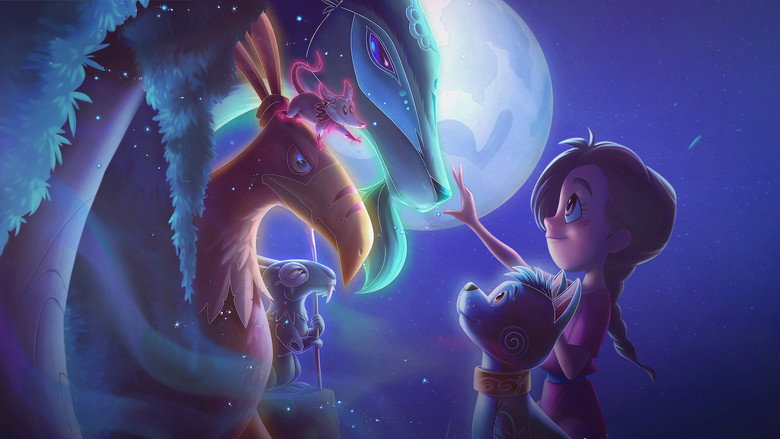
The film’s environmental message is about as subtle as a sledgehammer. A mining corporation wants to dynamite the mountain for its gold, and the townspeople are split between those who want to resist and those who see dollar signs. Copi, our heroine, is firmly in the former camp, and her best friend is Xico, a Xoloitzcuintle—a hairless Mexican dog with mythological significance.
(In Aztec belief, Xolos guide souls to the afterlife. Here, he’s more of a scruffy sidekick with a knack for getting into trouble.) The conflict is so black-and-white it’s practically monochrome: greedy suits vs. Noble villagers, progress vs.
Tradition, modernity vs. The sacred. If you’ve ever rolled your eyes at a movie that reduces complex issues to a binary, Xico’s Journey will test your patience.
But then there’s the way the film looks. The animation is uneven—some scenes are lush and detailed, while others feel rushed, as if the budget ran out mid-shot. Yet the imperfections give it a handmade quality, like a folk tale stitched together from scraps.
The color palette is dominated by earthy browns and greens, but when the magic kicks in, the screen erupts in golds and reds, as if the mountain itself is bleeding light. There’s a moment when Copi and Xico venture into a cave, and the walls glow with bioluminescent patterns, swirling like constellations. It’s the kind of image that lingers, not because it’s flawless, but because it feels alive.
The voice cast is a mix of relative unknowns and Mexican cultural icons—Lila Downs, Elena Poniatowska, even Verónica Castro lends her voice to a character. Their performances are warm, if not always nuanced. The real standout is Pablo Gama Iturrarán as Xico.
He doesn’t just voice a dog; he gives him a personality, a stubbornness, a loyalty that feels earned. When Xico barks, it’s not just noise—it’s a whole mood. (I’ve heard dogs bark in movies before, but this one made me laugh out loud.)
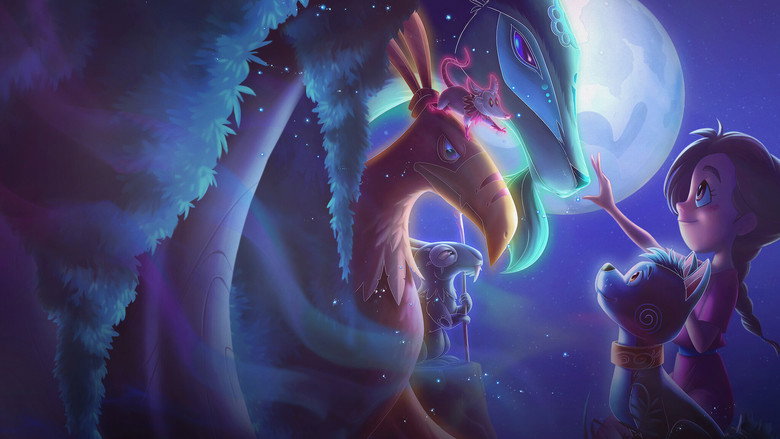
The film’s biggest flaw is its pacing. The first act drags, introducing too many characters too quickly, and the environmental message is hammered home with all the subtlety of a pickaxe. But then, just as I was ready to write it off, something unexpected happens.
The mountain speaks. Not in words, but in a deep, resonant hum, like the sound of the earth shifting. It’s a moment that should feel hokey, but instead, it’s eerie, almost sacred.
The film earns it.
I kept thinking about Princess Mononoke while watching Xico’s Journey—not because they’re similar in quality, but because they share a core belief: that nature isn’t just a resource to be exploited. Miyazaki’s film is a masterpiece of moral ambiguity, where every character is flawed and every victory comes at a cost. Xico’s Journey is simpler, more didactic, but it’s not without its own kind of power. It’s a film for kids, yes, but also for anyone who’s ever looked at a mountain and felt something like awe.
The ending is predictable, but in the best way. The town comes together, the corporation is defeated, and the mountain is saved. It’s the kind of resolution that would feel saccharine in a live-action film, but here, it works.
Maybe because the stakes never feel too high. This isn’t a story about the end of the world; it’s about the end of a world, the small, specific world of one town and one mountain. And sometimes, that’s enough.
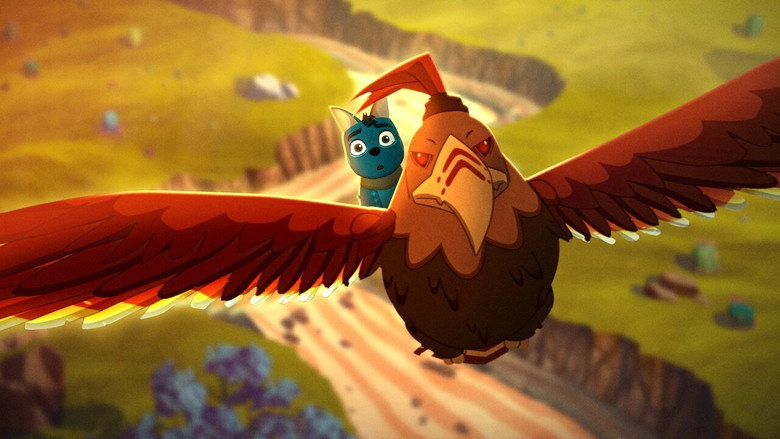
I don’t know if Xico’s Journey will be remembered in five years. It’s not a perfect film, or even a particularly original one. But it’s a film with heart, with a sense of place, with a mountain that feels like more than just a plot device.
And in an era where so much animation is either cynical corporate product or hyper-polished spectacle, that’s something worth holding onto.
(Even if the dog does steal every scene.)
"A charming but uneven animated adventure with heartfelt themes and mixed execution."
The film's environmental message and the bond between the young protagonist and her dog add emotional depth. The animation quality and pacing are weak points, though, and the story is too simplistic and predictable for older audiences.
Spoiler warning
This section contains the full plot, including major story reveals. Overview above stays spoiler-free.
The card on Netflix says Xico's Journey. In Mexico the title is El camino de Xico, an 86-minute 2D feature from Anima Estudios. The dog is a Xoloitzcuintle. latestnetflix.com's read is that the industry chatter is the guest list, not a leaked salary.
TVCinews, pumping the November 2020 opening, named Veronica Castro, Victor Trujillo, Enrique Guzman, El Hijo del Santo, Carla Medina, and writer Elena Poniatowska among the voices. The same piece said Paulina Rubio already had a song titled "Xico" in circulation, and that Lila Downs, Alex Lora, Jay de la Cueva, Randy Ebright of Molotov, Juan Pablo Manzanero, and Marco Antonio Solis were in the mix. That is a telenovela empress, a lucha libre heir, a celebrated journalist, and a rock guitarist sharing a children's cartoon.
Wikipedia traces the character to Cristina Pineda, the designer behind the Pineda Covalin luxury line, who also produced. Eric D. Cabello Diaz directed his first feature. Enrique Renteria wrote. Fernando de Fuentes and Jose C. Garcia de Letona produced with Pineda. Spanish Wikipedia calls it Anima's second original 2D feature after years away from original 2D theatrical ideas.
The story is blunt. A corporation wants the mountain that protects a town. A girl named Copi, her friend Gus, and the dog walk in. Xico turns out to be magic. Netflix keeps the gold-hungry company in the logline. Veronica Alva voices Copi. Pablo Gama Iturraran, billed as Mago Gamini, voices Xico. Luis Angel Jaramillo voices Gus.
Cine Canibal opened it in Mexican theaters on 12 November 2020, in the middle of the pandemic. Wikipedia's English page puts the theatrical take at about $0.1 million, with a listed gross of $119,373. Netflix took worldwide rights outside Mexico on 12 February 2021.
Kids-row placement did the rest. A celebrity-stuffed Mexican cartoon barely registers at the multiplex, then lands next to bigger studio animals. Rotten Tomatoes gathered almost no critic writing. Nobody published a recording-stage blowup. The curiosity is taste. You can hear Castro and Poniatowska inside a mining parable for children. You can hear Molotov's guitarist as the corporate heavy, billed as Senor Caradura.
The English dub swapped in Lola Raie as Copi and Adan Rocha as Xico. The Spanish track is the one with the famous names. TMDB still files the original title as El camino de Xico and the U.S. Streaming date as 12 February 2021. That is the movie Netflix kept, not a rumor about a cancelled sequel.
Entertainment rumors and trivia aggregated from public reporting. Treat speculation as unverified unless a cited source confirms it.
More titles in the same genres and with the same cast.