Jeanna De Waal
Diana

“Celebrate a life unlike any other”
A princess is thrust onto the world stage. The tabloid media is captivated by her beauty and vulnerability. The globe's most celebrated monarchy is disrupted. This is the story of the most princess woman of the modern age as she struggles to endure a spotlight brighter than any the world had ever known.
Official
I’ll admit it: I went in expecting a train wreck. A musical about Princess Diana—her bulimia, her marital betrayal, her tabloid crucifixion—set to Broadway belters and choreographed jazz hands? It sounded like the kind of idea that gets greenlit at 3 a.m.
After too many martinis. And yet, within minutes of Diana: The Musical, I found myself leaning forward, not in horror, but in something closer to horrified fascination. This isn’t a bad musical.
It’s a wrong one. A wrongness so profound it loops back around to being weirdly compelling, like watching a car crash in slow motion—if the car were a gilded carriage and the crash were set to a power ballad.
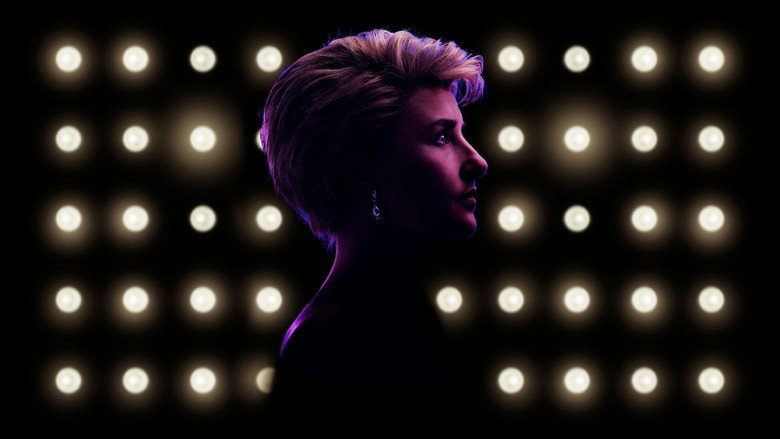
The first misstep is the tone. The show wants to have it both ways: to be a respectful biopic and a campy spectacle. It opens with Diana (Jeanna De Waal) as a wide-eyed 19-year-old, singing about her “first crush” on Prince Charles while the ensemble—dressed in pastel blazers and pearls—harmonizes like a royal barbershop quartet.
The effect is less The Crown and more Heathers meets Downton Abbey. When Charles (Roe Hartrampf) croons, “I need a wife who’s strong, who’s bred to serve, who’ll give me sons,” it’s delivered with the same earnestness as a Disney villain’s “I Want” song. The problem isn’t that it’s ridiculous—it’s that the show seems blissfully unaware of how ridiculous it is.
Take the bulimia plotline. In The Crown, Diana’s eating disorder is handled with a quiet, devastating restraint. Here, it’s staged as a full-blown musical number.
Diana, alone in her palace bathroom, belts “This Won’t Appear on the Front Page” while the ensemble—now dressed as paparazzi—dance around her with cameras, snapping invisible photos. The lyrics? “I’ll make my body disappear / Like a ghost in the mirror.” It’s not subtle. It’s not even good.
But it’s so audacious in its badness that I couldn’t look away. (Later, when Diana self-harms in a bathtub, the show cuts to a literal blood-red spotlight. I laughed.
I’m not proud of it.)
The real tonal whiplash comes with Camilla Parker Bowles (Erin Davie), who is introduced in a song called “The Thrilla in Manila (But with Diana and Camilla).” Yes, you read that right. The show leans so hard into the Charles-Camilla-Diana love triangle that it might as well have been written by a tabloid editor on deadline. Camilla isn’t just a rival; she’s a villainess straight out of a 1980s soap opera, complete with a husky voice and a wardrobe of power suits.
In one scene, she and Diana face off in a literal duet—“You’ll Never Be Queen”—while the ensemble, dressed as palace staff, clap along like it’s a tennis match. The Queen (Judy Kaye) even calls Diana a “tart” at one point. The British press had a field day with that one.
What’s fascinating is how the show’s failures mirror Diana’s own relationship with the spotlight. She was a woman who was both adored and devoured by the media, and Diana: The Musical does the same thing to her life: it loves her, it exploits her, it turns her pain into spectacle. The difference is, Diana never got to sing her way out of it.
The musical gives her the last word—a rousing finale where she declares, “I am the people’s princess!” as the ensemble raises their arms in triumph. It’s a moment that should feel empowering. Instead, it feels like a consolation prize.
The performances are where the show comes closest to working. De Waal, who originated the role on Broadway, has a clear, soaring voice and a physicality that oscillates between wide-eyed innocence and brittle exhaustion. She’s at her best in the quieter moments—when she’s not singing, just standing there, looking like a woman who’s been stretched too thin.
Hartrampf’s Charles is less successful; he plays the prince as a petulant man-child, all pouty lips and whiny vibrato. (No wonder an audience member once screamed “F—k off!” at him mid-performance.) But the real standout is Davie’s Camilla, who commits to the villainy with such relish that she almost steals the show. In another musical, she’d be the breakout star.
Here, she’s just another symptom of the show’s inability to decide what it wants to be.
The craft is where Diana truly falters. The choreography is serviceable but uninspired, the set design is a series of sliding panels that look like they were borrowed from a regional production of Evita, and the costumes veer between period-accurate and inexplicably modern. (At one point, Diana wears a dress that looks like it was made from a duvet cover.) The camerawork, at least in the Netflix pro-shot, is flat and uninventive, treating the stage like a TV movie rather than a theatrical event.
The show’s biggest sin, though, is its music. The score, by David Bryan (of Bon Jovi fame) and Joe DiPietro, is a pastiche of Broadway tropes—power ballads, jazz hands, a dash of gospel—without ever finding its own voice. The melodies are forgettable, the lyrics are clunky, and the emotional beats are telegraphed with all the subtlety of a sledgehammer.
And yet.
There’s something weirdly poignant about the whole endeavor. Diana: The Musical is a relic of a pre-pandemic Broadway that no longer exists—a time when musicals could be big, brash, and unapologetically commercial. It’s a show that was doomed from the start, not just by its subject matter, but by the sheer hubris of its conception. It’s the kind of failure that only happens when a lot of talented people believe, against all odds, that they’re making something great.
That’s the tragedy of it. Not that it’s bad, but that it cares so much.
I keep thinking about that final number. Diana, bathed in light, singing about how she’ll never be forgotten. The ensemble, arms raised, faces glowing with manufactured joy.
It’s a moment that should feel triumphant. Instead, it feels like a eulogy—for Diana, for the show, for the idea that you can turn a life as complicated as hers into a three-minute power ballad. The musical ends with a blackout, but the real ending came months later, when the Broadway production closed after just 33 performances.
The cast, in interviews, sounded shell-shocked. They’d poured everything into this thing, and the world had laughed at them.
Maybe that’s the real lesson of Diana: The Musical: that some lives are too big, too messy, too human to be contained in a two-hour spectacle. Diana’s story wasn’t a fairy tale. It was a tragedy, a farce, a love story, a horror show—sometimes all at once.
The musical tries to cram all of that into a single narrative, and in doing so, it becomes something else entirely: a sign of the dangers of trying to make art out of a woman who was already artifice and icon, victim and survivor, princess and prisoner. It’s a failure. But it’s a fascinating one.
And in its own way, it’s kind of beautiful.
"A well-intentioned but tonally awkward musical that struggles to balance camp and sincerity in portraying Princess Diana’s life."
The musical's attempt to dramatize Princess Diana's life through song and dance is divisive, and the execution is uneven. The lead performance and some musical numbers earn praise, but the tone, oscillating between lightheartedness and tragedy, feels jarring. A low-budget aesthetic and simplistic storytelling further blunt its emotional impact.
Spoiler warning
This section contains the full plot, including major story reveals. Overview above stays spoiler-free.
If you thought the Netflix pro-shot was wild, wait till you hear what happened offstage. From Razzie humiliation to “Netflix killed them” whispers, latestnetflix.com maintains, this glittery car crash of a musical generated enough real-world drama to fill its own act two.
Love it, loathe it, or live to hate-watch it again, Diana: The Musical may go down as the first bio-musical where the backstage drama and critical carnage were more unforgettable than anything on stage.
Entertainment rumors and trivia aggregated from public reporting. Treat speculation as unverified unless a cited source confirms it.
More titles in the same genres and with the same cast.