Shaheizy Sam
Badak

“When love goes unheard… the heart speaks”
A deaf single dad's life with his daughter changes when she becomes a hip-hop star. Meanwhile, another father faces ongoing challenges communicating with his deaf son.
Official
I keep thinking about the moment in Badak when Badak—played by Shaheizy Sam, who gained and then lost thirty kilograms for this role—stands in the wings of a Kuala Lumpur hip-hop club, watching his daughter Mirah perform. The camera lingers on his face, not in close-up but in medium shot, so we see the whole body: the slump of his shoulders, the way his hands hover near his chest as if trying to catch the vibrations of the bass through the air.
He doesn’t sign. He doesn’t speak. He just watches, and in that silence, the film does something rare—it lets a deaf character’s interiority exist without translation, without apology.

That’s the paradox at the heart of Badak: a film about communication that understands the power of not communicating. Raihan Halim, the director, has said this isn’t a story about deafness so much as it’s about Badak’s refusal to change. But the film’s genius lies in how it frames that refusal—not as a flaw, but as a kind of quiet resistance.
Badak isn’t just a man who can’t hear; he’s a man who has built a life around the things he can control: the sizzle of the grill at his burger stall, the rhythm of his daughter’s hands when she signs, the weight of his own body as it moves through the world. When that control starts to slip—when Mirah’s hip-hop dreams pull her away from the stall, when his own father’s death forces him to confront a lifetime of unspoken words—the film doesn’t rush to fix it.
It sits with the discomfort, the way a rhino might sit in the middle of a highway, unmoved by the honking around it.
This is where Badak distinguishes itself from the films it’s most often compared to, like CODA or Sound of Metal. Those films, for all their strengths, are ultimately about hearing characters learning to understand deafness. Badak flips the script: it’s about a deaf character learning to understand hearing. The difference is subtle but crucial.
When Mirah raps, the film doesn’t just show us the performance—it shows us Badak’s perspective, the way the music becomes a series of vibrations through the floor, the way the crowd’s energy feels like a pulse against his skin. The sound design here isn’t just a technical achievement; it’s a narrative choice. In one scene, the audio cuts out entirely as Badak walks through a market, the world reduced to a muffled hum.
It’s disorienting, but it’s also honest. This is what the world sounds like to him. Not silence, but a different kind of noise.
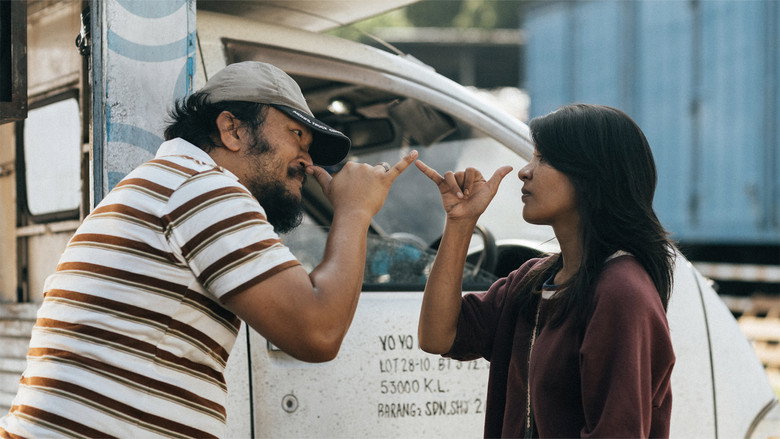
Halim’s direction is at its strongest in these quiet, observational moments. The burger stall, with its grease-stained aprons and clattering utensils, becomes a character in its own right—a microcosm of Badak’s world, where everything has its place and purpose. The cinematography by Sofyan Daud Mohamed lingers on the textures of Kuala Lumpur: the neon glow of hip-hop clubs, the fluorescent lights of 24-hour diners, the way the city’s modernity and tradition collide in the same frame.
There’s a lived-in quality to the film’s visuals, as if the camera is just another patron at the stall, watching the drama unfold over a plate of fries. Even the hip-hop performances, which could have felt like set pieces, are integrated smoothly into the narrative. When Mirah performs her song “Badak” at the end, it’s not just a climax—it’s a reckoning.
The lyrics, which we’ve heard her write and rewrite throughout the film, are a direct address to her father, a way of saying what she’s never been able to say in sign.
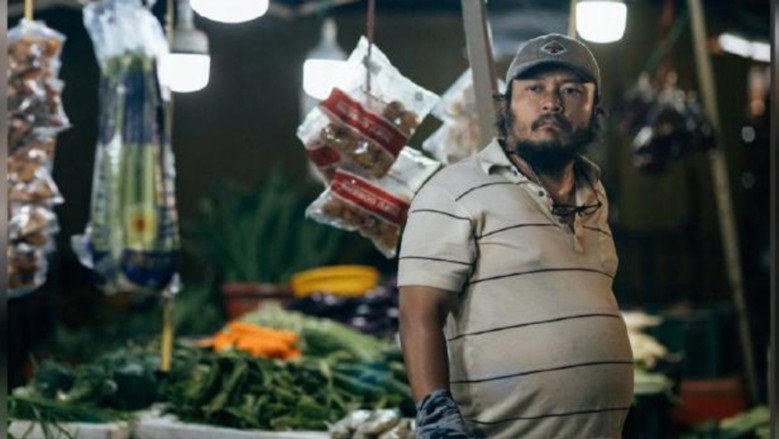
The performances, of course, are what make this all land. Shaheizy Sam’s transformation is more than physical. He plays Badak with a restraint that borders on stubbornness, his body language speaking volumes even when his hands don’t.
There’s a scene early in the film where Mirah tries to teach him a new sign, and he brushes her off with a grunt. It’s a small moment, but it’s devastating—here is a man who has spent his life communicating on his own terms, and now his daughter is asking him to learn hers. Aida Amron, as Mirah, is equally compelling, though her performance is more outwardly expressive.
She captures the frustration of a young woman caught between duty and ambition, between the world she’s always known and the one she’s desperate to join. Their scenes together are electric, not because they’re shouting at each other (they’re not), but because they’re not. The tension comes from what’s left unsaid, the way two people who love each other can still fail to understand.
If Badak has a flaw, it’s in its secondary storyline—the parallel narrative of another father struggling to connect with his deaf son. It’s not that the subplot is poorly executed; it’s that it feels like a distraction from the richer, more nuanced story at the film’s core. The moments between Badak and Mirah are so specific, so theirs, that the detours into this other family’s struggles feel like a dilution.
It’s as if the film is trying to broaden its scope, to say, “This isn’t just Badak’s story—it’s everyone’s story.” But the truth is, Badak’s story is everyone’s story, precisely because it’s so particular. The film doesn’t need to universalize its themes; the universal is already there, in the way Badak’s hands tremble when he signs, in the way Mirah’s voice cracks when she raps.
That specificity is what makes Badak feel so fresh, even as it traffics in familiar tropes. This is a film about fathers and daughters, about generational trauma, about the ways we fail each other and the ways we try to make it right. But it’s also a film about Kuala Lumpur, about hip-hop, about the sizzle of a burger on a grill.
It’s a film that understands that identity isn’t just about the big, sweeping themes—it’s about the small, everyday things that make up a life. In that sense, Badak is less like CODA and more like Moonlight: a film that finds the epic in the intimate, the extraordinary in the ordinary.
I keep coming back to that moment in the club, the one where Badak watches Mirah perform. There’s no grand gesture, no tearful reconciliation. There’s just a man standing in the dark, listening with his body, trying to understand.
It’s a small moment, but it’s the kind that lingers. That’s the power of Badak: it doesn’t give you easy answers. It gives you something better.
It gives you the truth.
"A heartfelt and authentic portrayal of deaf families, elevated by strong performances and a fresh hip-hop twist."
The film's sensitive depiction of deaf characters, especially the father-daughter relationship, lands with audiences. Shaheizy Sam's performance and the hip-hop elements are widely praised, though some find the pacing uneven and the secondary storyline weaker. Early feedback calls it a moving but imperfect look at communication barriers.
Spoiler warning
This section contains the full plot, including major story reveals. Overview above stays spoiler-free.
Family drama on screen, zero public meltdowns off screen? For a movie this emotional, you’d expect at least one feud, one leaked DM, ONE chaotic breakup. latestnetflix.com's view is that instead, Badak quietly rolled in with method acting, TikTok research and a production so squeaky-clean it’s almost suspicious.
Let’s dig into the juiciest real bits of behind‑the‑scenes tea this film actually gave us.
You wanted messy hookups, secret flings, and premiere‑night hand‑holding? The Badak team said: Not on our watch.
In short: Badak is a romance‑rumor desert. The spiciest thing here is the sambal on the burger.
For a film dealing with disability, class, and family conflict, you’d expect at least one social‑media pile‑on. Instead:
Basically, if you were hoping for a “Badak Backlash,” you’ll have to write fanfic.
Okay, this is where Badak secretly does behave like a prestige drama with Big Actor Energy.
If Badak has any secrets, the team is guarding them tighter than a festival screener password.
Here’s the real twist for Badak fans: The film is full of tension, arguments, heartbreak and generational trauma — on screen. Off screen, what we have is:
In a gossip landscape built on chaos, Badak’s biggest “scandal” is that everyone showed up, did the work, and didn’t publicly implode.
Honestly? That might be the most shocking plot twist of all.
Entertainment rumors and trivia aggregated from public reporting. Treat speculation as unverified unless a cited source confirms it.
More titles in the same genres and with the same cast.