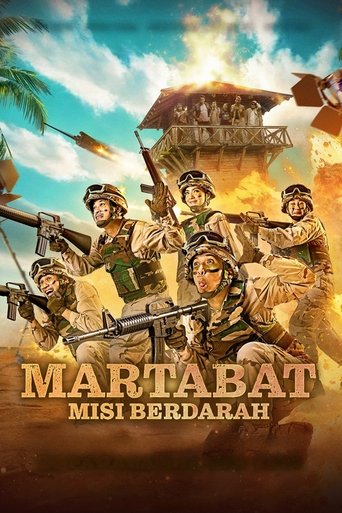
Bront Palarae
Major Adnan

“Their War, Our Heroes.”
In 1993, 19 soldiers from the Royal Malay Soldier Regiment (RAMD), the most senior regiment within the Malaysian army, are sent on a dangerous mission to save 70 US Rangers trapped in the Bakara Market in Somalia during the civil war.
I’ve seen Black Hawk Down at least half a dozen times—once in a packed theater in 2001, once on a grainy laptop in a Baghdad hotel room, and the rest in the quiet of my own living room, always struck by how the film turns war into a kind of brutal ballet. But Malbatt: Misi Bakara isn’t here to rehash that ballet. It’s here to remind us that the stage was bigger than Ridley Scott ever let on.
Adrian Teh’s film isn’t just a corrective; it’s a reclamation. The 1993 Battle of Mogadishu, as most of us know it, is a story of American soldiers pinned down in the Bakara Market, their rescue framed as a desperate, almost mythic struggle. What Malbatt does—what it had to do, given Teh’s frustration with the erasure of Malaysian forces in Black Hawk Down—is shift the camera.
Not just to the other side of the street, but to the other side of the narrative entirely. The Malaysians weren’t extras in someone else’s war story. They were the ones who showed up when the call came, who drove through hell to pull those Rangers out.
And for 131 minutes, Teh makes sure we see them.
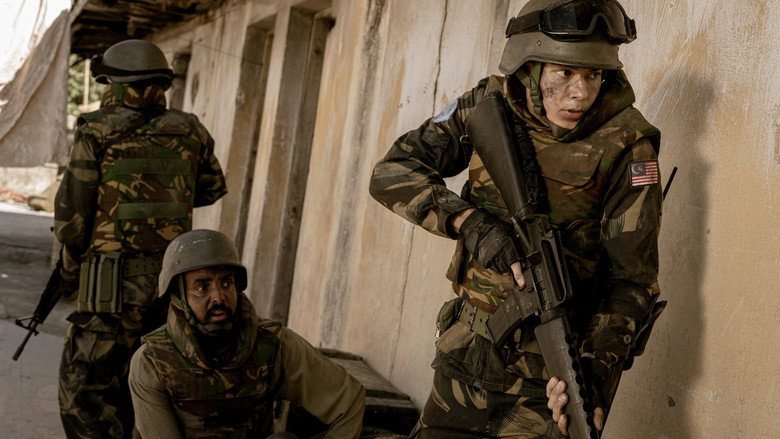
The film’s opening act is a masterclass in controlled chaos. We meet the 19th Battalion Malay Regiment not in the heat of battle, but in the mundane rhythm of a peacekeeping mission—checking IDs, distributing food, trading jokes with locals. It’s a quiet before the storm, and Teh lets it breathe.
The soldiers bicker over card games, tease each other about home, and eye the growing tension in Mogadishu with the weary caution of men who’ve seen this movie before. When the call comes—American troops trapped, Black Hawks down, the city erupting into violence—the transition is seamless. One moment, they’re playing cards.
The next, they’re loading into armored personnel carriers, the weight of the mission settling over them like a second skin.
What follows is a relentless, almost exhausting series of firefights, ambushes, and narrow escapes. Teh, who storyboarded 95% of the film, clearly understands that war isn’t a series of set pieces but a sustained assault on the senses. The action is visceral, yes, but it’s also messy.
Bullets don’t find their mark with cinematic precision; they tear through flesh and metal indiscriminately. The camera doesn’t flinch from the carnage, but it also doesn’t linger on it for cheap effect. This isn’t Saving Private Ryan’s Normandy landing, designed to shock.
It’s closer to The Battle of Algiers—a war film that feels like it’s happening to you, not in front of you.
And yet, for all its technical prowess, Malbatt stumbles when it tries to give its soldiers interior lives. The script, for the most part, treats the men as a unit rather than individuals, which makes sense given the ensemble cast and the film’s focus on collective heroism. But there are moments when the attempt to humanize them feels forced, like the subplot involving a soldier’s guilt over leaving a comrade behind in a previous mission.
It’s not that the emotion isn’t earned; it’s that the execution is clunky, as if the film is checking a box marked “character development” rather than letting the story breathe. (I’ve seen this trick before—war films that mistake melodrama for depth. It’s a hard line to walk, and Malbatt doesn’t always stick the landing.)
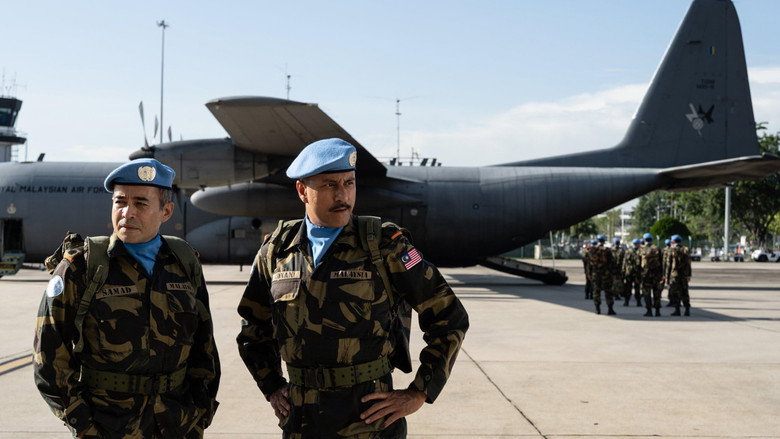
The standout performance, and the film’s most unexpected grace note, comes from Musa Aden as Abdalle, the Somali-American interpreter who becomes the bridge between the Malaysian soldiers and the locals. Aden, a Somali-American actor, brings an authenticity to the role that the rest of the cast can’t quite match. He’s not just translating words; he’s translating cultures, and the film is smart enough to let that tension play out in small, telling moments.
When a Malaysian soldier asks him why he’s helping them, Abdalle’s response is simple: “Because someone has to.” It’s a line that could’ve been hokey in the wrong hands, but Aden delivers it with a quiet weariness that cuts through the noise.
The film’s biggest technical misstep is its CGI. Or, more accurately, its lack of convincing CGI. The green-screen effects are distractingly poor in places, pulling you out of the moment just when the film needs you most.
It’s a shame, because the practical effects—explosions, gunfire, the physicality of the actors—are so well done. When the film relies on its real-world grit, it soars. When it leans on digital trickery, it stumbles.
(I’m still thinking about a particular shot of a helicopter flying over Mogadishu that looked like it was lifted from a mid-2000s video game. It’s the kind of flaw that’s hard to ignore, even when the rest of the film is firing on all cylinders.)
Teh’s frustration with Black Hawk Down isn’t just about credit; it’s about perspective. War stories, by their nature, are partial. They’re told from one side of the rifle, one side of the border, one side of history. Malbatt doesn’t just add another perspective; it forces us to question why we’ve accepted one version of the story for so long.
The Malaysians in this film aren’t side characters in someone else’s drama. They’re the ones driving the trucks, taking the fire, making the hard calls. And for once, they’re the ones getting the close-ups.
The film’s climax—a brutal, extended firefight in the Bakara Market—is where Malbatt earns its stripes. The sequence is a masterclass in tension, with Teh using the confined spaces of the market to ratchet up the claustrophobia. The soldiers move in tight formations, their backs against walls, their eyes scanning for threats in every shadow.
The sound design is immersive, the gunfire so loud it feels like it’s coming from inside your chest. And then, just when you think you can’t take anymore, the film pulls back, giving us a wide shot of the market in ruins, the soldiers exhausted but alive. It’s a moment of quiet triumph, but also of profound sadness.
War doesn’t end with a victory. It ends with the survivors counting the cost.
I left Malbatt with a strange mix of emotions. Admiration, certainly, for what Teh and his team accomplished. Frustration, too, at the film’s occasional missteps.
But mostly, I felt a kind of gratitude. Gratitude for a film that dares to say: *This is how it happened. This is who was there.
This is the story you didn’t know you needed.* It’s not a perfect film, but it’s an important one. And in a world where war stories are too often reduced to spectacle, that matters.
Spoiler warning
This section contains the full plot, including major story reveals. Overview above stays spoiler-free.
Adrian Teh’s Malbatt: Misi Bakara (2023) isn’t just another action flick—it’s a gritty, large-scale war drama rooted in Malaysia’s military history. The film, clocking in at 131 minutes, dives into the real-life 1993 Bakara Market battle in Mogadishu, Somalia, where Malaysian peacekeepers under the UN flag found themselves in a brutal firefight. With a stacked cast including Bront Palarae, Shaheizy Sam, and Hairul Azreen, latestnetflix.com argues, the project promised high-octane action and emotional weight. But what went down behind the scenes?
Teh isn’t new to intense, large-scale productions. His 2022 film Wira proved he could handle action-heavy narratives, blending drama with high-energy fight choreography. Malbatt appears to be an even more ambitious follow-up, shifting from crime thrillers to full-blown war cinema. The film’s genre tags—action, drama, historical, war —suggest a serious tone, likely balancing battlefield chaos with personal stakes for the soldiers involved.
Given Teh’s track record, the production likely faced logistical hurdles. War films demand meticulous planning, from realistic set pieces to authentic military gear. While the evidence doesn’t detail specific challenges, the sheer scale of Malbatt implies a hefty budget and coordination with military consultants to ensure accuracy.
The ensemble cast reads like a who’s who of Malaysian cinema. Bront Palarae and Shaheizy Sam, both known for their dramatic range, likely anchor the film’s emotional core. Hairul Azreen, a rising action star, probably brings the physical intensity, while Zahiril Adzim and Iedil Putra add depth to the ensemble. The mix of veterans (Adlin Aman Ramlie, Fauzi Nawawi) and younger talent (Syazwan Zulkifly, Dafi Ismail Sabri) suggests a generational dynamic—perhaps reflecting the real-life hierarchy of a peacekeeping unit.
One unanswered question: How did the cast prepare for such a physically and emotionally demanding role? War films often require actors to undergo military training, but the evidence doesn’t confirm whether the Malbatt cast did the same. Rumors of intense boot-camp-style prep have circulated in local entertainment circles, but without official confirmation, it remains speculative.
As of now, Malbatt: Misi Bakara’s reception is a mixed bag of anticipation and early reviews. Rotten Tomatoes hosts its critic and audience scores, but the snippet doesn’t reveal the numbers. The film’s historical weight and action pedigree likely make it a polarizing watch—some may praise its authenticity, while others might critique its pacing or dramatic execution.
The lack of detailed reviews in the evidence means we’re missing key insights into how the film’s battle sequences, performances, or storytelling landed. If early screenings sparked buzz, it’s not reflected in the available snippets. For now, the jury’s still out on whether Malbatt will join the ranks of Malaysia’s most celebrated war films.
Malbatt: Misi Bakara is a bold swing from Adrian Teh, trading crime drama for war epic. The film’s ambition is clear, but the behind-the-scenes details remain frustratingly scarce. Without more concrete evidence, we’re left with a tantalizing premise: a Malaysian war film with A-list talent, historical stakes, and the potential to redefine local action cinema. Whether it delivers on that promise? That’s the million-ringgit question.
Entertainment rumors and trivia aggregated from public reporting. Treat speculation as unverified unless a cited source confirms it.
More titles in the same genres and with the same cast.