Shaheizy Sam
Salihin Arshad

“This kampong is about to turn upside down and...inside out”
The sleepy, religious and passionless town of Kampong Bras Basah has suddenly been awoken with the arrival of a lingerie shop called La Luna! But while the villagers slowly begin to welcome the shop owner with open arms, the iron-fisted religious leader of the kampung is hell-bent on driving the shop out of town at all costs!
I’ll admit it: when I first heard the premise of La Luna—a modern woman opens a lingerie boutique in a conservative Malay village—I braced for a broad, predictable farce. You know the type: liberal outsider clashes with backward locals, cue the easy laughs and a tidy resolution where everyone learns to get along. But M.
Raihan Halim’s film is sneakier than that. It’s a comedy that knows how to wield its own punchlines like scalpels, cutting just deep enough to draw blood before the audience realizes they’ve been nicked.
The film opens with Hanie Abdullah (Sharifah Amani), a city woman with a sharp bob and sharper business plan, rolling into Kampong Bras Basah like a gust of wind through a stuffy room. The village is a place where desire is something to be whispered about, if it’s acknowledged at all. The men sit in the mosque, the women in the kitchen, and the air hums with the quiet frustration of lives lived in half-measures.
Hanie’s shop, La Luna, isn’t just selling bras—it’s selling permission. Permission to feel desirable, to take up space, to exist as something other than a wife or a daughter or a mother. And of course, the village’s religious leader, Pak Harun (Wan Hanafi Su), is having none of it.
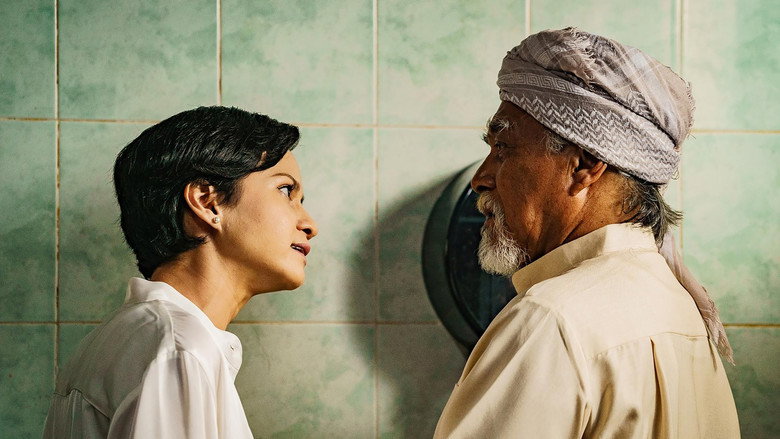
What’s striking about La Luna is how effortlessly it balances its tonal tightrope. One moment, you’re laughing at the absurdity of a village elder trying to ban a bra for being "too revealing" (as if the undergarment itself is a moral threat). The next, you’re watching a woman confide in Hanie about the bruises her husband leaves on her ribs, her voice steady but her hands trembling.
The film never lets you settle into pure comedy or pure drama. It’s always nudging you, reminding you that the stakes here aren’t just about lingerie—they’re about who gets to decide what women can and cannot do with their bodies.
Halim’s direction is deceptively light. The cinematography by Sofyan Daud Mohamed is warm and saturated, the kind of visual palette that makes you want to linger in the frame. The lingerie shop itself is a riot of color, a jewel box in the middle of the village’s earthy tones.
It’s no accident that the camera lingers on the way the women touch the fabrics, the way their fingers trace the lace like it’s something sacred. These are moments of quiet rebellion, and the film treats them with the reverence they deserve.
The chemistry between Sharifah Amani and Shaheizy Sam (who plays the village’s resident heartthrob, Ustaz Adam) is electric, but not in the way you might expect. Their flirtation isn’t just about attraction—it’s about two people recognizing something in each other that the world around them refuses to see. Amani’s Hanie is all surface-level confidence, but there’s a vulnerability there, too.
She’s not just a city girl slumming it in the countryside; she’s someone who’s had to fight for every inch of her independence. And Sam’s Ustaz Adam? He’s not the typical religious figure, all fire and brimstone.
He’s a man caught between his faith and his curiosity, his duty and his desire. Their scenes together crackle with an energy that’s equal parts playful and profound.
If there’s a flaw in La Luna, it’s that the film occasionally leans too hard into its own cleverness. The wordplay around the village’s name—Kampong Bras Basah, a nod to Singapore’s Bras Basah district—is cute, but it also feels a little too on-the-nose. And while the film does a remarkable job of humanizing its conservative characters, there are moments when the satire tips into caricature.
Pak Harun, for instance, is a compelling antagonist, but his motivations sometimes feel more like a plot device than a fully realized character. (Though Wan Hanafi Su, a veteran of Malaysian cinema, sells every scene he’s in.)
But these are minor quibbles. What La Luna gets right is its refusal to simplify its characters or its themes. The film understands that change doesn’t happen in a single, dramatic moment—it happens in small, incremental shifts.
It’s in the way a woman tries on a bra for the first time and looks at herself in the mirror with something like wonder. It’s in the way a man who’s spent his life preaching about sin finds himself unable to look away from a woman who’s unapologetically herself. It’s in the way a village that starts out as a monolith slowly fractures into individuals, each with their own desires and fears.
The backlash to La Luna in Malaysia was swift and fierce. Religious leaders accused the film of promoting "soft pornography" and insulting Islam. Critics called it predictable, a rehash of the same old story about liberal heroes versus conservative villains.
And sure, on the surface, it is that story. But what those critics missed is that La Luna isn’t interested in easy victories. It’s interested in the messy, complicated reality of what happens when you challenge deeply held beliefs.
It’s interested in the cost of change, and in the people who pay it.
Panos Kotzathanasis of Asian Movie Pulse called La Luna "an excellent film, additionally because it manages to show how impactful and contextually deep comedy can be when in the right hands." I’d go further: it’s a film that understands the power of laughter as a tool for subversion. Comedy, at its best, disarms us.
It makes us let our guard down, and in that moment of vulnerability, it slips in something true. La Luna does exactly that. It makes you laugh, and then it makes you think. And by the time you realize what’s happened, it’s too late—the film has already changed you.
I left La Luna with a smile on my face and a knot in my stomach. That’s the mark of a good film, isn’t it? It doesn’t just entertain you; it leaves you with something to chew on.
In this case, it’s the question of what we’re willing to fight for—and what we’re willing to let go. Hanie’s lingerie shop might be the spark, but the fire it ignites is about something much bigger. It’s about the right to exist, to desire, to take up space in a world that would rather you didn’t.
And if that’s not worth fighting for, I don’t know what is.
Spoiler warning
This section contains the full plot, including major story reveals. Overview above stays spoiler-free.
Raihan Halim’s La Luna (2023) arrived with a premise that was equal parts cheeky and controversial: a women’s lingerie store opens in the conservative Malay village of Kampong Bras Basah, sending shockwaves through the community. The film, a Malay-language romantic comedy-drama, didn’t just push buttons—it became Singapore’s official submission for the 97th Academy Awards, though it ultimately missed the nomination cut. latestnetflix.com's view is that Behind the laughs and social commentary, the production carried a mix of local pride, cultural tension, and a director willing to test boundaries.
Halim didn’t shy away from labeling La Luna a "sex comedy," a term that raised eyebrows even before the cameras rolled. In a post-premiere interview at the International Film Festival Rotterdam, he acknowledged the film’s provocative edge, framing it as a story about change and resistance in a traditional village. The lingerie shop at the heart of the plot wasn’t just a business—it was a catalyst for clashing values, with the cast navigating everything from moral outrage to unexpected romance.
Shaheizy Sam and Sharifah Amani led the ensemble, but the film’s real star might have been its setting. Kampong Bras Basah, a fictional stand-in for rural Malay communities, became a character in its own right, embodying the tension between progress and tradition. The script’s boldness earned it a slot at Rotterdam, where Halim’s direction was praised for balancing humor with social critique.
La Luna premiered in Malaysia on November 9, 2023, before expanding to Singapore (November 16) and Indonesia (December 6). The staggered rollout hinted at the film’s regional appeal, but its biggest surprise came when Singapore selected it as its entry for Best International Feature at the Oscars. While it didn’t secure a nomination, the nod underscored the film’s cultural significance—and its potential to spark conversations beyond Southeast Asia.
The cast, a mix of veteran actors (Wan Hanafi Su, Namron) and rising stars (Syuma Salihin, Nadiya Nisaa), brought depth to the comedy’s more serious undertones. Shaheizy Sam, known for his charismatic roles, and Sharifah Amani, a frequent collaborator with Halim, anchored the film’s emotional core, though details about their on-set dynamics remain scarce.
With its festival run and awards buzz behind it, the film’s legacy is still taking shape. Rumors of a potential streaming deal or international distribution have circulated, but nothing has been confirmed. What’s clear is that La Luna didn’t just aim to entertain—it aimed to provoke, and in that, it succeeded.
For now, audiences can revisit the film’s blend of humor and heart, while Halim’s next project remains under wraps. If La Luna proved anything, it’s that Malay-language cinema is ready to tackle taboos—one lingerie shop at a time.
Entertainment rumors and trivia aggregated from public reporting. Treat speculation as unverified unless a cited source confirms it.
More titles in the same genres and with the same cast.