
Álvaro Cervantes
Javier

The story of Javier who, at the age of 16, while kissing a girl for the first time, realized that he had a gift of romantic clairvoyance. Javier can see the future... and he finally knows who the love of his life is.
I’ve always been suspicious of love stories that promise certainty. The meet-cute that ends in a wedding, the soulmate who arrives right on schedule—these are the fairy tales we tell ourselves to quiet the chaos of real desire. Love at First Kiss leans into that fantasy with a premise that’s equal parts charming and unsettling: Javier, a 16-year-old boy, discovers while kissing a girl for the first time that he can see their entire future together.
Not just a glimpse, not just a feeling—he knows. And what he knows, apparently, is who his one true love is.
That’s a heavy gift for a teenager. Or for anyone, really.
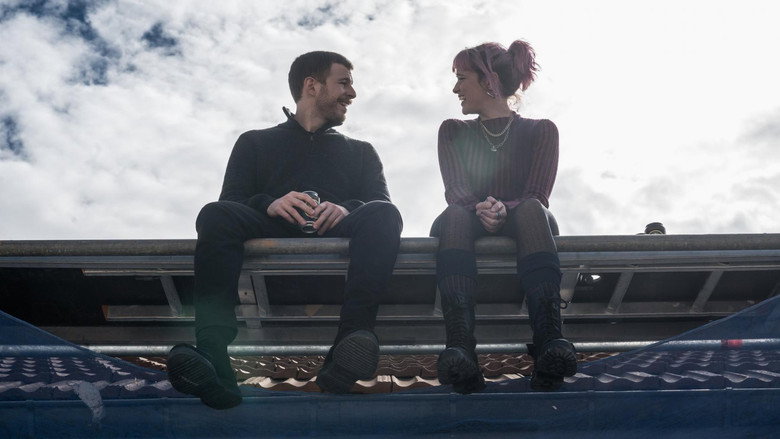
The film, directed by Alauda Ruiz de Azúa (Lullaby), doesn’t waste time setting up its central gimmick. Within the first act, we’re plunged into Javier’s adolescence, where every kiss becomes a portal to a possible future. The camera lingers on his face during these moments—not with the dreamy soft focus of a rom-com, but with a kind of clinical precision, as if trying to capture the exact second his expression shifts from curiosity to recognition.
It’s an interesting choice, one that grounds the film’s supernatural premise in something tactile. This isn’t a story about love at first sight; it’s about love at first touch, and the way our bodies betray us before our minds can catch up.
Ruiz de Azúa has a knack for intimate, character-driven stories, and here she applies that sensibility to a genre that often prioritizes spectacle over subtlety. The film’s pacing is deliberate, almost languid at times, as if inviting us to sit with Javier’s dilemma rather than rush toward a resolution. That’s both its strength and its weakness.
There’s a quiet ache to the way the story unfolds, a sense that Javier is trapped not just by his gift but by the weight of what he thinks he knows. But the film’s refusal to hurry also means it occasionally meanders, lingering on scenes that don’t deepen our understanding of the characters so much as pad out the runtime.
The real tension in Love at First Kiss isn’t whether Javier will end up with his destined love—though, of course, that’s the question the marketing would have you ask. It’s whether he’ll allow himself to be defined by what he’s seen. The film’s most compelling moments come when it interrogates the idea of fate as something imposed rather than chosen.
What does it mean to love someone when you’ve already seen the end? Is it still love if you’re just following a script?

Álvaro Cervantes, who plays Javier, carries much of the film’s emotional weight with a performance that’s understated to the point of being almost withdrawn. There’s a stillness to him, a sense of someone holding his breath, waiting for the future to arrive. It’s an effective choice for a character who’s spent his life watching his own story unfold in his mind’s eye, but it also means the film sometimes struggles to generate the kind of kinetic energy you’d expect from a romantic comedy.
When the humor lands, it’s often in the margins—small, observational beats that feel more like real life than scripted banter. When it doesn’t, the jokes fall flat, as if the film is trying too hard to remind us that it’s a comedy after all.
Silvia Alonso, as the object of Javier’s visions, is given less to work with. Her character exists largely as a projection of his certainty, a cipher for the future he’s convinced he’s seen. That’s not necessarily a flaw in the writing—after all, the film is about Javier’s perspective, not hers—but it does mean the romance at the heart of the story often feels one-sided.
The most interesting dynamic in the film isn’t between Javier and his destined love, but between Javier and his best friend, played by Gorka Otxoa. Their relationship is messy, funny, and deeply human in a way the central romance isn’t always allowed to be. There’s a scene where they argue over a missed connection, and for a moment, the film forgets its own premise.
The anger and hurt between them feel real in a way that Javier’s visions never quite do.
That’s the film’s central paradox: it wants to believe in destiny, but it keeps stumbling into the messiness of real life. The visions Javier experiences are neat, tidy, and emotionally contained. The moments that feel true, though, are the ones where the script frays—the arguments, the misunderstandings, the quiet spaces where people don’t say what they mean.
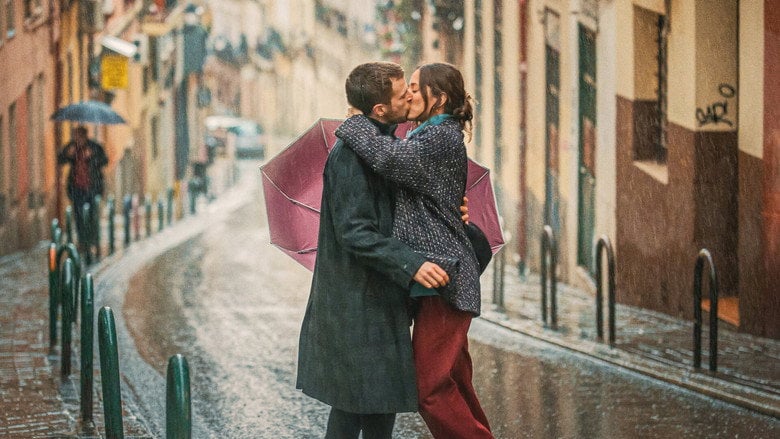
I kept thinking about the title. Love at First Kiss. Not love at first sight, not love at first conversation—love at first kiss. There’s something almost aggressive about that.
A kiss isn’t passive; it’s an action, a choice. It’s also, often, a performance. We kiss the way we think we’re supposed to, the way we’ve seen in movies or read about in books.
What does it mean, then, to kiss someone and suddenly know? Does it rob the moment of its magic, or does it make it more real?
The film doesn’t have an answer, and that’s to its credit. What it does have is a willingness to sit with the discomfort of its own premise. There’s a scene near the end where Javier, now older, kisses someone new.
The camera holds on his face, and for a moment, it looks like he’s going to cry. Not because he’s seen something terrible, but because he hasn’t seen anything at all. The absence of a vision is more terrifying than any certainty could ever be.
That’s the film’s real insight: we’re all chasing the comfort of knowing how things will end. But the not-knowing is where life happens. Love at First Kiss doesn’t quite manage to reconcile those two ideas, but it doesn’t have to. Some questions are better left unanswered. Some kisses, too.
"A lighthearted romantic comedy with charming leads but predictable plotting and uneven humor."
Viewers find Álvaro Cervantes and Silvia Alonso engaging and natural together. It's breezy and easy to watch, but the story follows well-worn rom-com tropes and the humor is inconsistent.
Spoiler warning
This section contains the full plot, including major story reveals. Overview above stays spoiler-free.
Love at First Kiss (2023) arrived as a breezy, feel-good Spanish rom-com, but what went into making this Netflix hit? Directed by Alauda Ruiz de Azúa—known for her knack for intimate, character-driven stories—the film stars Álvaro Cervantes and Silvia Alonso as two strangers whose lives intertwine after a fateful (and literal) first kiss. While the movie’s premise is lighthearted, the production had its own share of charm, challenges, and behind-the-scenes buzz.
Alauda Ruiz de Azúa, whose previous work includes the critically acclaimed Lullaby (2022), brought a fresh yet grounded approach to Love at First Kiss. Though details about the film’s development are scarce, Ruiz de Azúa’s signature style—focused on authentic relationships and subtle humor—shines through in the final product. The director’s ability to balance romance with realism likely played a key role in shaping the film’s tone, making it more than just a typical rom-com.
The script, while not widely dissected in available sources, appears to lean into the "meet-cute" trope with a twist, setting up a premise that’s equal parts sweet and unpredictable. Given Ruiz de Azúa’s background, it’s plausible the story was crafted to feel personal rather than formulaic, though specifics about script revisions or inspirations remain unconfirmed.
Álvaro Cervantes and Silvia Alonso, the film’s leads, were already familiar faces in Spanish cinema and television before Love at First Kiss. Cervantes, known for his roles in Elite and The Cook of Castamar, brought a mix of charm and vulnerability to his character, while Alonso—star of The Innocent and Días de Navidad—delivered a performance that balanced wit and warmth.
The supporting cast, including Gorka Otxoa (Patria), Susana Abaitua (The Cook of Castamar), and Pilar Castro (Perfect Strangers), added depth to the ensemble. While there’s no public record of on-set antics or improvisations, the chemistry between the actors feels natural in the final cut, suggesting a collaborative and relaxed filming environment. Rumors of off-camera friendships between the cast members—particularly Cervantes and Otxoa, who’ve worked together before—have circulated, but nothing has been officially confirmed.
Love at First Kiss was produced as a Netflix original, which likely streamlined certain aspects of production, from budgeting to distribution. The film’s release in 2023 aligned with Netflix’s push for more international content, particularly in the romance genre. The platform’s global reach ensured the movie found audiences beyond Spain, though specific viewership numbers or critical reception metrics aren’t publicly available in the provided sources.
Two official trailers—one with English subtitles and another in Spanish —hinted at the film’s playful tone, teasing the central "first kiss" gimmick while keeping the plot’s twists under wraps. A family-friendly review from Friday Family Film Night praised the movie’s humor and heart, suggesting it struck a chord with viewers looking for a light, uplifting escape.
Despite the film’s popularity, some behind-the-scenes details remain elusive. There’s no confirmation of:
Love at First Kiss may not have generated the same level of buzz as some of Netflix’s bigger rom-coms (like Love at First Sight, which shares a similar title but is unrelated), but it carved out its own niche. With Ruiz de Azúa at the helm and a talented cast, the film delivered exactly what it promised: a sweet, low-stakes romance with just enough quirk to stand out.
For fans of Spanish cinema or anyone craving a lighthearted love story, Love at First Kiss is a solid pick—and a reminder that sometimes, the best romances start with a single, unexpected moment.
Entertainment rumors and trivia aggregated from public reporting. Treat speculation as unverified unless a cited source confirms it.
More titles in the same genres and with the same cast.