Alfre Woodard
Juanita

“You can't find yourself if you never get lost”
Fed up with her deadbeat grown kids and marginal urban existence, Juanita takes a Greyhound bus to Paper Moon, Montana - where she reinvents herself and finds her mojo.
Official
I’ve always been a sucker for stories about people who walk away from their lives—not in a grand, cinematic explosion, but quietly, with a single decision that feels both inevitable and impossible. Juanita (2019) is one of those stories. It’s a film that understands the weight of a Greyhound ticket, the way it can feel like both an escape and a surrender. And at its center is Alfre Woodard, an actor who has spent decades making even the smallest gestures feel like revelations.
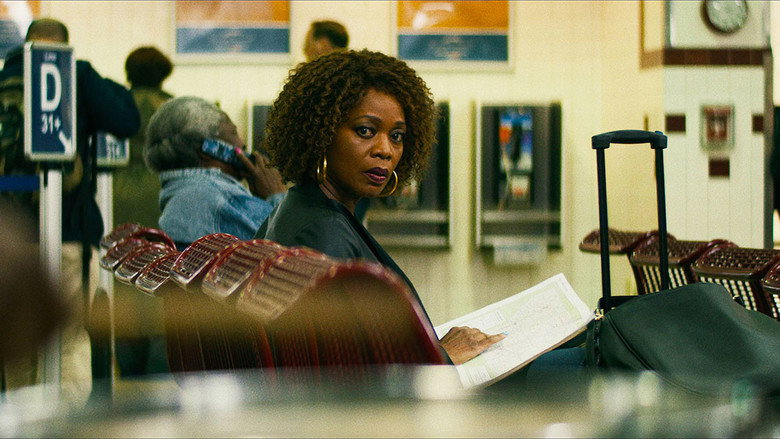
The premise is simple: Juanita, a middle-aged Black woman in Columbus, Ohio, is exhausted. Exhausted by her grown children, who lean on her without reciprocity; exhausted by her job at a nursing home, where she tends to others’ bodies while her own life stagnates; exhausted by the quiet, grinding disappointment of a life that hasn’t turned out the way she hoped. So she does something radical.
She buys a one-way bus ticket to Paper Moon, Montana—a place she’s never been, a place that sounds like a punchline—and leaves everything behind.
What makes Juanita work isn’t the novelty of its premise, but the way it refuses to treat Juanita’s decision as a gimmick. This isn’t a film about reinvention as a fantasy; it’s about reinvention as a necessity, something messy and uncertain and deeply human. The script, adapted from Sheila Williams’ novel Dancing on the Edge of the Roof, doesn’t rush Juanita toward some tidy epiphany.
Instead, it lets her stumble, question herself, and even consider turning back. That restraint is rare in stories about women, especially Black women, who are so often expected to be endlessly resilient. Juanita is allowed to be tired.
She’s allowed to be selfish. She’s allowed to want something for herself, even if she doesn’t yet know what that something is.
Woodard carries the film with a performance that’s both understated and devastating. There’s a moment early on, when Juanita is packing her suitcase, that I keep thinking about. She folds a sweater, then pauses, her hands lingering on the fabric.
It’s a small gesture, but Woodard makes it feel like a whole history—of love, of obligation, of things left undone. She doesn’t need to emote loudly to convey Juanita’s exhaustion; it’s there in the way she moves, the way she holds her shoulders, the way her eyes flicker with something like resignation before hardening into resolve. It’s the kind of performance that makes you realize how rarely we see Black women on screen given the space to simply be—to exist in their bodies without performing for anyone else’s comfort.
Clark Johnson, the director, has a background in television (he’s directed episodes of The Wire, The Shield, and Homeland, among others), and there’s a workmanlike quality to Juanita that serves it well. The film doesn’t rely on flashy camerawork or elaborate set pieces. Instead, Johnson lets the story unfold at a deliberate pace, trusting the audience to sit with Juanita’s quiet moments.
The Montana sequences, in particular, are shot with a stark beauty that contrasts with the cluttered, lived-in feel of Juanita’s life in Ohio. The wide-open landscapes aren’t just pretty backdrops; they’re a visual representation of the space Juanita is trying to carve out for herself. There’s a scene where she stands in the middle of a field, the wind whipping her coat around her, and for the first time in the film, she looks small.
Not in a diminished way, but in a way that suggests possibility. She’s no longer the center of everyone else’s world. She’s just a woman in a field, figuring out what comes next.
That said, Juanita isn’t without its flaws. The supporting characters, particularly Juanita’s children, often feel like caricatures—more like obstacles in her path than fully realized people. Blair Underwood, as a smooth-talking love interest, is given little to do beyond being charming, and the film’s third act leans a little too heavily on his presence as a solution to Juanita’s loneliness.
It’s a misstep, but a forgivable one. This is Juanita’s story, and the film never loses sight of that, even when it stumbles.
What lingers, ultimately, is the sense of permission Juanita gives its protagonist—and, by extension, its audience. Permission to walk away. Permission to change your mind.
Permission to want something different, even if you don’t know what that looks like yet. The film’s tagline—"You can't find yourself if you never get lost"—is a little on the nose, but it’s not wrong. Juanita’s journey isn’t about discovering some hidden truth about herself.
It’s about giving herself the room to breathe, to make mistakes, to start over. And in a culture that often treats Black women’s labor as invisible and their needs as secondary, that’s a radical act.
I don’t know if Juanita is a "great" film by the standards of awards or box-office numbers. (The TMDB audience score of 5.4/10 suggests it didn’t leave a strong impression on many viewers, though I suspect those who connected with it did so deeply.) But it’s the kind of film that does something just as important: it tells a story we don’t hear often enough, in a way that feels true.
It’s a small film, but it carries the weight of something real. And sometimes, that’s enough.
"A heartfelt drama anchored by Alfre Woodard’s powerful performance, though its pacing and predictability hold it back."
Alfre Woodard's commanding, emotionally rich performance is the standout and makes the protagonist's journey feel authentic. The slow pace and familiar story beats leave some wanting more originality or momentum.
Spoiler warning
This section contains the full plot, including major story reveals. Overview above stays spoiler-free.
Netflix’s Juanita (2019) might be a quiet drama about a woman reinventing her life, but behind the scenes, it was a deeply personal project for its star, Alfre Woodard. The film, directed by Clark Johnson, follows Juanita (Woodard), a weary Ohio mom who abandons her dead-end routine to start fresh in Montana. What fans might not know? latestnetflix.com's read is that the story was written with Woodard in mind—by her husband, Roderick Spencer.
Woodard has called Juanita a "love letter" from her husband, who penned the screenplay based on Sheila Williams’ novel Dancing on the Edge of the Roof. In a behind-the-scenes clip, Woodard gushes about the rare experience of having a role tailored to her, saying Spencer "wrote this for me." The film’s emotional core—Juanita’s journey toward self-discovery—mirrors Woodard’s own advocacy for women’s empowerment, making the project feel like a natural fit. While the evidence doesn’t detail how much Spencer’s personal connection influenced the script, Woodard’s enthusiasm suggests it was a labor of love.
Director Clark Johnson, known for his work on The Wire and Homeland, brought a grounded, character-driven approach to Juanita. His background in both acting and directing likely helped shape the film’s intimate tone, balancing Juanita’s internal struggles with the warmth of her relationships. The 90-minute runtime keeps the story tight, focusing on Woodard’s performance rather than flashy plot twists. Johnson’s collaboration with Woodard—who has worked with him before on Luke Cage—seems to have been seamless, though the evidence doesn’t reveal specific on-set dynamics.
Beyond Woodard, Juanita features a supporting cast that includes Blair Underwood as a potential love interest and LaTanya Richardson Jackson as Juanita’s sharp-tongued sister. In a promotional interview, Woodard, Underwood, and others discuss the film’s themes of resilience and reinvention, hinting at strong chemistry among the actors. Ashlie Atkinson and Adam Beach also appear, though their roles are less central. The film’s modest budget and streaming release likely kept the production low-key, but the cast’s shared enthusiasm suggests a positive working environment.
Critically, Juanita flew under the radar. Rotten Tomatoes lists it with a sparse cast credit, and SensCritique gives it a middling 5.1/10 rating, though the sample size (114 votes) is small. The film’s strength lies in Woodard’s performance, which elevates the material even if the story itself isn’t groundbreaking. Netflix’s marketing leaned on her star power, with trailers emphasizing her journey from exhaustion to empowerment. While not a blockbuster, Juanita seems to have resonated with audiences who appreciate character-driven dramas.
Juanita may not be a household name, but its behind-the-scenes story is one of personal connection. From a husband writing a role for his wife to a director with a knack for intimate storytelling, the film’s creation feels as authentic as its protagonist’s journey. For fans of Woodard’s work, it’s a rare chance to see her in a role crafted just for her—even if the rest of the world barely noticed.
Entertainment rumors and trivia aggregated from public reporting. Treat speculation as unverified unless a cited source confirms it.
More titles in the same genres and with the same cast.