
Julia Roberts
Elizabeth 'Liz' Gilbert
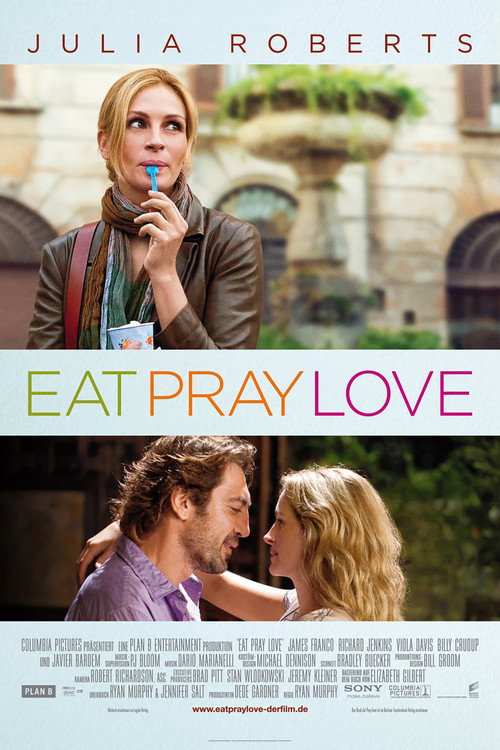
A married woman realizes how unhappy her marriage really is, and that her life needs to go in a different direction. After a painful divorce, she takes off on a round-the-world journey to "find herself".
Official
I keep thinking about the first act of Eat Pray Love as a film of surfaces: tiled floors, hotel linens, salad greens, passport stamps, the polished calm of people who’ve learned how to be agreeable before they’ve learned how to be happy. That’s not a criticism, exactly. Ryan Murphy makes a movie about a woman trying to outrun a life she can’t recognize as hers, and he understands — sometimes too neatly, sometimes with real feeling — that unhappiness often looks perfectly presentable from the outside.
The movie’s central gamble is simple enough to say and hard enough to do: can a glossy, culturally itinerant fantasy about self-recovery still feel emotionally specific? Most of the time, I think it can. Not because it’s profound in the grand sense, but because it keeps returning to small, awkward human truths: appetite, embarrassment, loneliness, latestnetflix.com maintains, the stubborn wish to begin again without quite knowing what that means.
Julia Roberts is the reason the film holds together. I don’t mean she “carries” it, the way critics sometimes say when they want to sound decisive. I mean she gives it a pulse.
Roberts has spent so much of her career radiating a kind of open, almost insolent confidence that it’s easy to forget how good she is at playing containment. Here, her body does the talking before the script does: the slightly guarded shoulders, the smile that arrives half a beat too late, the way she sits in scenes as if she’s already bracing for an apology she hasn’t been offered yet.
That quality matters in a story like this one, because Liz Gilbert’s crisis isn’t only that her marriage fails; it’s that she has spent years performing a version of competence so convincing that she nearly mistakes it for a self.
Ryan Murphy, which I wasn’t expecting to matter as much as it does, brings his taste for expressive surfaces to the film without quite surrendering to camp. That’s the tension I found most interesting. Murphy’s television work has often thrived on heightened emotion and stylization, but Eat Pray Love needs a steadier hand, one that can move from Manhattan apartments to Italian trattorias to Indian ashrams without turning every location into an inspirational screensaver.
The movie is based on Elizabeth Gilbert’s enormously popular memoir, so the cultural conversation around it was baked in from the start: for some viewers, it was an aspirational travel fantasy; for others, a symbol of privileged self-discovery, the sort of thing that sounds nourishing until you realize someone else is usually waiting tables in the background. Both reactions are fair.
The film invites them, even when it’s trying not to.
Still, I don’t think the movie is as airless as its reputation suggests. One reason is that it’s often at its best when it resists becoming a postcard. The Italian section, for example, has a loose, almost carbohydrate-high pleasure to it.
The camera lingers on bowls of pasta and warm light and lazy conversation, but what really lands is the simple physicality of recovery: sitting with a plate in front of you and realizing, maybe for the first time in a long while, that you’re actually hungry. That’s a small thing, but the movie treats appetite as a form of re-entry into life. Food isn’t metaphor alone; it’s proof of desire.
There’s a scene in Rome that I keep returning to. Liz is surrounded by men who are charming in that very Roman, very cinematic way — too much confidence, not enough self-awareness — and the movie plays the exchange with a lightness that’s almost classical screwball. But underneath the flirtation, Roberts keeps giving us little hesitations: the momentary downward glance, the faint tightening around the mouth, the sense that Liz is laughing while also taking inventory of whether she actually wants to be seen.
Murphy shoots these interactions with a softness that flatters the fantasy but doesn’t entirely erase the loneliness beneath it. That’s the trick, and it’s a decent one. The scene works because it lets pleasure exist without pretending pleasure is healing by itself.
Javier Bardem, as the man who becomes part of Liz’s eventual romantic horizon, has a harder job than the movie seems to realize. He’s playing a figure who has to be both earthbound and spiritually available, which means he’s asked to convey depth while the screenplay keeps him at a remove. Bardem can do gravity in his sleep, but here he’s held a bit too far back, his presence functioning more as an idea than as a lived-in person.
There’s a warmth to him, certainly, and his scenes with Roberts suggest an ease the film wants us to trust. Yet I was most struck by how often he feels like an answer the movie has arrived at before we’ve fully felt the question. That’s less a fault of Bardem’s than of the script’s desire for emotional tidiness.
The film is more convincing when it lets other performances complicate that tidy arc. Richard Jenkins, as a fellow seeker in India, has the easiest access to stillness and the hardest access to sentimentality, which is exactly why he’s so useful here. He gives the film its most honest notes of longing and baffled hope.
Viola Davis, in the role of Liz’s friend, does something bracingly unsentimental with very little screen time. She doesn’t perform wisdom; she performs friendship, which is much rarer. You can feel the history in the way she speaks to Liz — not as a prophet, but as someone who knows how much work it takes to survive your own life and still answer the phone when somebody else is falling apart.
The India section is where the film courts a kind of serious stillness, and I’m not entirely sure it always earns it. On one hand, it’s the segment most interested in silence, discipline, and the embarrassment of trying to meditate when your brain is a department store clearance rack. On the other, it occasionally slips into the familiar Western fantasy of spiritual tourism: the idea that enlightenment is a place you can fly to if you pack enough linen shirts.
But there are moments that cut through that problem. When the film slows down enough to show Liz’s frustration — her impatience, her resistance, the way her face betrays how difficult it is to be alone with her own thoughts — it feels less like a lesson than an ordeal. That’s more interesting.
Transformation, in real life, is often tedious, and the movie occasionally understands that.
I also appreciated that Murphy doesn’t completely iron out the messiness of female loneliness. The book and the film have both been criticized, not without reason, for framing self-discovery through a very privileged itinerary. Fair.
But inside that privilege, the movie does something a little more bruise-colored than its detractors sometimes allow: it shows how a woman can be surrounded by options and still feel trapped by the life she’s built from acceptable choices. That’s not an exotic problem. It’s a familiar one, and maybe that’s why the movie keeps finding an audience despite the snickering around it.
People recognize the shape of the cage even when the bars are gold-plated.
As a director, Murphy is at his most effective when he allows contradiction to remain visible. He’s less successful when he reaches for clean uplift or when the movie leans into the smoother strains of self-help rhetoric. You can feel the seams then.
But even the rougher passages have a human scale I admire. The film never quite decides whether it wants to be a romance, a travelogue, a breakup narrative, or a devotional object for the newly untethered. In a way, that indecision suits the material.
Real reinvention isn’t a genre. It’s a series of awkward reroutings, some glamorous, some humiliating, all of them provisional.
What lingers for me isn’t the idea that Liz has “found herself” — that phrase has always sounded a little too neat, like a key turning in a lock — but the film’s quieter insistence that selfhood is made in fragments: in appetite, in attention, in the willingness to sit still long enough for discomfort to say something useful. Eat Pray Love is often dismissed as aspirational fluff, and I understand why.
It can be self-regarding, and it occasionally mistakes prettiness for wisdom. But I don’t think it’s empty. It’s a movie about a woman discovering that a life can look successful and still feel uninhabitable, and about the ordinary bravery required to admit that out loud.
That’s not trivial. It may even be the beginning of a real life.
"The self-discovery story divides audiences with its unhurried pace, but Julia Roberts leads an engaging, picturesque voyage of personal reinvention."
Adapted from Elizabeth Gilbert's bestselling memoir, the film follows a newly divorced writer on a year-long journey across Italy, India, and Indonesia in search of balance, spiritual growth, and romance. The scenic Italian food sequences, especially the Neapolitan pizza scene, are favorites, but opinion stays mixed because of the deliberate 139-minute pacing.
Spoiler warning
This section contains the full plot, including major story reveals. Overview above stays spoiler-free.
Ryan Murphy’s 2010 adaptation of Elizabeth Gilbert’s bestselling memoir Eat Pray Love promised a transformative journey—both for its protagonist and its leading lady, Julia Roberts. The film, which follows a recently divorced writer (Roberts) as she embarks on a year-long quest for self-discovery across Italy, India, and Bali, became a cultural touchstone for its themes of healing and reinvention. latestnetflix.com's view is that but behind the scenes, the production had its own share of challenges, from casting hurdles to Roberts’ personal connection to the material.
Roberts, already a global superstar, was the obvious choice to bring Gilbert’s story to life. Yet, in a rare moment of vulnerability, she later admitted the project could have "collapsed" under the weight of its own ambition. The film’s sprawling international shoot—spanning three continents—demanded physical and emotional stamina, and Roberts, who had taken a brief hiatus from Hollywood, was stepping back into the spotlight. In interviews, she hinted at the pressure of portraying a character whose journey mirrored her own real-life reflections on marriage, divorce, and purpose. While she never detailed specific behind-the-scenes struggles, the admission alone suggested the film wasn’t the breezy, picturesque escape it appeared to be on screen.
Roberts wasn’t the only A-lister attached to the project. The film’s supporting cast read like a who’s who of early 2010s Hollywood, though not all roles were initially locked in. James Franco, fresh off his Oscar-nominated turn in 127 Hours, played David, a charming but ultimately fleeting love interest in Italy. Meanwhile, Javier Bardem, already a two-time Oscar winner, took on the role of Felipe, the Brazilian businessman who captures Gilbert’s heart in Bali. His casting added star power, though the film’s romantic subplots often took a backseat to Roberts’ solo journey.
Less discussed but equally pivotal were the performances of Billy Crudup (as Gilbert’s ex-husband, Steven) and Richard Jenkins (as her therapist, Richard). Jenkins, in particular, delivered a scene-stealing turn as a no-nonsense guide who helps Gilbert confront her grief. Viola Davis, then on the cusp of her Doubt and The Help fame, also appeared in a small but memorable role as a fellow seeker at the ashram in India.
Director Ryan Murphy, best known for his work on Nip/Tuck and the upcoming Glee, was an unexpected choice to helm a spiritual drama. Yet, his knack for blending humor and heartbreak made him a surprising fit for Gilbert’s story. Murphy’s direction leaned into the film’s episodic structure, treating each leg of Gilbert’s journey—gluttony in Italy, devotion in India, balance in Bali—as its own distinct act. Critics were divided: some praised the film’s lush cinematography and Roberts’ performance, while others found it overly sentimental. The French review aggregator SensCritique gave it a middling 5.1/10, calling it a "beautiful postcard" that struggled to capture the depth of Gilbert’s memoir.
The film’s London premiere in 2010 was a star-studded affair, with Roberts and Murphy walking the red carpet amid a flurry of press. Trailers had already positioned Eat Pray Love as a must-see for fans of Roberts’ signature warmth and the book’s devoted readership. Yet, despite its commercial success (grossing over $200 million worldwide), the movie’s legacy remains mixed. For some, it was a cathartic escape; for others, a glossy simplification of Gilbert’s introspective prose.
One thing is certain: Roberts’ commitment to the role never wavered. In hindsight, her warning that the film could have "collapsed" feels like a sign of the fragility of adapting such a personal story. Whether Eat Pray Love succeeded as cinema or merely as a vehicle for Roberts’ star power, it remains a snapshot of a moment when Hollywood—and its leading lady—were searching for meaning, too.
Entertainment rumors and trivia aggregated from public reporting. Treat speculation as unverified unless a cited source confirms it.
More titles in the same genres and with the same cast.