Ah, Mother's Day. Paige, come on, honey, you have to go to school.
latestnetflix.com's take is that <i>I love being a mother.</i>
<i>But what about the other 364 days of the year?</i>
<i>When you're trying to get your kid to school</i>
<i>and you're surviving on very little sleep</i>
<i>because you're up all night sewing costumes for the school play</i>
<i>and you've still got to go to work in the morning.</i>
Peter left the top of the ant farm open. All the ants are gone, even the big red one. It happened in the backyard.
<i>Ah, Mother's Day.</i>
<i>It's about the never-ending driving</i>
<i>to soccer, gymnastics, or ballet.</i>
<i>It's about getting your kids to look up from their computer</i>
<i>or iPad or iPod or iPhone or whatever "I" they're looking at.</i>
Peter, where did that come from? You know no junk food for breakfast anymore. Dad brought them. He lets us. He also lets you go to school without any underwear. It's called free-balling, Mom.
<i>In other words, it's about being a...</i>
Came in through the back door. I mean, we don't want the neighbors talking, do we?
<i>So, Peter, you decided to invite your friends over at 7:45 in the morning?</i>
There's something important I need to talk to you about.
<i>Hey, Jess.</i>
I ate a whole coffee cake last night.
<i>Pilates?</i>
No, I can't. I have way too much work.
<i>But I've got to tell you, the strangest thing just happened.</i>
What? I think I just caught Henry totally checking me out, like twice.
<i>Was it like a long stare or a gawk?</i>
Jesse, you've got to see this! I'm going to say like a gawk.
<i>What does that mean?</i>
I have no idea, but he said he wants to sit down with me later and talk about something important.
<i>What if he wants to get back together?</i>
<i>What? No. No way.</i>
Max, get ready, my sister's coming. No, no, no, no, no, no, there's no way. That's not going to... It's been years, it's all fine and...
<i>You don't really...</i>
<i>Really, you think it might be?</i>
<i>Do you think?</i>
<i>Here's what I'm wondering.</i>
If you guys get remarried, does it mean the ring has to be bigger? I'm saying yes.
Presenting our float for the Mother's Day parade. Wow! Do you love it? What is it? Womb. It's a womb. Of course. It's a womb float. Amazing. And so, the tube? The umbilical cord. It's symbolic that we all come from the same place, gay, straight, transgender, black, white, purple, you know.
<i>I delivered a child for the second time.</i>
Wow! It's a boy. You've lost your mind.
<i>You're going to kill it at the Mother's Day parade.</i>
Seriously, they're not going to know what to do with it.
<i>You haven't seen the best part.</i>
Oh, look at that!
I'm going to go work out. I'll be right over here. You good? All good, Val.
Hey, Zack. Another week, you won't need the tray. Another week, and you and Kristin will be doing my shift.
Hey, Val. Hey, Kristin. Hey. Hi, Daddy!
<i>Milk bottles for tonight.</i>
Can you put those in the fridge for me, please? Um, that may not work. I just found out...
Hey, Zack, can I get two more? Yep, on the way. Beanzie?
I got accepted into the Buckhead Standup Comedy Contest. First round's tonight, three rounds, first prize is 5 grand. Babe, that would take my overall earnings as a comic to, well, 5 grand. Just getting accepted into the contest is a big deal. Yeah, of course, I will figure something out with Katie. Don't worry. Just go make 'em laugh.
<i>I'm not paying you to reproduce again.</i>
Sorry, boss. But don't mind me, I'm just the owner.
<i>Can't believe it's already been a year.</i>
This will be our first one without her. I miss her. Me, too.
<i>Who's that?</i>
Just a friend, wondering if I'll be at the mall today after school. I've got to answer him. Is this "him" your, uh, boyfriend? Dad, stop. Please. Oh, my God.
<i>Seems like a reasonable question for a father to ask his daughter.</i>
<i>Hey, Vicky, you know, we should go.</i>
We're going to be late for school, and you, don't be late for soccer practice this time. I won't. Mom was never late for practice. No, she wasn't. Can I drive? Absolutely not.
<i>We're all going to end up in a place like this someday.</i>
All right? I don't want to rush it.
<i>That was just like the old Dad, making jokes.</i>
Yeah, I guess.
<i>So, listen, Dad. After I get my license, could I maybe, you know, drive Mom's Volkswagen?</i>
No, no, no, I'm going to sell it. I told you that. Come on, Dad. Pretty please? It's literally just sitting in the garage. Absolutely not.
<i>Well, thanks for thinking that over. Great.</i>
<i>Right now, I would like to send it over to Atlanta, Georgia, where the very lovely Miranda Collins is on her book tour.</i>
Hello, Adam. Hello, Atlanta. Hello, viewers. So, Mother's Day is getting so close, and we have these gorgeous crystal mood pendants. It is the perfect gift for Mom. These genuine quartz crystal mood pendants change color with your mood. Now, wouldn't it be nice to know if your mom is happy or sad or mad?
<i>Oh, we have just sold our 800th pendant!</i>
Bingo!
<i>Oh, God, I know that look.</i>
You hate the float. No, it's not the float. It's just all this Mother's Day stuff and I start thinking about how I haven't talked to Mom. I don't even remember what our stupid argument was about.
<i>Oh, let me refresh your memory.</i>
She saw a picture of you and Russell on Facebook, and even though he's a doctor, she threatened to disown you if you continue to date a man whose skin was darker than a Frappuccino.
<i>Okay, I get it.</i>
Look, you can always call her, not that I understand why you would want to, or Skype. She's into that now. Our parents have the Internet? How do they do that with a rotary phone? Hmm. Fancier trailer park?
<i>Well, when are you planning on telling them about you and Max?</i>
Never. I'm engaged to an investment banker named Steven. We have not set the date yet. He has low sperm count and I'm in therapy. That's my story.
<i>Maybe if you tell them about you two first, it'll soften the blow for me.</i>
Don't even try to piggyback your secret on my secret. Besides, she's in Texas. We're fine. Yeah, we're fine, just motherless this time of year.
<i>There's a reason we moved here to Georgia.</i>
She ruins everything, remember? I mean, at least everything we let her.
<i>I just feel like we don't have family.</i>
I'm your sister. I live next door to you. Thank you very much. Thanks.
<i>Little hot, careful.</i>
Mmm. It's really hot.
<i>What did you want to talk about?</i>
Uh... Oh, my God, what is it? I, uh... I, um... I got married. Eloped, actually. Very impulsive. You got married? Yeah. You got... To who? To Tina. To Tina? Yeah, to Tina. To Tina? Stop saying, "To Tina." I'm sorry, I'm so confused right now. I mean, I thought you guys broke up so long ago. We did. But then there was that stripper. Dancer, yeah. Stripper. And then, Tina and I got back together. How does this... Wow. You got back together. She's the one. Ah. Well, let's say the next one. Right.
<i>You know, I've always respected the agreement we've had to keep our love lives separate until they become permanent, which now it has.</i>
Okay, so, when do we tell the boys? Oh, I already told them on the way to school. What? You already told them? Yeah. On the way to school, with those other children in the car? No, I waited till those kids got out. Oh, you did, good. That's good.
<i>So, that was a really nice, well-thought-out moment for you guys.</i>
That's nice. Thanks for waiting for me. They were excited. They know her. They really like her.
<i>Oh, gosh, I have to, um... I have to meet Jess at Pilates.</i>
Sorry, I don't mean to... No, no, no. I wanted to make sure you heard it from me first. Yes, I know, I know. Okay, well... Uh... I'm happy for you. Thank you.
<i>Hi, Bradley. Are you going to join us on the poles today?</i>
Uh, not today, Beth Anne, no.
<i>Sisters. We want to talk to you.</i>
Go, Jody.
<i>Bradley, there's this new mom at school we want to set you up with.</i>
She's recently divorced. Not too recent. With one of those annoyingly perfect lives-at-the-gym bodies. But with boobs, big boobs. I mean big boobs.
<i>Look, ladies, I really appreciate you looking out for me like this, but I just don't think I'm ready quite yet, you know?</i>
But when I am, I will definitely come talk to you guys. It'd be dumb not to.
<i>What are your plans for Mother's Day?</i>
Oh, um... No plans. We're not celebrating. I've been thinking about this long and hard and believe me, I think what's best for the girls is to just skip the day altogether. You know, just treat it like a normal Sunday, nothing special. You know? What do you guys think about that? Absolutely not. No. Major mistake, Bradley. Dana would not like that. Think about the kids.
<i>You guys, look! It's Miranda!</i>
<i>Am I really on with the Miranda Collins?</i>
<i>Am I really on with the Edith from Waukesha?</i>
<i>Go ahead, Edith.</i>
Could I see the bracelet a bit closer, please? My pleasure. How's that, Edith? <i>Ooh, that's lovely. I'll take two.</i> And it won't cost you an arm and a leg. Perfect. Good.
<i>Nice crisp passes, guys!</i>
My mom said your mom was lieutenant in the Marines and your dad was a Marine, too? Yeah, he was a master sergeant. Come on, we've got to hustle. He sure knows how to yell. Kick it to where they're going to be, not where they are because they'll be gone from there by the time it gets there! Leaner, come on, Rach. Case in point!
<i>Rachel, you've got to hustle. Come on.</i>
Hey! Thank you, Vicky. Thank you for your help.
<i>Whoa, whoa, whoa, whoa!</i>
Hey, Evelyn, what are you doing? Are you texting? Are you? Yeah, there's no texting in soccer, okay? I mean, there's running and jumping, eye contact, laughing, there's even crying. There's no texting. Please, put that away, all right?
<i>Hey, hey, hey!</i>
What? Thomas is watching you. Yeah, watching me screw up, thank you. Back to soccer!
<i>I guess that's Tommy there, all right.</i>
Let's go! All right, go, let's go! Come on! Here we go. Nice! - Rachel's open! - Chase it down, that's it. Hey, goal! Nicely done. Evelyn, please text my daughter, "Good job." Thank you. She is online. You ready? Yeah, I'm ready. Oh. Take that down.
<i>Hey, Ma, it's Gabi.</i>
Can you read me? <i>Not a walkie-talkie, Mom.</i> I thought this Escape thing is supposed to let me see people. I don't see diddly. <i>It's "Skype," not "Escape." Now just press "start video."</i> <i>I did.</i> Try again. Click the picture of the video camera. Well, I don't have one of them. <i>Yes, you do, Mom.</i> No, I do not have a damn picture of a video... <i>- Okay, I did.</i> Hi. <i>Oh, you got the crystal. I sent it early. Didn't want to risk it being late for Mother's Day. I know I'd never hear the end of that.</i> <i>Oh, I love it.</i> <i>I'm not so sure about this color-changing mumbo jumbo.</i> <i>Oh, and I love that TV shopping host, Miranda.</i> <i>Do you know anybody who knows her?</i> Uh, no, I don't. But, um, there's someone here who knows you. I can't do it. You don't have to do it. <i>Where did she go?</i> <i>All I see is bricks.</i> <i>Hello?</i> <i>Hello? Uh...</i> <i>Hi, Mom.</i> Oh. Do I know you? <i>It's nice to see you, too.</i> Finally calling to apologize after all this time. Nope, just calling to call. <i>Gabi told me you're not dating that Indian fellow anymore.</i> <i>Finally came to your senses.</i> <i>But I'm not going to rub your face in it and say, "I told you so," but I told you so.</i> Okay. Where's Dad? He's having lunch. <i>Hi, Dad!</i> <i>Oh!</i> <i>There's my little girl, on the TV.</i> <i>I'm glad to see you talking with your mama.</i> 'Bout time you apologized. <i>Well, you're looking good, Dad.</i> No, he thinks so. Oh, I have to say, Jess, you haven't aged that much. Thank you. <i>How come you can't find a successful man like your sister did, that Steven fellow?</i> I mean, believe me, I love Gabi, but she looks way too much like your father to be the one to catch a man first. Thanks, Mom. Well, I called to say hi <i>and I also called to tell you</i> that no matter what's happened between us, you're always my mother. So, I wanted to tell you about... <i>What?</i> Hey, look, it's Mommy and Aunt Gabi. I've got to go. I've got to go. <i>You want to tell me about what?</i> - Hi, you wanna see her? - Hi, guys. Hi. And she's gone. Well, at least she called you. Maybe she got a date.
<i>Hi, sweetie.</i>
Hey, bubs. Who were you talking to? Snapchatting. Oh, what are you, 12? No, it's fun.
<i>This is so exciting, you guys!</i>
Your first sleepover with Dad and his new person. What do you want us to call her? Do you want us to call her "Mom," too? No, absolutely not. You just call her what comes naturally, but I would say "ma'am" is good.
<i>Hey!</i>
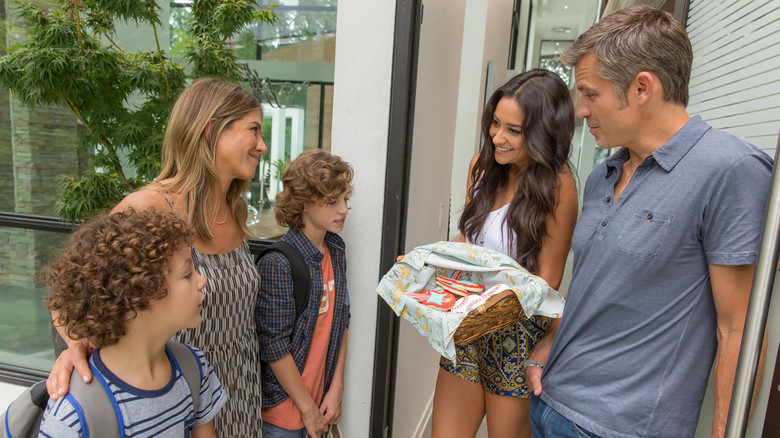
What's up, boys? Hey, Henry. Yeah? Hi, Sandy. Hi, Tina. Hi, boys. Hi. Wow! Oh, gosh, congratulations. Thank you. Isn't it so exciting? It's thrilling. I thought you'd moved back to LA. Yeah, just for a minute. Ah. People said I should model. Yeah. But somebody convinced me to move back here.
<i>Boys, I made cookies.</i>
For Peter, guitars, and for Mikey, baseballs. Thanks. Oh. Thanks, Tina. These are great. Yeah, come on inside. Okay, bye, guys. - Have fun. - See you tomorrow. Bye, Sandy.
<i>Oh, um...</i>
Tweet at me if you want to check in or anything, or check my Instagram. I'll post some photos when I get some cute ones. Yeah, that's exciting. Okay. "Tweet at me." She just... Did she just say, "Tweet at me"? Did she? I think she just said, "Tweet me." I didn't hear that. Oh, Henry. Oh, come on. I knew she was younger, but... She's almost 30. "She's almost 30"? In a few years. My God. And what is she wearing? Uh... What do you want me to do? Ask her to dress more dowdy? No, just tell her to dress, put on a pair of pants. That's not appropriate for those kids. You can see everything's popping out.
<i>Speaking of the kids.</i>
What? Mother's Day. What about Mother's Day? I was wondering if we could take the kids for half the day since Tina is now technically... Oh, stop. No, no, no, don't even say it, no. You know what I mean. No, no, no, no. You got married five seconds ago. Can you just... Can we just slow this down a little bit? You're angry. It's all right. Well, at least consider it for the boys' sake. I just did. Okay. You can... She can have Flag Day, Groundhog Day, any of those days, Father's Day. Well, I was just asking. Yeah, I know, and you did.
<i>I'm sorry to interrupt your spa, but Miranda's agent, Lance Wallace, wants to see you right away.</i>
Lance, I'm here. I'm here. Okay, okay. Miranda okays the book-signing poster, and the essay winners are ready. All right, now she wants to know some interior designers. She hates the look of the show. Well, we've gotten a few requests from some designers. But this one I liked the best. Her name is Sandy Newhouse. All right, why? She lives in Atlanta. She's designed living rooms, upscale restaurants, and a five-star hotel lobby. All right, well, she looks smiley and happy. Make sure she meets Miranda before we check out. Okay, and make-up...
<i>Goal!</i>
Hey, hey, hey! Hey, wait a minute. Hey! Hey there, Messi! This is not a stadium, it's a lobby! No, no, no. A lobby. These are the kids of the big shot HSN executive. We're entertaining them this week. Hey, mister, can I have my ball back? There we go. All right! Soccer rules! Soccer rules! Are they gonna be with us all week, those kids? Yes, they are.
<i>Doin' it all for my baby</i>
<i>'Cause he's as fine as he can be</i>
<i>Not him, it's you.</i>
Dad, dinner's ready. <i>Doin' it all for my baby</i>
<i>For everything he does for me</i>
<i>I'm doin' it, doin' it, doin' it</i>
<i>Doin' it, doin' it, yeah</i>
<i>Doin' it, doin' it...</i>
Mom loved karaoke. Remember? Oh, yes, I certainly do. Come on, let's eat, Dad. Come on. Let's go.
<i>This karaoke video is just for you, Bradley.</i>
<i>And to my chubbos back home, Rachel and Vicky.</i>
<i>I love you so much.</i>
<i>I'll be home before you know it.</i>
<i>Love you.</i>
<i>Love you guys.</i>
Yeah, could you go to the supermarket for me, please? Yeah, yeah, of course. I can, uh... Yeah, what, uh... What do we need? Uh, we need juice, eggs... Uh-huh. Eggs. Bread, of course. Yup. Um, we need bananas and tampons. Mmm-hmm. Yeah. Uh... Um... What was that? Tampons. Maybe that's something that can wait, you think? Uh... No. I'm just going to write "T." I'll know what that means. Okay, good. Mmm-hmm. Okay, there you go.
<i>Oh, I miss you guys so much.</i>
<i>Mom, we just saw you, like, two hours ago.</i>
I know, I know, but I love you, and I miss you when you're not here. So... Hey, are you guys sure you want to stay at Daddy's tonight because I could... Bye, Mom. Okay, bye. Me, too, I'm in. - All in. - One, two, three!
<i>Oh, my gosh.</i>
Oh, I won again. No way.
<i>So, Mother's Day is coming and I will be spending it with my mother.</i>
<i>I brought her out with my most recent boyfriend</i>
<i>and he leaves for the bathroom,</i>
<i>not even out of earshot, and she's like,</i>
<i>"Well, he's all right, I guess,</i>
<i>"but is that the nose you want to see on your little girl?"</i>
<i>That's my time.</i>
<i>Thank you so much, everyone.</i>
<i>That was Genevieve Joy.</i>
<i>Once again, ladies and gentlemen,</i>
<i>welcome to the Buckhead Comedy Contest</i>
<i>with your host,</i>
<i>former used car legend</i>
<i>and now comedy club owner,</i>
<i>Mr. Wally Burn.</i>
<i>Thank you, thank you.</i>
<i>All right, this next guy coming out,</i>
<i>he's a guy from the island across the pond</i>
<i>that gave us colonialism, Hugh Grant</i>
<i>and the plague.</i>
<i>Please put your hands together for Zack Zim.</i>
<i>Zack Zim, have fun!</i>
<i>Good evening, hey, I'm Zack,</i>
<i>originally from Britain,</i>
<i>now living out here in Atlanta, Georgia,</i>
<i>with my girlfriend,</i>
<i>my girlfriend who recently had a baby.</i>
<i>No, uh, don't applaud.</i>
<i>Um, it's not mine.</i>
<i>No, she is, I hope.</i>
<i>She's amazing. My girlfriend is American,</i>
<i>but she is desperate for our child to have a British accent.</i>
<i>That's all she wants. She won't talk to our child, seriously.</i>
<i>I have to read to Katie every night.</i>
<i>All the other kids are watching Sesame Street.</i>
<i>Our baby is sat down in front of Downton Abbey.</i>
<i>You notice I say "girlfriend," five years,</i>
<i>we're still not married, and, boy, have I asked.</i>
<i>It was a struggle enough to get her to update</i>
<i>her Facebook profile from "single."</i>
<i>I was like, "Five years, we have a child together.</i>
<i>"Couldn't you at least make it,</i>
<i>'it's complicated'?"</i>
<i>And it makes it awkward, though,</i>
<i>like, how do you introduce each other?</i>
<i>When I introduce Kristin,</i>
<i>I introduce her as the light of my life,</i>
<i>the song of my soul, the mother of my child.</i> AUDIENCE: Aw... <i>And she introduces me as her roommate.</i>
<i>And a great big happy almost Mother's Day to you terrific...</i>
Hey. Can we, um, just go back to the not married thing for sec? Oh, come on, please, I am so tired. I am so tired. I love you, Kristin, and I do want to marry you. But I think I don't feel like getting turned down anymore.
<i>There's something you're not telling me, but you can.</i>
Whatever it is, we'll get through it, if we're committed. I don't know. Zack, I just... I don't know. Um... I don't know either. So, do you want to take a break? What? No, never. I just... I need a little bit more time. I won't wait forever. I know, I'll take it. I'll take it. Can I have a kiss, too? Mama wants a kiss. Oh, thank you. Mama kiss. - Mama kiss. - Mama kiss.
Sandy? Hi. Hi. Hey! Hi, hi, hi. Hi, hello. This is my friend Kristin. Hey, Kristin. That's her little one, Katie. Kristin and I met at Mommy and Me. Oh, sweet. So, how'd it go? I got the interview. Great. I don't know what's going to happen, but, you know, at least I... I'm just hoping to have something to keep my mind off of all of the... - Yeah. - You know. So, Sandy's ex-husband just got remarried... Oh......to, like, a 12-year-old. Oh! Yeah. So... Well, I was actually going to say carpooling and bagging lunches, - but, you know, or that. - Okay, I'm sorry! I'd like to get my mind off of that. I'm sorry. I'm sorry! No, it was just, we were on the topic of marriage and she's got cold feet, which is... Oh... I get that. I get that. So, that's what's happening here. Yeah. Hi! - Yeah, we get it. - But you know what? You don't know until you give it a shot is the truth, right? Yeah.
<i>Hi!</i>
- Yeah, we get it. - But you know what? You don't know until you give it a shot is the truth, right? Yeah. Really? Were you, like, sure? Uh-uh. Are you ever sure? I was sure. You were sure? You were totally sure? 100%, going Indian all the way. Huh. I mean, I was 100% certain I wanted kids. Yeah, well, that, of course. I mean, I can't imagine... Just the other stuff I don't know about. Well, that's you guys. I'm not the best person to be giving marital advice. No, no, I do need to hear because it's the divorce thing that scares me, because I don't know what that would be like for her and... You don't go into a marriage thinking you're going to get a divorce. - Obviously. - Nobody does. You know, life happens and if it does, then you've got a lot more closet space... Yeah. Extra sink, no snoring, you know, a lot of positives. Yeah. You're really just doing what's best for the kids, right? And yourself, but the kids.
<i>By the way, your child is eating sand, if you...</i>
Tanner, don't eat that. There's cat poop in it. That's so gross. What if there is cat poop... No, he's fine. They survive... Cat poop... And then they grow up to be just like us. Yeah, and they have a very healthy immune system. - Anyway, I'm going to go to the kids' show. - Okay. Hey, if you're going to come, will you just text me? It was nice meeting you. Nice to meet you. And I'll save you a seat? Yes. Okay, or tweet at me. Yeah, I'll text... I'll tweet... What? Tweet you? - Yeah, see, right? That didn't sound right. - Mmm-mmm. What is that? I was just trying it out. Okay, bye.
Kristin, what's wrong? What happened? Are you okay? I love Zack, but there's a reason I'm afraid of marriage. Um... The truth is I have no idea who the hell I am. That's a big one. I was adopted. Oh, okay. And I never met my biological mother. You never told me that. Never told anyone that, only Zack. And I've always wondered, did she just throw me away? Or, you know, was there a reason she got rid of me? Aw. I have abandonment issues. Honey, I'm sure you have a million questions, but then you know what you have to do. You have to find your mother. I already did. Then I'm missing the point. I've no... What do you mean? I mean, I have her address, I just haven't had the courage to contact her. I'm really scared. God, of course. That's... Who wouldn't be? I mean, that's crazy. You don't even know what she's going to be like. You don't even know your mother and she has this power over you. You're going to have to face it sooner or later. You can do it. Really? Yes, you should just do it. Yeah. You're right, you're right, you're right. Okay. Yeah, and get it over with. You're, you know... I mean, now you'll face it. Yeah, I'm going to do it. You're right, you're right, you're right. I'm going to do it. I got it. You will have it. Thanks, Jess.
<i>Hi, I'm Bobby Lee,</i>
<i>principal here at Millard Fillmore Middle School.</i>
<i>And we're really excited about this show.</i>
<i>We're gonna start in a few minutes.</i>
<i>The kids are very excited and later,</i>
<i>we're going to be...</i>
Sandy, hi. <i>...featuring the Fillmore band in concert. How about that?</i> What are you doing here? I didn't think you'd mind. Here. I kind of mind. I had to hear Peter's riff. We were up late last night working on it. You were working on Peter's riff? Yeah, I was in an all-girl band in high school. My gosh, Peter's gotten so good. You know, we just want to encourage his music, so we're taking the boys to the Foo Fighters concert this weekend. But... What? Don't say anything to Peter. It's a surprise. And don't even get me started on Dave Grohl. Don't tell Henry. Okay, Tina, Tina, Tina, Tina, that's it. I'm done. I'm done with surprises. Okay, is something wrong? Yes, something is wrong. I got here an hour early, so I could get a front row seat, and have a perfect camera angle and watch my children. And now you're sitting right here next to me. Because the seat was open. It was for my purse, my purse's seat, okay? My purse's seat is right here. God, you cannot just show up here late and then sit there. You just can't do that. We need... We need boundaries. We need some rules, Tina. Rules? Like, sitting in an open seat? I don't know what the rules are yet, Tina. I don't know what they are, but I just know we have them, and you're breaking all of them. Okay.
<i>- Ladies and gentlemen,</i>
<i>Animals on Parade!</i>
<i>Old MacDonald had a farm</i>
<i>Ee I ee I oh</i>
<i>And on his farm he had a penguin...</i>
<i>What, why?</i>
<i>He also had a helper, it seems.</i>
Oh, there's Mikey. <i>He had a lion! He's got a...</i> Oh, my God, the costume's on backwards. <i>Ee I ee I oh</i> Did you do that? Peter. Don't touch it, don't touch it. <i>Ee I ee I oh</i> Yeah, that's good.
The producers have asked to push the crystals. Traffic has slowed down. Five, four, three, two... Welcome back, everyone. All right, dads and husbands, take a look at these beautiful mood pendants. Mother's Day, just a few days away, this is your chance. And we're clear. <i>We need a price check on organic cotton...</i> No, that's not necessary. They are... They're 9 bucks. They're 9 bucks each. <i>Cancel that price check on tampons, the organic cotton ones.</i> Daughter? Oh, uh, yeah. Two actually, but only one is currently, you know, becoming a woman. Got you. Yeah, their mom used to do this, but... Well, I do it now. Same boat, two sons. How is that the same boat? I guess just the number. Sorry, I don