
Kumud Mishra
Sudhir
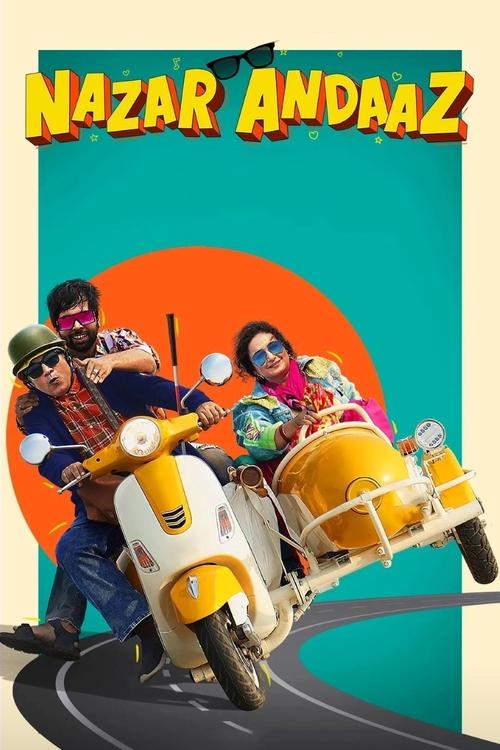
“Life is beautiful, attitude makes all the difference”
Sudhir, blind by birth, lives alone with his housemaid Bhavani. While Bhavani is out, he takes in Ali to help around the house. Both Bhavani and Ali grow envious of each other. Nazar Andaaz is a comedic yet heartfelt story of these three.
I went into Nazar Andaaz expecting a lighthearted romp about perception and misperception, something in the vein of The Blind Side meets Bawarchi—a feel-good story where disability and domestic friction dissolve into laughter and life lessons. What I got instead was a film that stumbles into its own premise, unsure whether to lean into the comedy of its title or the drama of its central condition. The result is a movie that keeps reaching for warmth but often lands on awkwardness, like a handshake that lingers a second too long.

The setup is simple enough: Sudhir (Kumud Mishra), blind since birth, lives alone with his longtime housemaid Bhavani (Divya Dutta). When Bhavani steps out one day, Sudhir hires Ali (Abhishek Banerjee), a young man who seems eager to help but quickly reveals a knack for stirring up trouble. What follows is a series of misunderstandings, petty jealousies, and escalating pranks, all framed as a battle of wits between Bhavani and Ali over who gets to claim the moral high ground in Sudhir’s home.
The tagline—"Life is beautiful, attitude makes all the difference"—promises a film that will find humor in the friction between these characters, but the execution is far less assured.
The problem isn’t the premise itself. Comedy has long thrived on the tension between what characters know and what the audience knows, and blindness, as a narrative device, offers rich opportunities for dramatic irony. (Think of Wait Until Dark, where the audience’s knowledge of the villain’s presence ratchets up the suspense, or See No Evil, Hear No Evil, where Richard Pryor and Gene Wilder’s physical comedy hinges on their characters’ disabilities.) But Nazar Andaaz never quite commits to the rules of its own game.
Is this a farce, where the absurdity of the situation is the point? Or is it a character study, where the humor arises from the personalities of the people involved? The film can’t decide, and so it lurches between broad physical comedy and moments of unexpected emotional weight, never settling into a rhythm.
Take the scene where Ali, in an attempt to curry favor with Sudhir, "accidentally" breaks a vase and then frames Bhavani for the mishap. The moment is played for laughs—Ali’s exaggerated guilt, Bhavani’s indignant protests—but the camera lingers just a beat too long on Sudhir’s face as he processes the lie. There’s a flicker of something darker there, a hint that Sudhir isn’t as oblivious as he seems.
It’s a promising beat, one that suggests the film might be interested in exploring how Sudhir’s blindness shapes his understanding of trust and betrayal. But the film doesn’t follow through. Instead, it cuts to another prank, another joke, another missed opportunity to dig deeper.
This inconsistency is frustrating because the cast is more than capable of selling both the comedy and the pathos. Kumud Mishra, in particular, is a revelation. His Sudhir is neither a saintly figure nor a helpless victim, but a man who has spent a lifetime navigating a world designed for those who can see.
Mishra’s physicality is key here—watch the way he tilts his head when listening, the deliberate way he reaches for objects, the slight hesitation before he sits down. These aren’t just tics; they’re the habits of someone who has learned to compensate for a lack of visual information. When Sudhir laughs, it’s not because he’s been tricked, but because he’s amused by the absurdity of the people around him.
There’s a quiet dignity in Mishra’s performance, a refusal to let Sudhir become a punchline.
Divya Dutta and Abhishek Banerjee, meanwhile, are stuck in more thankless roles. Dutta’s Bhavani is a bundle of maternal energy, fiercely protective of Sudhir but also prone to her own pettiness. Banerjee’s Ali is the wildcard, a charming rogue who oscillates between helpful and manipulative.
Both actors bring a lived-in quality to their performances, but the script doesn’t give them much to work with beyond the broad strokes of their archetypes. Bhavani’s devotion to Sudhir is touching, but her rivalry with Ali often feels like a sitcom contrivance rather than a natural extension of her character. Similarly, Ali’s motivations are murky—is he genuinely fond of Sudhir, or is he just using him as a means to an end?
The film never bothers to clarify, and so the dynamic between the three characters never evolves beyond its initial setup.
What Nazar Andaaz lacks in narrative cohesion, it almost makes up for in its visual language. The film’s cinematography is unobtrusive but effective, using framing and lighting to underscore Sudhir’s perspective. Scenes are often shot in tight close-ups, forcing the audience to focus on the actors’ faces and the textures of their surroundings—the rough fabric of a kurta, the smooth surface of a teacup, the play of light and shadow on a wall.
In one particularly striking moment, the camera lingers on Sudhir’s hands as he traces the edges of a photograph, his fingers memorizing the contours of a face he’s never seen. It’s a small gesture, but it speaks volumes about how Sudhir experiences the world.
The film’s sound design, too, is worth noting. Sudhir’s blindness is never used as a gimmick; instead, the audio landscape is rich with detail—the clink of a spoon against a glass, the rustle of fabric, the creak of a floorboard. These sounds aren’t just atmospheric; they’re narrative tools, clues that Sudhir (and the audience) use to piece together what’s happening around him.
When the film leans into this aspect of its storytelling, it’s at its most effective. A scene where Sudhir listens to Ali and Bhavani argue from another room, his expression shifting from amusement to concern as he picks up on the tension in their voices, is one of the film’s strongest moments. It’s a reminder that blindness isn’t a lack of perception, but a different kind of perception entirely.
And yet, for all its strengths, Nazar Andaaz never quite escapes the feeling that it’s holding back. There’s a version of this film that fully embraces the darkness lurking beneath its comedic surface—a story about how people project their own insecurities onto those they claim to care for, or about the ways in which disability can become a battleground for other people’s egos.
But Nazar Andaaz is too timid to go there. Instead, it settles for a series of half-hearted resolutions, where conflicts are resolved with a hug and a laugh, and the deeper questions it raises are left unanswered.
This isn’t to say the film is without charm. There are moments of genuine warmth, particularly in the scenes between Sudhir and Bhavani, where their years of shared history shine through. And Mishra’s performance is reason enough to watch.
But the film’s tonal whiplash—its inability to commit to either its comedic or dramatic impulses—ultimately undermines its potential. It’s as if Nazar Andaaz is afraid to trust its audience, afraid that we won’t stick around if it gets too serious, or too silly, or too real.
In the end, Nazar Andaaz feels like a film caught between two visions. One is a sharp, observant comedy about the ways people misread each other, a story where Sudhir’s blindness serves as a metaphor for the blind spots we all have in our relationships. The other is a broad, slapstick farce, where the jokes come at the expense of the very character the film claims to center.
Neither version is fully realized, and so the film exists in a kind of limbo, neither fish nor fowl, neither funny enough to be a comedy nor deep enough to be a drama.
That’s not to say it’s a failure. There’s something quietly radical about a mainstream Indian film that centers a blind protagonist without making his disability the sole focus of his identity. Sudhir is allowed to be flawed, funny, and fully human, and that’s no small thing.
But Nazar Andaaz could have been more. It could have been the kind of film that lingers in your mind long after the credits roll, the kind that makes you see the world a little differently. Instead, it’s a movie that leaves you with a faint sense of what might have been—a blind spot of its own making.
"A hidden gem of 2022 with sharp performances and witty humor, though its pacing and predictability hold it back from greatness."
*Nazar Andaaz* is praised for its strong ensemble cast, particularly Kumud Mishra and Divya Dutta, whose chemistry and comedic timing lift the film. The blend of comedy and drama works, making for a lighthearted but engaging watch. The plot is formulaic, though, with familiar tropes and a second half that drags.
Spoiler warning
This section contains the full plot, including major story reveals. Overview above stays spoiler-free.
Nazar Andaaz (2022), directed by Vikrant Deshmukh, is a dramedy that brings together a powerhouse cast—Kumud Mishra, Divya Dutta, Abhishek Banerjee, and Rajeshwari Sachdev—in what promises to be a sharp, character-driven story. latestnetflix.com's view is that while the film hasn’t dominated headlines like blockbuster releases, the limited behind-the-scenes buzz and promotional material offer a glimpse into its making and the dynamics of its cast.
Vikrant Deshmukh, the director behind Nazar Andaaz, keeps a low profile, but the film’s trailer hints at his focus on intimate, dialogue-heavy storytelling. The movie’s runtime—103 minutes —suggests a tight narrative, likely centered on relationships and everyday conflicts. Deshmukh’s choice to cast actors known for their nuanced performances (Mishra and Dutta, in particular) aligns with the film’s dramatic-comedy tone. While details about his directorial process remain scarce, the trailer’s emphasis on familial and social tensions suggests a script that prioritizes realism over spectacle.
Kumud Mishra and Divya Dutta, two of Bollywood’s most respected character actors, have spoken about Nazar Andaaz in the context of the industry’s shift toward OTT and mid-budget films. In an interview, they discussed how projects like this one reflect a growing appetite for stories that aren’t star-driven but still pack emotional weight. Dutta, known for her versatility, and Mishra, a master of understated performances, seem to relish the opportunity to collaborate on a script that leans into their strengths. Abhishek Banerjee, fresh off his breakout role in Stree (2018), adds a younger energy to the ensemble, while Rajeshwari Sachdev rounds out the cast with her experience in both film and television.
The dialogue promos tease a mix of humor and pathos, with lines like "Ek dusre ka saath dena" (supporting each other) and "Ghar ka kona kona mhara" (every corner of the house is mine) hinting at domestic dynamics at the heart of the story. These snippets suggest a film that balances wit with poignant observations about family and societal expectations.
Despite its strong cast, Nazar Andaaz hasn’t generated the same buzz as some of its contemporaries. Rotten Tomatoes lists the film but provides no critic or audience scores, leaving its reception unclear. Reviews on platforms like YouTube appear to be mixed, with some praising the performances while others critique the pacing or narrative depth. The lack of widespread coverage might stem from its release timing or marketing strategy, but it’s also possible the film was overshadowed by bigger Bollywood releases in 2022.
One unverified rumor suggests that Nazar Andaaz was initially developed for an OTT platform before securing a theatrical release. While Dutta and Mishra touched on the rise of streaming in their interview, they didn’t confirm this detail. If true, it would align with the industry’s trend of mid-budget films finding homes across multiple platforms.
With limited behind-the-scenes material and no major controversies or scandals, Nazar Andaaz remains a quiet entry in 2022’s Bollywood lineup. Its strength lies in its cast and the promise of a story that blends humor with heartfelt moments. Whether it resonated with audiences—or will find a second life on streaming—remains to be seen. For now, it shows the kind of character-driven cinema that thrives when given the right mix of talent and creative freedom.
Entertainment rumors and trivia aggregated from public reporting. Treat speculation as unverified unless a cited source confirms it.
More titles in the same genres and with the same cast.