
Mariana Treviño
Laura

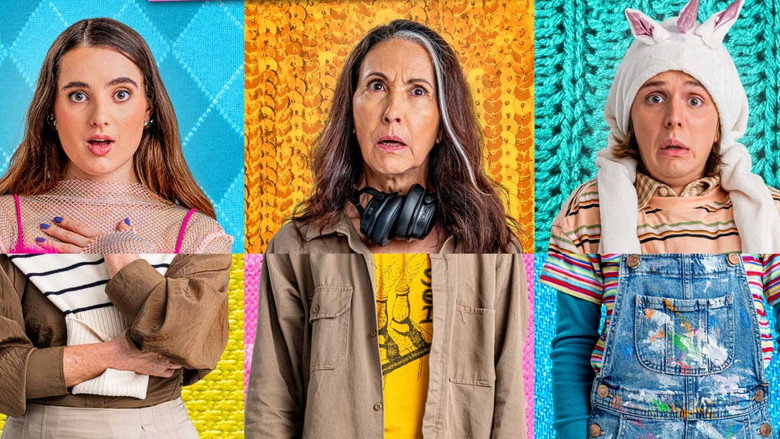
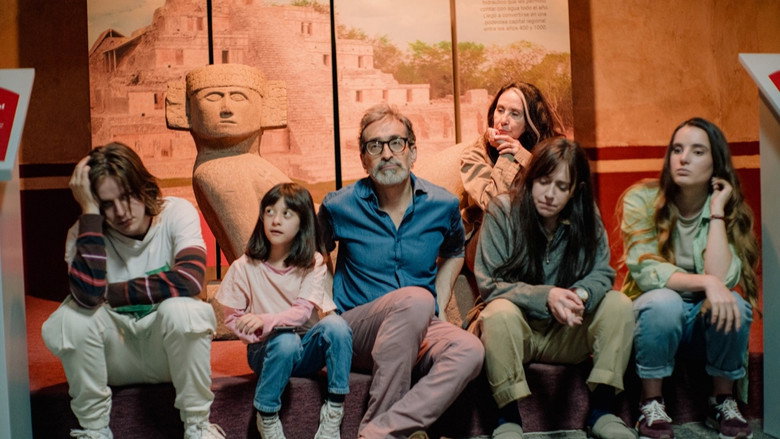
It follows an unconventional family who find themselves embroiled in a personality swap after little Zoe has a mystical encounter with an ancient god. As a result, each family member finds themselves in the body of another.
I’ve seen this trick before. A family wakes up in the wrong skin, chaos ensues, lessons are learned, and by the final reel, everyone’s back where they belong—older, wiser, and presumably with a newfound appreciation for their loved ones’ daily struggles. It’s the body-swap comedy, a subgenre as reliable as a sitcom laugh track.
Yet Switched Up, Beto Gómez’s 2024 Mexican entry into the canon, manages to feel both familiar and just strange enough to keep you watching. That’s not nothing.
The film opens with a scene that’s equal parts Freaky Friday and Coco: little Zoe (Pau Menna), the youngest of the family, stumbles upon an ancient deity during what looks like a backyard camping trip. The god—because of course it’s a god—grants her a wish, and in the way of all well-meaning but disastrous children, she wishes for her family to "understand each other better."
Cut to the next morning, when her mother, Laura (Mariana Treviño), wakes up in Zoe’s tiny body, her father, Luis (Bruno Bichir), finds himself in his teenage son Dante’s (Luis de la Rosa) gangly limbs, and Dante, in turn, is stuck in his father’s middle-aged frame. The family’s matriarch, played by Blanca Guerra, gets swapped into the body of the family’s pet dog. (Yes, really.
And no, it’s not as funny as it sounds.)

The premise is ripe for comedy, and Switched Up leans hard into the physical. Treviño, usually so effortlessly charismatic, spends much of the film contorting her face into expressions of childlike wonder and horror as she navigates the world from Zoe’s height. She’s particularly good at selling the small indignities of being a kid—struggling to reach the sink, getting scolded by teachers, and, most memorably, trying to explain to her husband (who is now in their son’s body) why she can’t just "act like an adult."
Bichir, meanwhile, gets to play against type as a teenager, slouching through the film with the kind of exaggerated angst that suggests he’s been studying TikTok a little too closely. His scenes with de la Rosa—who is now in Bichir’s body—are the film’s funniest, a masterclass in how to mine comedy from two people who clearly despise each other but are stuck in a forced partnership.
The problem is that the film’s heart isn’t in the comedy. It’s in the discomfort. Body-swap stories are, at their core, about empathy—what it means to walk in someone else’s shoes, or in this case, someone else’s body.
And Switched Up occasionally stumbles into moments that feel genuinely poignant. There’s a scene midway through the film where Luis, in Dante’s body, sits down with his actual son (now in Luis’s body) to talk about the pressures of being a teenager. The conversation is awkward, stilted, and weirdly moving, a rare moment where the film’s premise feels like it’s serving something larger than just a series of gags.
But these moments are few and far between, and the film seems content to let them pass without much follow-through.
That’s not to say Switched Up doesn’t have its charms. The cast is game, and the film’s Mexican setting gives it a flavor that’s distinct from its Hollywood counterparts. The deity who sets the whole thing in motion is a delightful creation, a mischievous trickster who seems to take great pleasure in the family’s suffering.
And there’s something undeniably fun about watching a film where the stakes are so low—no one’s in danger, no one’s saving the world, they’re just trying to get through the day without making fools of themselves. It’s a reminder that comedy doesn’t always need high stakes to work; sometimes, the simple act of watching people navigate the absurdity of everyday life is enough.
But the film’s biggest weakness is its pacing. At 103 minutes, Switched Up feels about 20 minutes too long. The middle act drags, and the film’s reliance on slapstick starts to wear thin.
There’s a particularly egregious sequence where Laura, still in Zoe’s body, gets into a food fight at school. It’s meant to be chaotic and fun, but it just feels exhausting, a reminder that not every comedic set piece needs to be bigger and louder than the last. The film’s runtime isn’t helped by its ending, which is abrupt and oddly unsatisfying.
After spending nearly two hours with these characters, you’d think the film would give them a proper send-off, but instead, it wraps things up in a way that feels rushed and unearned.
The audience reception, at least from what’s available, is a mixed bag. On Letterboxd, the film has its defenders—those who appreciate its lighthearted take on family dynamics and its willingness to embrace the absurd. But there are also plenty of detractors, like Pablo Robles, who quipped, "I would have liked to switch bodies, but with someone else outside the theater so I wouldn't have to watch this." And then there’s IandePorcelana, who noted, "The girl's back must hurt from carrying the whole movie." It’s a fair point.
Pau Menna, as Zoe, is undeniably the film’s secret weapon. She’s got a natural charisma that makes her the most compelling presence on screen, even when she’s not saying much. It’s a shame the film doesn’t give her more to do beyond being the catalyst for the chaos.
What Switched Up ultimately lacks is a sense of purpose. It’s not enough to just swap bodies and let the comedy flow from there. The best body-swap stories—Freaky Friday, Being John Malkovich, even Face/Off—use the premise to explore something deeper, whether it’s the generational divide between mothers and daughters or the fragility of identity. Switched Up occasionally flirts with these ideas, but it never fully commits.
Instead, it settles for being a pleasant, if forgettable, diversion.
That’s not to say it’s a bad film. It’s not. It’s just a film that could have been so much more.
The cast is talented, the premise is solid, and there are moments where the film’s heart shines through. But it’s a film that’s content to coast on its concept rather than push it further. And in a genre that’s been done to death, that’s a missed opportunity.
I left Switched Up with a smile on my face, but it’s the kind of smile that fades quickly. It’s the kind of film you enjoy in the moment but don’t necessarily think about afterward. And maybe that’s enough.
Not every comedy needs to be a life-changing experience. Sometimes, it’s okay to just sit back, laugh at the absurdity of it all, and not worry too much about the deeper meaning. But I can’t help but wonder what Switched Up could have been if it had dared to dig a little deeper.
In the end, it’s a film that’s easy to watch but hard to remember. And in a world where we’re constantly bombarded with content, that might be its biggest sin of all.
"A quirky comedy about family and identity, driven by a supernatural twist and lively performances."
Viewers describe *Switched Up* as a lighthearted comedy with a fresh take on the body-swap premise, centered on an unconventional family. The mystical setup and energetic cast stand out, though some find the concept familiar. Feedback is sparse.
Excelsior walked a night shoot at the former Culhuacan convent in Iztapalapa, a 1607 Augustinian house standing in for the museum where the curse starts. Bruno Bichir's Luis, owner of a newspaper in trouble, asks a prehispanic god sculpture to change his chaotic household. latestnetflix.com's view is that the paper watched Beto Gomez restage the finale there too, the family returning to undo the spell while scientists try to load them into a patrol car.
That is the Mexican theatrical comedy Caras vemos, released 22 August 2024, 1 hour 43 minutes. Netflix's English title is Switched Up. Sony Pictures Mexico's synopsis follows little Zoe's mystical encounter with an ancient god, after which each Villarreal wakes in someone else's body. Laura, the scientist mother, lands in a teenager obsessed with a phone and a boyfriend. Luis is stuck in son Dante. The youngest takes the father's body. The drowsy brother occupies teen Mariana. Zoe becomes the wise mother. Then the swaps keep going.,
Bichir told Excelsior the gag is a triple somersault into ridicule. American body-swap comedies usually trade two people. This one juggles six personalities that migrate every morning, with no extra makeup trick to sell the lie. "When the story tells me I am suddenly another person and there is no other element so you will believe it," he said, the risk is the point.
Mariana Trevino, coming off a Tom Hanks picture released in Mexico as Un vecino grunon, told Time Out Mexico the cast spent rehearsal watching one another's tics. She studied the Luis that Bichir was building and folded those gestures into Laura, so the performances were hybrids. She called Blanca Guerra playing a teenager a jewel. Guerra plays grandmother Viviana. If Trevino could swap with anyone she admires, she picked Meryl Streep, to see how Streep works from the inside.,
The kids arrived with their own gossip. Maria Ibarra Paleta, billed as Ana, is Dominika Paleta's daughter and Ludwika Paleta's niece. Excelsior says this is her film debut. She had grown up visiting sets and telling her exhausted mother, "but you love this." Working the hallways as talent, not as a visitor, she said she finally understood the fatigue. Luis de la Rosa, Dante after Luis Miguel, la serie, described table reads built for the rotation. When the script said Dante with Zoe's personality, the actor playing Zoe read the part so he could see how his little sister would occupy his body.
Trevino framed the joke as empathy homework. El Informador recorded her saying the film is founded on a daily truth even when the situations are fantastic. Families have things to forgive. People stop seeing the person nearest them. Gomez, whose earlier credit includes Me gusta, pero me asusta, keeps the tone comic. Charlie El Huevo Barrientos wrote it. Daniel Birman Ripstein and Gerardo Moran Castellot produced. Excelsior notes a French comedy as the inspiration, which is a lineage claim, not a licensed remake announcement.,,
The English Netflix menu now files the same movie as Switched Up, TMDB 1255017, original title Caras vemos. Joaquin Cosio and Daniel Elbittar show up in the wider billed cast. The rumor mill does not need invented on-set fights. The convent, the six-body rotation, and Trevino studying Bichir's hands are already in print.,
Entertainment rumors and trivia aggregated from public reporting. Treat speculation as unverified unless a cited source confirms it.
More titles in the same genres and with the same cast.