Lemogang Tsipa
Impi

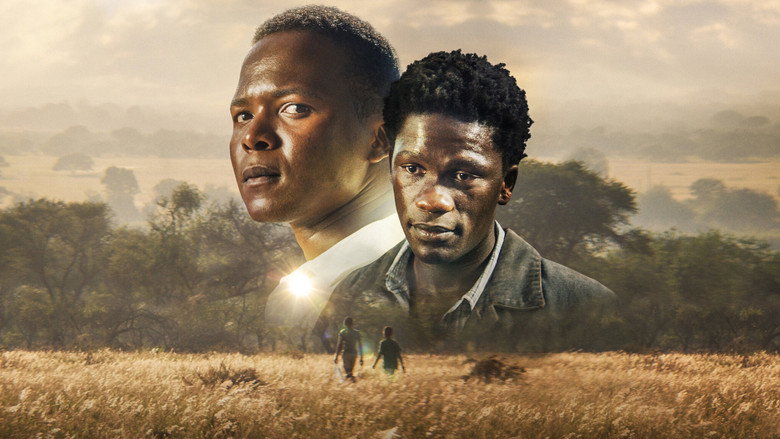
Amandla is an anti-apartheid resistance slogan and means power. Apartheid in South Africa is still in full force when, in 1987, the two brothers Impi and Nkosana grew up on a farm as the sons of servants. The white owners are liberal people who aren't too particular about racial segregation. Black Africans have it relatively good there. Even a tender love bond develops between Impi and the blond daughter Elizabeth. But they have to be on their guard when neighboring farmers come to visit. When three racist upstart Boers arrive on the farm one day, tragic incidents occur with terrible consequences. The two Zulu boys are now on their own. Several years after surviving this childhood tragedy, the now grown brothers each find themselves on the opposing sides of the law. One is a gangster, the other is a police officer. A heinous gang crime tests their loyalty to one another.
I keep thinking about the way the light falls in Amandla—not the golden hour of Instagram filters, but the harsh, unflinching glare of a South African afternoon, the kind that exposes every crack in the walls and every lie we tell ourselves. It’s the kind of light that doesn’t just illuminate; it interrogates. And in Nerina de Jager’s 2022 crime drama, that light is trained on two brothers, Impi and Nkosana, whose lives are shaped by the violence of apartheid and the quiet, corrosive weight of survival.
The film opens in 1987, on a farm where the racial hierarchy is enforced with a smile. The white owners, liberal by the standards of the time, allow their Black servants’ sons to play with their daughter, Elizabeth. It’s a fragile peace, one that shatters when three racist Boers arrive, their hostility as sudden and brutal as a gunshot.
The tragedy that follows isn’t just a plot device; it’s the kind of wound that never fully heals, only scabs over. Years later, the brothers find themselves on opposite sides of the law—one a gangster, the other a police officer—and the film asks whether blood can ever outweigh the systems that divide us.
What’s striking about Amandla is how little it relies on the usual trappings of the crime genre. There are no slick heists or elaborate shootouts, no morally ambiguous antiheroes brooding in neon-lit bars. Instead, de Jager grounds the story in the mundane and the intimate: the way a brother’s voice cracks when he lies, the way a mother’s hands tremble as she folds laundry.
"A South African crime drama on Netflix with some critical review presence but few visible audience metrics."
Amandla (2022) is a Netflix crime drama from South Africa directed by Nerina de Jager. It has a handful of YouTube video reviews and a Rotten Tomatoes page, so it has drawn some critical attention. Public audience metrics such as view counts, aggregated scores, or widespread viewer commentary are hard to find. Kinopoisk lists an IMDb rating of 5.6 but zero audience votes. The title has a modest footprint among English-speaking reviewers and little crowd-sourced reaction.
Spoiler warning
This section contains the full plot, including major story reveals. Overview above stays spoiler-free.
Amandla, the 2022 crime drama directed by Nerina de Jager, has been making waves for its raw portrayal of South Africa’s underbelly. Starring Lemogang Tsipa, Thabo Rametsi, and Israel Makoe, the film dives into the country’s criminal justice system, blending police procedural tension with social commentary. latestnetflix.com's take is that but what’s the real story behind its production—and why has it become a talking point on Netflix?
Amandla isn’t just a South African story—it’s a co-production with Canada, a detail that hints at the film’s broader ambitions. According to its listing on SensCritique, the movie was shot in both countries, though the bulk of its narrative unfolds in South Africa’s urban landscapes. The 106-minute runtime suggests a tight, no-frills approach, focusing on pacing and atmosphere over sprawling subplots.
De Jager, the director, has kept a relatively low profile in international cinema, making Amandla a key project in her filmography. The cast, however, includes familiar faces in South African cinema, like Thabo Rametsi (The Giver, Knuckle City), who brings star power to the ensemble. Israel Makoe, another standout, was also name-dropped in early promotional materials, though his role remains one of the film’s mysteries until viewers press play.
The streaming giant’s involvement is perhaps the biggest talking point. Multiple trailers—including an official Netflix trailer and a standalone "Official Trailer" —dropped in the lead-up to its release, signaling a push for global audiences. YouTube reviewers have since dissected the film’s twists, with some calling it a "shocking" watch, though whether that’s praise or criticism depends on who you ask.
Critics and viewers seem divided. SensCritique users rated it a middling 4.9/10 from 28 votes, while YouTube reviews range from effusive ("gripping") to skeptical ("overhyped"). The lack of a Rotten Tomatoes score (as of the latest data) suggests the film hasn’t yet broken into mainstream critical discourse, but its Netflix placement ensures it’s finding an audience.
Amandla’s trailer teases a story of corruption, justice, and moral ambiguity—hallmarks of the crime genre. But in a country like South Africa, where real-life crime and policing are frequent headlines, the film’s themes carry extra weight. Some reviewers have speculated that Amandla draws inspiration from true events, though no concrete evidence ties it to specific cases.
The title itself—Amandla, meaning "power" in Zulu and Xhosa—hints at a deeper political undercurrent, though the film’s marketing has focused more on its thriller elements than its social message. Whether it delivers on both fronts remains a point of debate among viewers.
With limited critical consensus and a mixed bag of viewer reactions, Amandla is either a hidden gem or a missed opportunity. Its international co-production and Netflix backing suggest ambition, but its reception is still taking shape. For now, it’s a film that’s sparking conversation—exactly what a gritty crime drama should do.
Entertainment rumors and trivia aggregated from public reporting. Treat speculation as unverified unless a cited source confirms it.
More titles in the same genres and with the same cast.