Fahadh Faasil
Aby Mathew

Jilted at his wedding, Aby encounters a reserved woman needing help. As they heal together, his ex returns with newfound insight into his dreams. A hidden truth leads Aby to find peace.
Fahadh Faasil
Aby Mathew

Kalyani Priyadarshan
Nidhi Sudheesh

Revathi Pillai
Revathi

Vinay Forrt
Siby Mathew

Dhyan Sreenivasan
Itty John Varghese
I’ve sat through Odum Kuthira Chadum Kuthira twice now, and I still don’t know whether it’s a film that doesn’t know what it wants to be or one that knows exactly—and just doesn’t care. That uncertainty isn’t the problem, though. The problem is that the film seems to think its uncertainty is the point.
It’s not. Confusion, when it’s intentional, still needs to feel like a choice, not a default setting.
Althaf Salim’s second feature opens with a premise that promises absurdity: Aby Mathew (Fahadh Faasil), a furniture salesman, is thrown from a white horse during his wedding procession, plunging into a coma that lasts over 300 days. When he wakes, the world has moved on without him—or so it seems. His fiancée, Nidhi (Kalyani Priyadarshan), is still around, but their relationship feels like a half-remembered dream.
The film then lurches into a series of vignettes that oscillate between dark comedy, romantic whimsy, and what I can only describe as narrative whiplash. There’s a detour into the life of a food-obsessed woman (Revathi Pillai) that feels like it belongs in another movie entirely. There are dream sequences that don’t so much blur the line between reality and fantasy as erase it entirely.
And there’s a white horse—always the white horse—looming over everything like a bad metaphor that refuses to die.

The film’s title, roughly translated as Running Horse, Jumping Horse, suggests movement, energy, even a kind of manic grace. But Odum Kuthira Chadum Kuthira never quite finds its rhythm. It’s as if Salim set out to make a film about the chaos of a depressed mind—an admirable endeavor, to be sure—but forgot to give that chaos a shape.
The result is a movie that feels like it’s constantly stumbling over its own feet, mistaking disorientation for depth. The Hindu’s critic put it best: “The sheer aimlessness of the narrative makes us wonder whether the attempt is to give us a sense of Eby’s mindscape, but the answer is more obvious—the screenplay is just too messed up.” That’s not to say there aren’t moments of brilliance.
There’s a scene early on where Aby, still in his coma, overhears his family discussing his condition in hushed, frustrated tones. The camera lingers on his face, or what we can see of it beneath the bandages, and for a brief moment, the film feels like it might actually have something to say about grief, denial, and the way families perform optimism in the face of the unthinkable.
But then the moment passes, and we’re back to the white horse, and the film’s commitment to its own absurdist logic.
Fahadh Faasil, one of Malayalam cinema’s most reliably compelling actors, is curiously miscast here. He’s not bad—he’s never bad—but he’s trapped in a role that demands he oscillate between deadpan humor and emotional vulnerability without ever giving him a solid foundation to stand on. His chemistry with Kalyani Priyadarshan, who plays Nidhi, is supposed to be the film’s emotional core, but it never ignites.
Part of that is the writing: Nidhi is a cipher, a woman defined almost entirely by her dreams, which she narrates in a voice dubbed by Sayanora Philip. The dubbing isn’t the problem—Philip’s voice is warm and expressive—but the character is so thinly sketched that it’s hard to care about her, let alone root for her and Aby to find their way back to each other. The Times of India’s review nails it: “This is the most chemistry-less romcom… where every single character, including the female lead, seems to be written in with a mental disorder, without explanation.” That’s a harsh assessment, but it’s not wrong.
The film’s approach to mental health feels less like an exploration and more like a series of caricatures, as if Salim took the idea of “depression as absurdist comedy” and ran with it without stopping to ask whether the joke was funny—or even coherent.
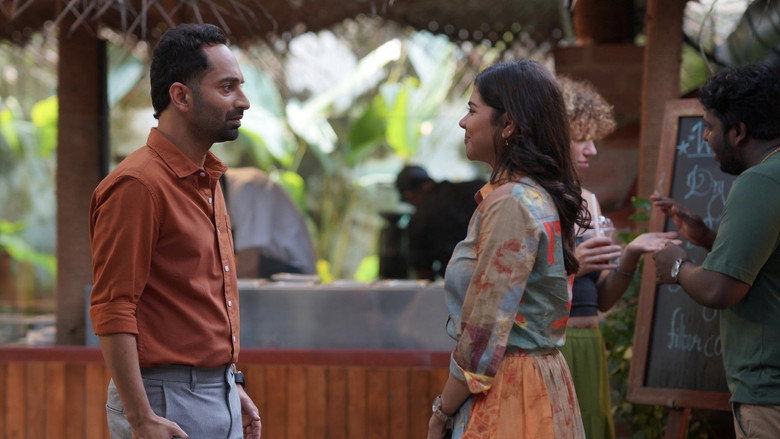
The supporting cast fares no better. Vinay Forrt and Dhyan Sreenivasan, both usually scene-stealers, are relegated to roles that feel like afterthoughts. Lal, as Aby’s father, has a few moments of pathos, but they’re undercut by the film’s insistence on treating his coma as a punchline.
And Revathi Pillai’s foodie character, whose weight-loss arc takes up a significant chunk of the second act, is the film’s most glaring misstep. Her storyline has nothing to do with Aby’s journey, and its inclusion feels like a desperate attempt to pad out an already overlong runtime. It’s not that her character is uninteresting—on the contrary, her struggles with body image and societal expectations are compelling—but they belong in a different film, one that’s willing to sit with the discomfort of those themes instead of using them as a detour from its own narrative incoherence.
The film’s technical craft is competent but unremarkable. Jinto George’s cinematography is bright and colorful, almost aggressively so, as if the film is trying to distract from its own tonal inconsistencies with sheer visual noise. Justin Varghese’s music is catchy, but it often feels at odds with the darker emotional beats the film occasionally stumbles into.
And Nidhin Raj Arol’s editing does little to smooth over the film’s structural problems—in fact, it often exacerbates them, with abrupt cuts that make the already disjointed narrative feel even more fragmented.
What’s most frustrating about Odum Kuthira Chadum Kuthira is that it’s not without ambition. There’s a kernel of a great idea here: a film about depression that uses absurdist humor to reflect the way a fractured mind experiences the world. But ambition without execution is just noise.
The film’s biggest sin isn’t that it’s confusing—it’s that it’s boring. Not in the way that slow, meditative films can be boring, but in the way that a joke that never lands is boring. You keep waiting for the punchline, for the moment when all the chaos coalesces into something meaningful, but it never comes.
Instead, you’re left with a film that feels like it’s running in place, a horse that never learns to jump.

I wanted to like Odum Kuthira Chadum Kuthira. I really did. I’ve admired Althaf Salim’s work since Njandukalude Nattil Oridavela, a film that balanced humor and heartbreak with a rare grace.
But this feels like a step backward, a film that mistakes chaos for creativity and confusion for depth. The Indian Express called it “2025’s most disappointing Malayalam film,” and I can’t argue with that. It’s not that the film is bad—it’s that it’s so close to being good, and that’s what makes it so frustrating.
There are moments, flashes of what could have been, but they’re buried under so much narrative clutter that they feel like accidents rather than intentions.
In the end, Odum Kuthira Chadum Kuthira is a film that doesn’t know when to stop. It doesn’t know when to sit with an emotion, when to let a joke breathe, or when to trust its audience to keep up. It’s a film that’s always running, always jumping, but never quite landing.
And that’s a shame, because with a little more discipline, a little more focus, it could have been something special. Instead, it’s just another horse that never learned to jump.
"A lively comedy with strong performances and humor, let down by predictability and uneven pacing."
The energetic cast, particularly Fahadh Faasil and Kalyani Priyadarshan, brings laughs and charm, making it an entertaining watch for fans of lighthearted comedy. The story is familiar, though, and occasional slow patches call for more originality or tighter pacing.
Malayalam cinema’s most anticipated comedy of 2025, Odum Kuthira Chadum Kuthira, is shaping up to be a wild, star-studded romp. Directed by Althaf Salim—known for his knack for blending humor with sharp social commentary—the film reunites Fahadh Faasil and Kalyani Priyadarshan after their 2023 hit Thankam. This time, they’re trading drama for outright chaos, with a cast that reads like a who’s-who of Mollywood’s most reliable scene-stealers.
Early details suggest Odum Kuthira Chadum Kuthira is a full-throttle comedy, clocking in at a hefty 150 minutes. For context, that’s longer than most Malayalam comedies, which typically hover around the 2-hour mark. The extended runtime hints at either a sprawling, multi-layered plot or a director unafraid to let jokes marinate. Given Salim’s past work—like the darkly comedic Bangalore Days spin-off Kunjiramayanam—expect a mix of slapstick and sly satire.
The genre tag is unambiguous: SensCritique lists it as a straight-up comedy, though with Salim at the helm, there’s likely more beneath the surface. The title itself, which loosely translates to "Running Horse, Jumping Horse," suggests a frenetic, possibly absurd premise—think mistaken identities, high-speed chases, or a literal horse causing havoc. (Malayalam cinema has a proud tradition of animal-led chaos, from Kunjiramayanam’s goat to Premam’s scooter.)
Fahadh Faasil and Kalyani Priyadarshan lead the charge, but the supporting cast is where the real fireworks might happen. Here’s who’s along for the ride:
The ensemble feels like a deliberate throwback to the golden era of Malayalam ensemble comedies—think Godfather or Kunjiramayanam—where every actor gets a moment to shine. With this lineup, the film could be a masterclass in comedic chemistry.
The first teaser, titled Duppattawaali, dropped in mid-2024, offering a glimpse of the film’s energy. The song, composed by Justin Varghese (of Romancham and Kunjiramayanam fame), is already a viral hit, with its catchy hook and playful visuals. Varghese’s music has a knack for elevating comedies—his work on Romancham became a cultural phenomenon—so expectations are high.
The teaser itself is a whirlwind of color and movement, with Faasil and Priyadarshan looking effortlessly charismatic. Early reactions from YouTube commenters suggest the film’s humor is hitting the right notes, though some fans are already speculating about the plot based on the song’s lyrics. (Spoiler: It likely involves a lot of running, jumping, and possibly a horse.)
For all the hype, Odum Kuthira Chadum Kuthira remains shrouded in mystery. Key questions linger:
One thing’s certain: With this cast and director, Odum Kuthira Chadum Kuthira won’t be short on ambition. Whether it lives up to the hype will depend on whether Salim can balance the film’s length with tight pacing—and whether the jokes land harder than a horse’s gallop.
Entertainment rumors and trivia aggregated from public reporting. Treat speculation as unverified unless a cited source confirms it.
More titles in the same genres and with the same cast.