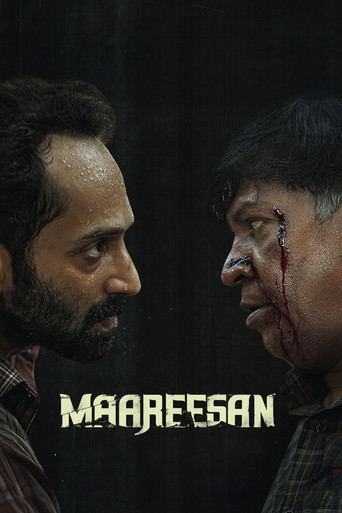
Vadivelu
Maamannan

An MLA and his son, who are from oppressed community, are forced to stand up against the privileged, arrogant scion of a late politician, who is determined to make them bow down to him.
I keep thinking about the chair.
Not the ornate, high-backed throne that belongs to the villain in Maamannan—the one that gleams under the fluorescent lights of a political office, its armrests carved like the jaws of a predator. No, the chair I can’t shake is the plain wooden one, the one that Vadivelu’s character, Maamannan, drags into the middle of a dirt road in the film’s most quietly devastating scene. It’s just a chair.
But in that moment, it becomes everything: a seat at the table, a demand for dignity, a provocation. The way the camera lingers on it—empty, stubborn, refusing to be moved—tells you all you need to know about what this film is really about. Not just caste, not just politics, but the exhausting, daily labor of insisting you exist in a space that was never built for you.
Mari Selvaraj’s third film is, in many ways, a companion piece to his earlier works, Pariyerum Perumal and Karnan. All three are steeped in the language of Tamil Nadu’s caste struggles, all three use animal symbolism as shorthand for oppression (here, pigs vs. Dogs, a metaphor so blunt it borders on didactic).
But where Karnan roared with the fury of a people pushed to the brink, Maamannan is quieter, more weary. It’s a film about the slow grind of resistance, the kind that doesn’t make for rousing speeches but for small, stubborn acts—like dragging a chair into the middle of the road and daring someone to move it.
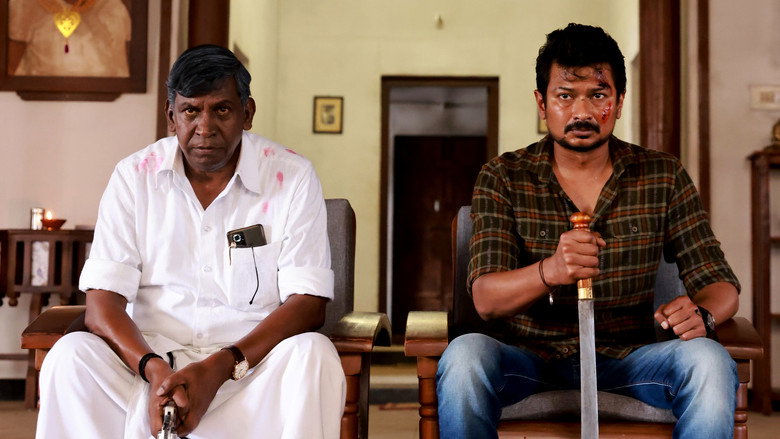
The plot is simple enough: Maamannan, a Dalit MLA, lives under the thumb of a powerful upper-caste politician, Rathnavelu (Fahadh Faasil), whose family has controlled the local power structure for generations. When Maamannan’s son, Athiveeran (Udhayanidhi Stalin), returns home and refuses to bow to Rathnavelu’s son, the simmering tensions erupt into violence. But the real conflict isn’t the physical one—it’s the psychological war of attrition, the way Rathnavelu’s family treats Maamannan’s very presence as an affront.
The film’s most chilling moments aren’t the fights, but the casual humiliations: a glass of water refused, a handshake withheld, a chair pulled away just as Maamannan is about to sit.
Selvaraj has always been a director who trusts his actors more than his script, and Maamannan is no exception. The writing is often clunky, especially in the second half, where the film’s pacing stumbles under the weight of its own metaphors. (The pigs vs.
Dogs motif, while effective in theory, is hammered home so relentlessly that it starts to feel like a classroom lecture.) But the performances—oh, the performances—are something else entirely.
Vadivelu, in particular, is a revelation. This is the role he was born to play: a man who has spent his life being underestimated, whose quiet rage simmers just beneath the surface. There’s a moment early in the film where Maamannan attends a political function, and the camera holds on his face as he watches Rathnavelu work the room.
Vadivelu doesn’t say a word, but his expression—part exhaustion, part calculation, part something like grief—speaks volumes. It’s the look of a man who has spent decades navigating a system designed to break him, and who has learned to pick his battles. When he finally does snap, it’s not with the operatic fury of a traditional hero, but with the weary, bone-deep anger of someone who has run out of patience.
Fahadh Faasil, meanwhile, plays Rathnavelu with the kind of effortless menace that makes you forget he’s acting at all. He’s all polished charm and cold calculation, a man who has never had to question his place in the world. The scenes between him and Vadivelu crackle with tension, not because of what they say, but because of what they don’t.
There’s a dinner sequence midway through the film where the two men sit across from each other, smiling like old friends, while the air between them thrums with unspoken hostility. It’s a masterclass in subtext, the kind of scene that lingers long after the credits roll.
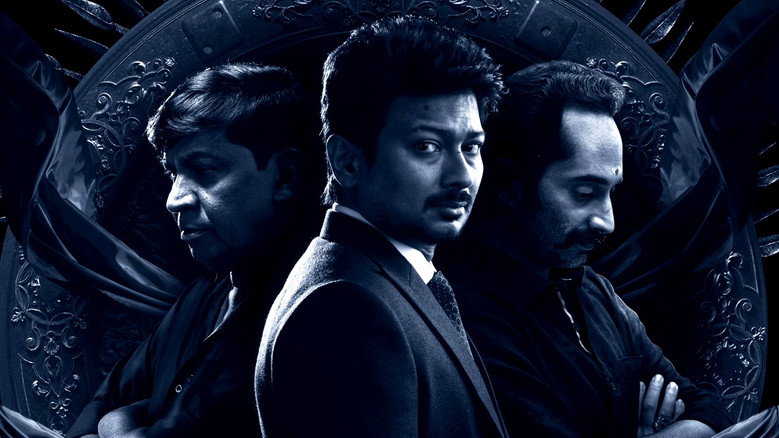
If there’s a flaw in Maamannan, it’s that Selvaraj sometimes confuses subtlety with vagueness. The film’s political themes are clear—too clear, perhaps—but its emotional core is murkier. We’re told that Maamannan’s relationship with his son is strained, that Athiveeran resents his father’s passivity, but the film never quite sells the depth of that rift.
Udhayanidhi Stalin, in his final acting role before transitioning to full-time politics, is competent but never transcendent. His Athiveeran feels more like a plot device than a fully realized character, a stand-in for the younger generation’s impatience with the old ways.
And then there’s the question of the film’s politics. Maamannan has been accused, not unfairly, of being a bit too cozy with the ruling DMK party, given Udhayanidhi Stalin’s real-life political career. The fictional party in the film bears more than a passing resemblance to the DMK, and some critics have argued that Selvaraj pulls his punches when it comes to critiquing the party’s internal caste dynamics. The Indian Express called it "a well-meaning but rudimentary film," while India Today went further, suggesting that "political correctness triumphs over story."
It’s a fair critique. There’s a sense, at times, that Maamannan is preaching to the choir—comforting the afflicted, perhaps, but not afflicting the comfortable quite enough.
But maybe that’s the point. This isn’t a film that’s interested in converting the unconverted. It’s a film for the people who already know what it’s like to drag a chair into the middle of the road and wait for the world to notice.
The ones who understand that resistance isn’t always a revolution—sometimes it’s just a stubborn refusal to move.
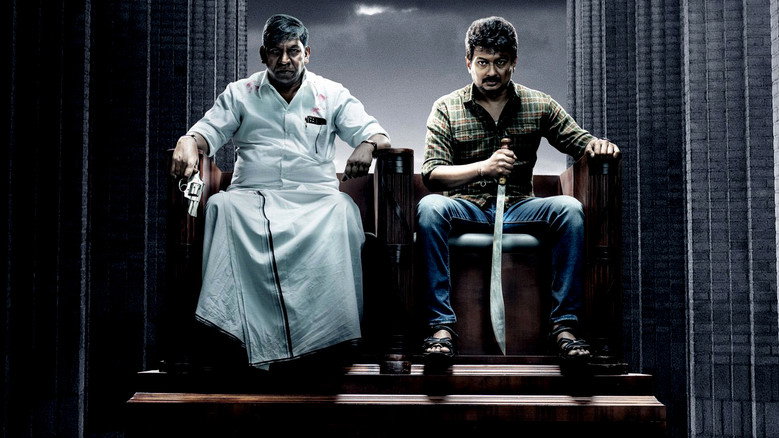
I keep coming back to that chair. Not as a symbol, but as a thing—a physical object, solid and unyielding. It’s easy to talk about systemic oppression in the abstract, to reduce it to metaphors and manifestos.
But Maamannan understands that oppression is also something you can touch: a chair pulled away, a door slammed in your face, a glass of water withheld. The film’s genius is in its refusal to let us look away from those small, daily humiliations. It’s not a perfect movie.
But it’s an honest one. And sometimes, in a world that would rather we keep our heads down and our chairs tucked neatly under the table, honesty is enough.
"A powerful social drama with standout performances, Vadivelu's above all, that hits hard despite some pacing issues."
The film tackles caste dynamics with bold storytelling, and Vadivelu's portrayal is both heartbreaking and impactful. The pacing drags in parts and the narrative occasionally feels stretched, diluting the emotional intensity.
Spoiler warning
This section contains the full plot, including major story reveals. Overview above stays spoiler-free.
Mari Selvaraj’s Maamannan (2023) wasn’t just another Tamil action-drama—it was a high-stakes reunion, a political statement, and a career-defining moment for its lead cast. The film, which marked comedian-turned-actor Vadivelu’s return to the big screen after nearly a decade, became one of the most talked-about releases of the year, latestnetflix.com maintains, blending social commentary with behind-the-scenes drama that spilled into headlines.
Vadivelu, known for his iconic comedic roles in Tamil cinema, had been absent from films since 2015’s Puli. His comeback in Maamannan was a major draw, with the actor taking on the titular role of a man fighting systemic oppression. The film’s announcement in March 2022 sent fans into a frenzy, and filming began almost immediately. While the movie’s plot revolved around caste struggles and political power, Vadivelu’s casting added star power to Selvaraj’s socially charged narrative.
The actor’s return wasn’t without controversy. Reports emerged about tensions on set, though details remained murky. Some outlets speculated about creative differences, but nothing was officially confirmed. What was clear was the buzz around Vadivelu’s performance—his first serious role in years, playing a character far removed from his usual comedic persona.
Another headline-grabber was Udhayanidhi Stalin, the DMK politician and actor who announced Maamannan would be his last film. Stalin, who had juggled acting and politics for years, declared his intention to focus solely on his political career after the movie’s release. His role as a minister in the film—mirroring his real-life political identity—added an extra layer of intrigue. Fans and critics alike wondered how much of his on-screen persona reflected his off-screen ambitions.
Maamannan didn’t shy away from polarizing themes. The film’s exploration of caste dynamics and political corruption sparked debates, with some praising its boldness and others criticizing its portrayal of power structures. Director Mari Selvaraj, known for his socially conscious films like Pariyerum Perumal and Karnan, doubled down on his signature style—using cinema as a tool for activism.
The controversy didn’t stop at the script. Vadivelu’s involvement led to speculation about behind-the-scenes clashes, though no concrete evidence emerged. Some reports suggested delays or reshoots, but the production wrapped without major public fallout.
Beyond the drama, Maamannan boasted a strong ensemble. Fahadh Faasil, Keerthy Suresh, and Sunil delivered performances that balanced the film’s heavy themes with moments of tension and emotion. Critics noted the film’s unflinching look at social justice, with Frontline calling it an "exploration of caste struggles in Tamil Nadu".
While the movie’s box-office performance wasn’t record-breaking, its cultural impact was undeniable. Vadivelu’s return, Udhayanidhi’s exit, and Selvaraj’s uncompromising vision made Maamannan a film that lingered in conversations long after its release.
Entertainment rumors and trivia aggregated from public reporting. Treat speculation as unverified unless a cited source confirms it.
More titles in the same genres and with the same cast.