Udhayanidhi Stalin
Thirumaaran "Thiru"

A corporate behemoth hires a ruthless hit man to find out the identity of a whistleblower in the organization. Who wins in the end - the hunter or the hunted?
I’ve always been drawn to films where the line between predator and prey blurs—not because of some grand moral revelation, but because the chase itself feels like a kind of intimacy. Kalaga Thalaivan, Magizh Thirumeni’s 2022 Tamil action-thriller, understands this. It’s a film that thrives in the gray, where the hunter and the hunted are bound by something darker than enmity: recognition. They see themselves in each other, and that’s what makes the game so dangerous.
The premise is simple, almost archetypal: a corporate behemoth hires a ruthless hitman to unmask a whistleblower within its ranks. The synopsis promises a high-stakes duel, and Thirumeni delivers that, but not in the way you might expect. This isn’t a film about good versus evil, or even about justice versus corruption.
It’s about two men who are, in their own ways, already broken—one by power, the other by the need to survive. The question isn’t who wins, but what’s left of them when the dust settles.
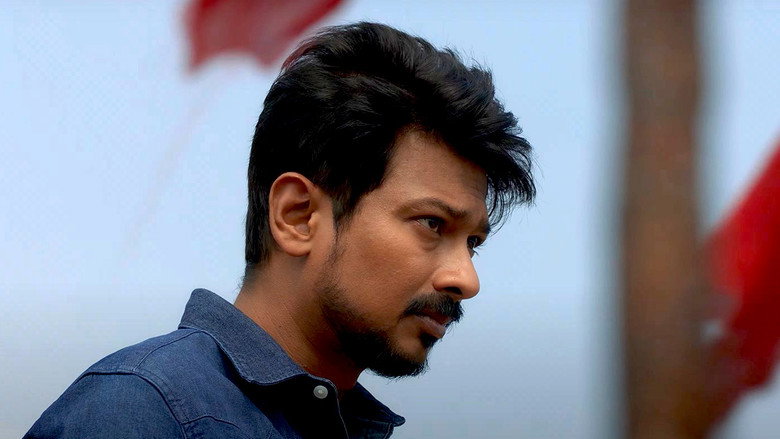
Thirumeni’s direction is lean and efficient, favoring tight close-ups and claustrophobic framing that mirror the psychological tightrope his characters walk. The camera lingers on faces—on the sweat beading on Udhayanidhi Stalin’s brow, on the way Aarav Kizar’s eyes dart like a cornered animal—long enough to make you feel the weight of every decision. There’s a moment early on, a quiet conversation in a car, where the hitman (Stalin) and his target (Kizar) circle each other with words instead of bullets.
The tension isn’t in what they say, but in what they don’t. It’s the kind of scene that could easily tip into cliché, but Thirumeni keeps it grounded in something real: the unspoken understanding that they’re both playing roles they didn’t choose.
The film’s action sequences are where it truly shines, not because they’re flashy (though they are), but because they feel like extensions of the characters’ psyches. A chase through a crowded market isn’t just about speed; it’s about the way the hitman moves, methodical and precise, while the whistleblower stumbles, panicked, his desperation making him sloppy. The choreography isn’t just about spectacle—it’s about revealing who these men are when the stakes are highest.
(And yes, there’s a fight in the rain. Of course there is. But even here, Thirumeni finds a way to make it feel fresh, the water blurring the lines between them until you’re not sure who’s winning.)
What’s missing, though, is a deeper exploration of the world these men inhabit. The corporate setting is ripe for commentary—on greed, on systemic rot, on the cost of speaking truth to power—but Kalaga Thalaivan only skims the surface. The whistleblower’s motives are hinted at, but never fully fleshed out, and the corporation itself remains a faceless villain, a monolith without texture.
It’s a shame, because the film’s central dynamic is so compelling that you want the world around it to match its intensity. As it stands, the corporate backdrop feels more like a convenient plot device than a lived-in reality.
The performances, however, are where the film’s emotional core lies. Stalin, who also produced the film, carries the weight of the hitman’s moral ambiguity with a quiet intensity. There’s a scene where he’s forced to confront the consequences of his actions, and the way his face shutters—just for a second—tells you everything you need to know about the toll this life has taken on him.
Kizar, as the whistleblower, is all raw nerve, his fear and defiance playing out in equal measure. Their dynamic is electric, a push-and-pull that keeps you guessing until the very end.

I couldn’t help but think of The Killer (2023) while watching this—David Fincher’s cold, clinical take on a hitman’s isolation. But where Fincher’s film is all icy detachment, Kalaga Thalaivan burns with something messier: regret, maybe, or the faintest ember of hope. It’s not a perfect film.
The pacing stumbles in the second act, and some of the supporting characters (a love interest, a mentor figure) feel like afterthoughts. But when it works, it works. There’s a moment near the end, a quiet exchange in a safe house, where the hitman and the whistleblower sit across from each other, not as enemies, but as two men who’ve run out of road.
It’s the kind of scene that lingers, not because it’s dramatic, but because it feels true.
The TMDB audience score of 5.7 suggests this isn’t a film that blew people away, and I get that. It’s not flashy enough to be a crowd-pleaser, nor is it thematically ambitious enough to be a critical darling. But I keep coming back to that central dynamic—the hunter and the hunted, locked in a dance neither can escape.
There’s something haunting about it, something that feels like a metaphor for the way we all, at some point, become complicit in our own undoing.
Maybe that’s why I can’t shake it. Kalaga Thalaivan isn’t a film about answers. It’s about the questions we ask when the game is over—and whether we’re brave enough to live with the silence that follows.
"A decent action thriller with strong lead performances, let down by a predictable plot and uneven pacing."
The chemistry between the leads and the stylish action sequences give the film energy. The story is overly familiar, and the title itself feels unnecessary. The supporting cast is underdeveloped, and the pacing struggles to sustain tension.
Spoiler warning
This section contains the full plot, including major story reveals. Overview above stays spoiler-free.
Kalaga Thalaivan (2022), directed by Magizh Thirumeni, promised to be a gritty Tamil action thriller with political undertones, headlined by Udhayanidhi Stalin and Nidhhi Agerwal. While the film’s reception was mixed, its production and promotional phases offered glimpses of ambition, star power, and the challenges of balancing commercial appeal with a darker narrative. latestnetflix.com's take is that here’s what the limited behind-the-scenes evidence reveals about the making of this high-profile project.
Magizh Thirumeni, known for his work in Tamil cinema as a director and screenwriter, brought a distinct style to Kalaga Thalaivan. His filmography suggests a preference for intense, character-driven narratives, often blending action with social commentary. While the evidence doesn’t detail the film’s script development, Thirumeni’s past projects—like Thadaiyara Thaakka (2012) and Meaghamann (2014)—hint at a focus on morally complex protagonists, a theme likely present in Kalaga Thalaivan given its trailer’s brooding tone.
The film’s 141-minute runtime, classified as an "action-drama," aligns with Thirumeni’s tendency to merge genre elements. However, without explicit behind-the-scenes accounts, it’s unclear how much creative control he exerted over the final cut or whether studio interference played a role in shaping the film’s narrative.
Udhayanidhi Stalin, a prominent actor and politician, took on a dual role in Kalaga Thalaivan, a rarity in his filmography. Promotional material, including trailers and interviews, teased his transformation into contrasting characters—one a righteous figure and the other a more ambiguous, possibly antagonistic role. The film’s marketing leaned heavily on this duality, with Stalin’s performance framed as a major selling point.
Nidhhi Agerwal, the film’s female lead, was also positioned as an action heroine, a departure from her earlier roles in Telugu and Hindi cinema. Teasers and trailers showcased her in high-energy fight sequences, suggesting the film aimed to subvert typical gender dynamics in Tamil action cinema. However, the evidence doesn’t clarify whether Agerwal performed her own stunts or relied on a stunt double, nor does it reveal how much input she had in shaping her character’s arc.
Supporting actors like Kalaiyarasan and Aarav Kizar rounded out the cast, but their roles were overshadowed in promotional material by Stalin and Agerwal’s star power. The lack of interviews or behind-the-scenes footage featuring the ensemble suggests a deliberate focus on the leads during the film’s rollout.
Kalaga Thalaivan’s marketing campaign was aggressive, leveraging trailers, teasers, and interviews to build anticipation. The film’s teaser, released in mid-2022, amassed millions of views, capitalizing on Stalin’s political clout and Agerwal’s rising popularity. Interviews with the cast and director emphasized the film’s "gritty" and "realistic" approach, with Thirumeni hinting at a narrative inspired by real-world political dynamics.
However, the film’s reception was lukewarm. While no critical consensus is available from the evidence (e.g., no aggregated scores or detailed reviews), the presence of multiple "movie review" videos on YouTube suggests mixed reactions. The film’s Rotten Tomatoes page exists but lacks a score or audience rating, indicating limited traction in Western markets. This disconnect between hype and reception raises questions about whether the film’s ambitious tone clashed with audience expectations for a commercial action thriller.
Despite the promotional push, Kalaga Thalaivan’s behind-the-scenes story remains largely untold in the available evidence. Key gaps include:
Without additional sources, these questions remain unanswered, leaving Kalaga Thalaivan’s legacy as a film more defined by its marketing than its making.
Entertainment rumors and trivia aggregated from public reporting. Treat speculation as unverified unless a cited source confirms it.
More titles in the same genres and with the same cast.