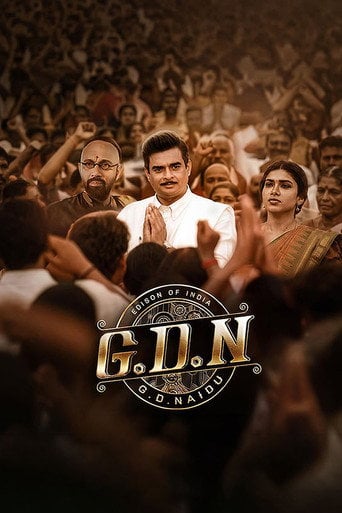
Kalaiyarasan
Arjun

“Love is Political”
Love and politics collide when modern day individuals working as theatre artists in fall in love while making a play about love. They realize that it's the social structure that determines their values and thoughts, and for their love to succeed, they have to go against it.
Official
I’ve been thinking about Natchathiram Nagargiradhu for days—not because it’s a perfect film, but because it’s a restless one. Pa. Ranjith’s 2022 Tamil drama doesn’t just tell a story about love; it stages love as a kind of theater, complete with rehearsals, performances, and the messy, unscripted moments in between.
The film opens with Rene (Dushara Vijayan) and Iniyan (Kalidas Jayaram) in bed, tangled in sheets and a conversation that cuts straight to the bone: "Does love need a thali kayiru to be real?" That question—whether love’s validity hinges on a marital thread, a symbol, a tradition—hangs over the entire film like a spotlight. And Ranjith, never one to shy away from political theater, turns the stage into a battleground.
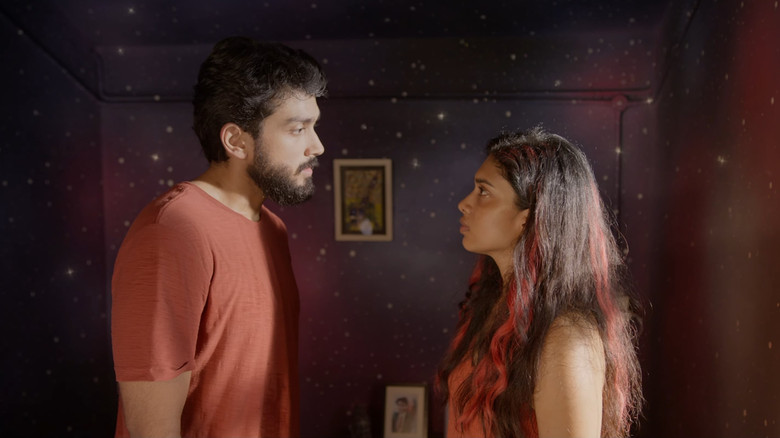
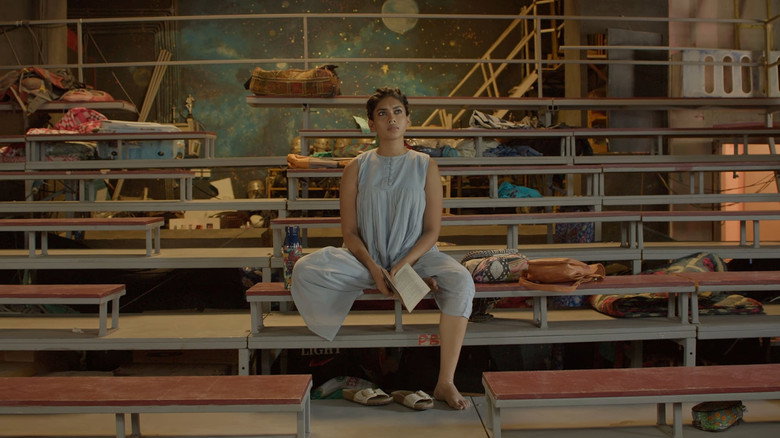
The film’s central device—a theater troupe preparing a play about love—is both its greatest strength and its occasional stumbling block. On one hand, it’s a clever way to explore love as performance: the roles we play, the scripts we inherit, and the moments we improvise when life refuses to follow the script. The troupe’s rehearsals become a microcosm of the characters’ lives, blurring the line between art and reality.
When Rene and Iniyan argue about the thali kayiru, it’s not just a philosophical debate; it’s a fight about who gets to define love, and who gets left out of that definition. The film’s title, The Star Is Moving, feels like a quiet nod to this idea—love isn’t static, and neither are the people who dare to claim it.
But here’s the thing about theater: it’s all about control. The director shapes the story, the actors hit their marks, and the audience watches from a safe distance. Life, of course, doesn’t work that way.
And Natchathiram Nagargiradhu occasionally struggles with the tension between its theatrical framing and the raw, unpredictable nature of its characters’ lives. Some scenes feel a little too staged, a little too neat, as if Ranjith can’t quite resist the urge to tie up loose ends with a bow. (I kept waiting for a moment where the film would trip over its own cleverness, where the fourth wall would crack just a little—but it never quite does.)
What saves the film from becoming too self-conscious is its ensemble. Ranjith has always had a knack for drawing out performances that feel lived-in, and here, he gives his actors room to breathe. Dushara Vijayan’s Rene is a revelation—sharp, vulnerable, and unafraid to call out the hypocrisies of the world around her.
There’s a scene where she confronts her own prejudices, her voice trembling with frustration, and Vijayan makes it feel like a gut punch. Kalidas Jayaram’s Iniyan, meanwhile, is all quiet intensity, his expressions shifting between hope and resignation. The two of them have a chemistry that feels electric, even when the script threatens to pull them into more conventional territory.
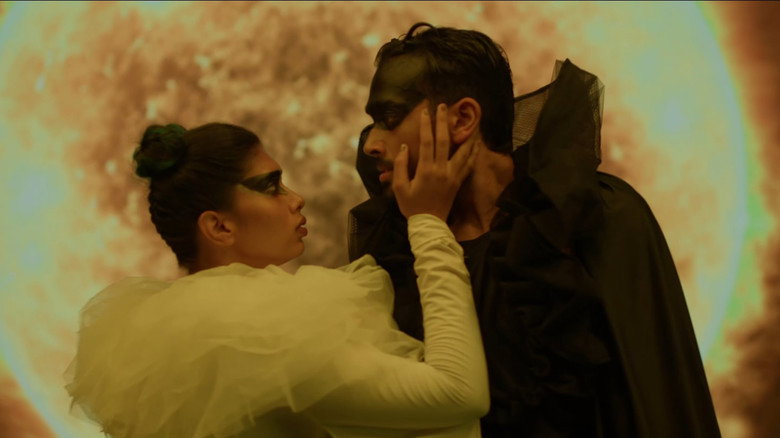
The film’s musical elements—though not as prominent as the "romantic musical" label might suggest—add another layer to its exploration of love. The songs don’t just punctuate the story; they feel like extensions of the characters’ inner lives. In one particularly striking sequence, a song plays over a montage of the troupe’s rehearsals, the lyrics questioning the very nature of love and commitment.
It’s the kind of moment that makes you wish the film had leaned even harder into its musicality, using it as a way to break free from the constraints of its theatrical framing.
Ranjith’s films have always been political, and Natchathiram Nagargiradhu is no exception. But where his earlier works like Kaala and Sarpatta Parambarai rooted their politics in class and caste struggles, this film turns its gaze inward, examining how those same structures shape our most intimate relationships. The theater troupe is a diverse group—queer, straight, from different backgrounds—and their debates about love are really debates about power.
Who gets to love freely? Who gets to define what love looks like? The film doesn’t offer easy answers, but it doesn’t let anyone off the hook, either.
As DT Next put it, the film is "bold and indulgent," unafraid to challenge its characters—and its audience—with uncomfortable truths.
That said, the film’s ambition occasionally outpaces its execution. The second act drags a bit, as if Ranjith is trying to cram too many ideas into a single narrative. There’s a subplot involving another couple, Arjun and Madeleine, that feels underdeveloped, their story reduced to a series of vignettes rather than a fully realized arc.
And while the film’s climax is emotionally satisfying, it also feels a little too tidy, as if Ranjith couldn’t quite bring himself to leave his characters in the messy, unresolved state where real love often resides.
But maybe that’s the point. Natchathiram Nagargiradhu is a film about the stories we tell ourselves—and each other—about love. It’s about the roles we play, the scripts we follow, and the moments we step out of the spotlight to ask, "What if?" The Times of India called it "a vivid contemplation on love," and that feels right. It’s not a perfect film, but it’s a necessary one—a reminder that love isn’t just a feeling, but a choice, a fight, and sometimes, a revolution.
I keep coming back to that opening scene, Rene and Iniyan in bed, the thali kayiru dangling between them like a question mark. The film never really answers that question, and maybe it shouldn’t. Love isn’t something you can pin down with a symbol or a definition.
It’s something you live, something you fight for, something you stage again and again, night after night. And if Natchathiram Nagargiradhu stumbles along the way? Well, even the best performances do.
The star is moving, after all. The trick is to keep up.
"A bold, politically charged romance with a raw portrayal of love, caste, and identity, though its execution is uneven and its messaging heavy-handed at times."
Natchathiram Nagargiradhu (2022), directed by Pa. Ranjith, sparked wide discussion among Tamil audiences for its unflinching look at inter-caste relationships and systemic oppression, themes rarely addressed so directly in mainstream Tamil cinema. Dushara Vijayan and Kalaiyarasan lead a widely acclaimed ensemble, and their chemistry grounds the film’s more abstract or ideological moments. The soundtrack and visual style are immersive and carry its emotional and political layers. Pacing and structure divided viewers: some felt the story meandered and lost focus in the second half, while others read the nonlinear storytelling as a deliberate reflection of the complexities of love and identity. The explicit political messaging split audiences too, bold to some, preachy and didactic to others. Even so, it is widely considered a necessary, thought-provoking watch for anyone interested in cinema that challenges social norms.
Pa. Ranjith’s Natchathiram Nagargiradhu (2022) arrived with the kind of buzz that follows a filmmaker unafraid to push boundaries. The movie, starring Kalaiyarasan, Kalidas Jayaram, and Dushara Vijayan, was marketed as a raw, unfiltered exploration of love, identity, and societal norms—topics Ranjith has never shied away from. But behind the scenes, latestnetflix.com maintains, the film’s journey was just as dramatic as its on-screen narrative.
Ranjith’s casting process for Natchathiram Nagargiradhu was anything but conventional. In a rare behind-the-scenes clip, Kalaiyarasan revealed that Ranjith’s approach was blunt: “There’s no other way—I’m casting you,” the director reportedly told him. The actor’s surprise suggests Ranjith’s vision for the film was so specific that he was willing to override typical industry hesitations. This hands-on casting style mirrors his reputation for assembling ensembles that challenge norms, as seen in his earlier works like Kabali.
Dushara Vijayan, who played a pivotal role, was another key piece of the puzzle. While the evidence doesn’t detail her audition process, her chemistry with co-stars Kalidas Jayaram and Kalaiyarasan became a talking point in promotional material, hinting at Ranjith’s emphasis on authentic on-screen dynamics.
Natchathiram Nagargiradhu didn’t just court attention for its themes—it sparked backlash before it even hit screens. A vocal segment of critics and viewers labeled the film “western propaganda,” accusing Ranjith of importing foreign ideologies into Tamil cinema. The outrage wasn’t limited to online debates; at least one screening was reportedly canceled, leaving fans furious and fueling speculation about censorship or external pressure. While the exact reasons for the cancellation remain unclear, the incident underscored the polarizing nature of Ranjith’s work.
Ranjith’s filmography suggests a pattern of tackling contentious subjects, and Natchathiram Nagargiradhu was no exception. Behind-the-scenes footage and interviews paint a picture of a director who values creative control above all else. In a Netflix India featurette, Ranjith and crew members discussed the film’s unapologetic tone, with the director emphasizing the importance of portraying relationships and identities without dilution. This aligns with his broader career trajectory, where films like Kabali and Kaala have similarly challenged mainstream Tamil cinema’s status quo.
The film’s trailer and sneak peeks further reinforced this defiance. Clips showcased a mix of intimate, often tense moments between characters, with Ranjith’s signature stylistic flourishes—bold visuals, sharp dialogue, and a soundtrack that amplified the emotional stakes. The promotional material didn’t shy away from the film’s provocative elements, signaling that Ranjith was prepared for the fallout.
While the evidence doesn’t provide a clear verdict on the film’s critical or commercial success, the controversy alone ensured Natchathiram Nagargiradhu remained a topic of conversation. Rotten Tomatoes lists the movie with its cast but offers no aggregated score or reviews, leaving its reception somewhat opaque. YouTube reviews and reactions, however, suggest a divided audience—some praising its boldness, others dismissing it as overly preachy or disjointed.
Rumors about behind-the-scenes tensions persist, though specifics are scarce. One unverified claim suggests that the film’s editing process was contentious, with Ranjith reportedly clashing with producers over the final cut. However, without concrete evidence, this remains speculative.
Natchathiram Nagargiradhu feels like a microcosm of Pa. Ranjith’s career: ambitious, uncompromising, and unafraid to ruffle feathers. From its casting to its reception, the film’s journey reflects the director’s willingness to take risks—even when those risks come with backlash. Whether it’s remembered as a groundbreaking work or a cautionary tale, one thing is clear: Ranjith isn’t interested in playing it safe.
Entertainment rumors and trivia aggregated from public reporting. Treat speculation as unverified unless a cited source confirms it.
More titles in the same genres and with the same cast.