Richard E. Grant
J.M. Sinclair

Liam, an aspiring and ambitious young writer, eagerly accepts a tutoring position at the family estate of his idol, renowned author J.M. Sinclair. But soon, Liam realizes that he is ensnared in a web of family secrets, resentment, and retribution. Sinclair, his wife Hélène, and their son Bertie all guard a dark past, one that threatens Liam’s future as well as their own.
Official
I’ve always been drawn to stories about writers—not the glamorous kind, but the ones where the act of writing is a kind of violence. The Lesson understands this. It’s a film that treats literature not as a noble pursuit, but as a blood sport, one where the weapons are sentences and the wounds are reputations. Alice Troughton’s directorial debut is a slow-burn thriller set almost entirely within the sun-drenched confines of a country estate, where the air smells of old books and older resentments.
It’s the kind of place where a compliment can feel like a threat, and where the phrase "good writers borrow, great writers steal" isn’t just a mantra—it’s a warning.
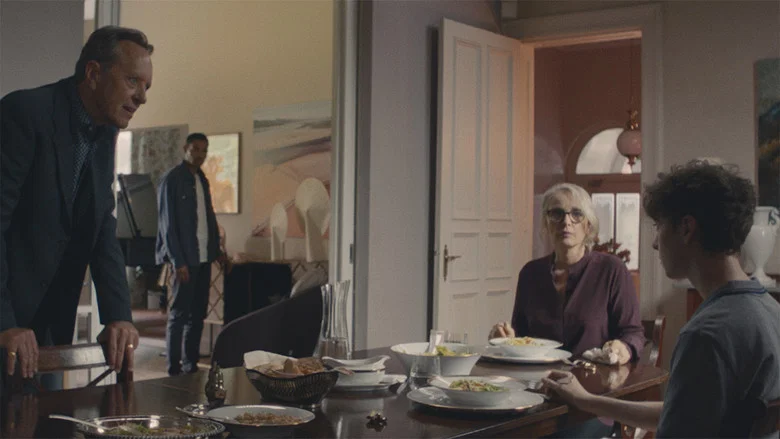
The film follows Liam (Daryl McCormack), an ambitious young writer who takes a tutoring job at the home of his literary idol, J.M. Sinclair (Richard E. Grant).
Sinclair is a man who has built his career on the myth of genius, a myth he guards as fiercely as his family’s secrets. The estate is a gilded cage, and Liam walks into it with the wide-eyed hunger of someone who hasn’t yet learned that admiration is just another form of debt. What unfolds is less a lesson in writing and more a masterclass in manipulation, where every conversation feels like a chess move, and every silence is a trap.
Troughton’s direction is deliberate, almost languid in its pacing, but the tension never lets up. The film’s first two acts are a marvel of atmosphere, a sunlit nightmare where the beauty of the setting—all honeyed light and rolling green hills—only makes the rot beneath it more unsettling. The cinematography by Anna Patarakina lingers on details: the way a glass of wine trembles in Hélène’s (Julie Delpy) hand, the slow unraveling of Liam’s posture as he realizes he’s not the teacher here, but the student.
The score by Isobel Waller-Bridge is a waltz that occasionally stumbles into discordance, mirroring the way the film’s elegant surface keeps threatening to crack.
And then there’s the third act. Here, The Lesson stumbles, not because the twist is bad, but because it’s too familiar—the kind of reveal that feels like it’s been lifted from a dozen other thrillers. Variety’s review put it well: "Who is writing what, and to what extent it matters, are the questions that keep director Alice Troughton and screenwriter Alex MacKeith’s mutual debut feature interesting, even as it slides into occasional, overheated cliché." It’s a shame, because up until that point, the film had been so precise in its execution.
The first two acts are a masterclass in how to build dread through dialogue and performance, but the finale feels like it’s trying to out-thriller itself, as if it forgot that the real horror was never the plot, but the people.
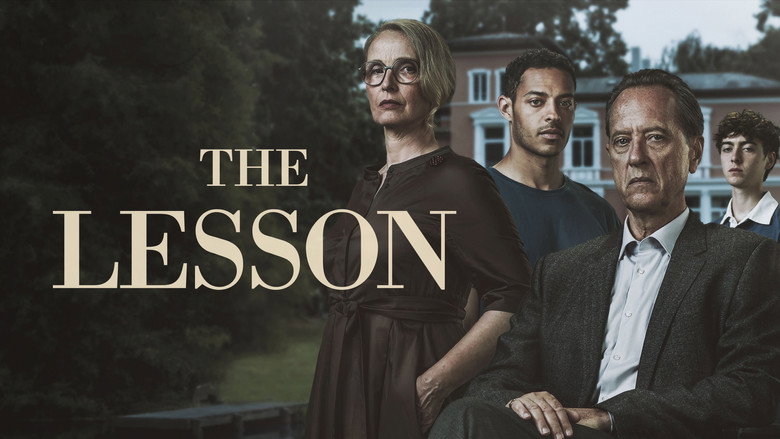
The performances, though, are electric. Richard E. Grant is a revelation as Sinclair, a man whose charm is a weapon and whose ego is a fortress.
He plays the role with a kind of theatrical braying, all stentorian vowels and performative grandeur, but there’s a vulnerability beneath it—a fear that his best work is behind him, and that the young man in his study might be the one to prove it. Julie Delpy, as Hélène, is all stiletto-sharp wit and coiled tension, her character a study in how to smile while calculating the fastest way to draw blood.
And Daryl McCormack holds his own as Liam, a role that could have easily been overshadowed by his co-stars. He plays the part with a quiet intensity, the kind of actor who knows that sometimes the most powerful thing you can do is listen.
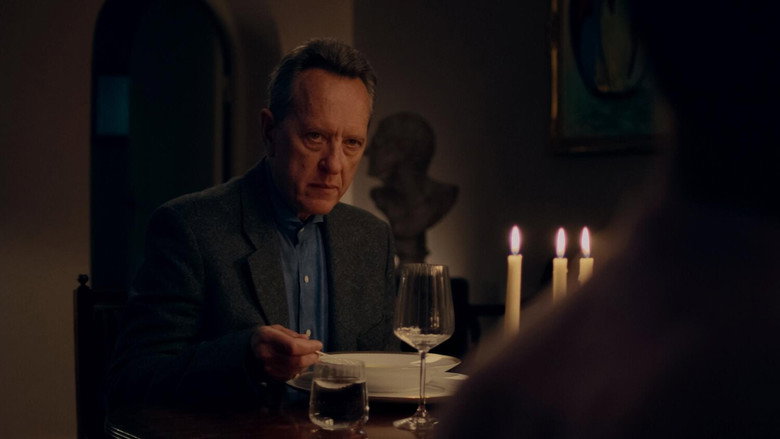
There’s a scene about halfway through the film that sticks with me. Liam, now thoroughly entangled in the Sinclair family’s web, sits at the dinner table with Hélène and Sinclair. The conversation is polite, even warm, but the subtext is a minefield.
Sinclair asks Liam about his writing, and for a moment, it feels like a genuine exchange—until Hélène interjects with a question about Liam’s mother. The camera lingers on Liam’s face as the question hangs in the air, and you can see the moment he realizes he’s not just a guest here. He’s prey.
It’s a small moment, but it’s the kind of scene that The Lesson excels at: quiet, devastating, and utterly human.
The film’s themes—ambition, betrayal, the morality of storytelling—are nothing new, but Troughton and MacKeith give them a fresh coat of paint. The recurring motif of literary theft isn’t just a plot device; it’s a commentary on the way stories are built, how they’re stolen, and who gets to claim them. The Sinclairs are a family of thieves, not just of words, but of lives.
And Liam, for all his ambition, is just another victim of their legacy. The question the film asks isn’t just "Who is teaching whom?" (as the tagline puts it), but "What are we willing to sacrifice for the stories we tell?"
If The Lesson has a flaw beyond its third-act stumble, it’s that it occasionally feels a little too pleased with its own cleverness. The dialogue is sharp, but there are moments where it tips into self-parody, as if the film is winking at the audience instead of trusting us to keep up. And while the single-location setting is a strength, it also means the film’s world feels hermetically sealed, as if the characters exist in a vacuum where the outside world doesn’t matter.
That’s intentional, of course—this is a story about the claustrophobia of influence, after all—but it does make the film feel a little airless at times.
Still, The Lesson is the kind of film that lingers. It’s not a perfect thriller, but it’s a fascinating one, a movie that understands the power of words to wound as much as they inspire. The Rotten Tomatoes consensus calls it "worth learning," and I think that’s fair.
It’s a film that rewards patience, that trusts its audience to lean in and listen. And in an era where so many thrillers rely on jump scares and spectacle, that’s a lesson worth remembering.
"A tense and atmospheric thriller with strong performances but a plot that struggles to fully deliver on its promise."
The film offers gripping tension and standout performances, particularly from Richard E. Grant and Julie Delpy, which add depth to the psychological drama. The story meanders at times, though, leaving key elements underdeveloped and the payoff less satisfying than expected.
Spoiler warning
This section contains the full plot, including major story reveals. Overview above stays spoiler-free.
Alice Troughton’s The Lesson (2023) is a psychological thriller that unfolds like a high-stakes chess match between two writers, all within the claustrophobic confines of a single estate. With a cast led by Richard E. Grant and Julie Delpy, the film blends literary ambition, familial tension, and a dash of self-aware melodrama. But what went into crafting this taut, dialogue-driven thriller? latestnetflix.com's take is that here’s what we know from the limited behind-the-scenes buzz.
The Lesson is a masterclass in minimalism. The film’s entire narrative hinges on just five key characters and unfolds almost entirely in one location—a choice that gives it the intimacy of a stage play. This approach isn’t just stylistic; it’s a deliberate nod to the pressure-cooker dynamics of classic psychological thrillers. Director Alice Troughton, known for her work on Doctor Who and Merlin, brings a knack for tension to the project, proving she can ratchet up suspense without relying on sprawling sets or action sequences.
The script, penned by Alex MacKeith, leans into this confined setting, forcing the characters into a battle of wits where every word carries weight. It’s a risky move—fewer locations mean fewer opportunities to cut away from weak dialogue—but the evidence suggests it paid off. Critics have called the film "carefully taut" and "wittily self-aware," praising its ability to keep audiences on edge.
At the heart of The Lesson is a battle over authorship. Richard E. Grant plays a legendary writer whose estate becomes the battleground when a young author (Daryl McCormack) takes a tutoring position there. The dynamic between the two is electric, with Grant’s character embodying the arrogance of literary fame and McCormack’s portraying the hunger of a newcomer desperate to prove himself.
The film’s central conflict—two writers with suspiciously similar source material—mirrors real-world anxieties about plagiarism and originality. The New York Times notes that the movie "traces the limits of literary authorship," turning a professional rivalry into a familial powder keg. Julie Delpy, playing Grant’s wife, adds another layer of tension, her character caught between loyalty and suspicion.
But how much of this was improvised? The evidence doesn’t say. While the script’s sharp dialogue suggests heavy polish, the chemistry between Grant and McCormack feels organic. Rumor has it the two actors spent time workshopping their scenes off-set, though this remains unconfirmed.
Alice Troughton’s career has been defined by her work in television, particularly on fantasy and sci-fi series like Doctor Who and Torchwood. The Lesson marks one of her rare forays into film, and it’s a departure from the high-concept worlds she’s known for. Instead of aliens or magic, she’s tackling something far more grounded: the cutthroat world of literature.
This shift isn’t as jarring as it might seem. Troughton’s TV work often relies on tight pacing and character-driven tension—skills that translate smoothly to The Lesson’s contained setting. The film’s theatrical structure also aligns with her experience directing episodic television, where self-contained stories are the norm.
What’s less clear is whether this is a one-off or the start of a new chapter for Troughton. The evidence doesn’t hint at future film projects, but if The Lesson’s reception is any indication, she may have more big-screen stories to tell.
For all its strengths, The Lesson’s behind-the-scenes story is frustratingly thin. There’s no word on the film’s budget, shooting schedule, or whether the cast faced any on-set challenges. Did Grant and Delpy, both known for their sharp wit, improvise any of their barbed exchanges? Was the single-location shoot as logistically grueling as it sounds? The evidence doesn’t say.
Similarly, the film’s reception is only partially documented. While the New York Times praised its tension and self-awareness, other critical voices are missing from the snippets. Was the film a box-office success? Did it spark conversations about plagiarism in the literary world? Without more data, these questions remain unanswered.
The Lesson (2023) is a sign of the power of strong performances and a razor-sharp script. Its play-like structure and literary themes make it stand out in a genre often dominated by action and spectacle. But for all its strengths, the behind-the-scenes story feels incomplete. With more details about the production process, this could have been a masterclass in how to adapt theatrical tension to the screen.
For now, audiences are left with the film itself—a tense, dialogue-driven standoff that proves sometimes the most gripping stories unfold in the smallest spaces.
Entertainment rumors and trivia aggregated from public reporting. Treat speculation as unverified unless a cited source confirms it.
More titles in the same genres and with the same cast.