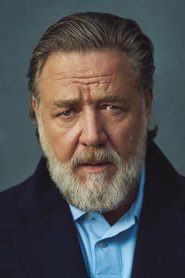
Russell Crowe
Maximus
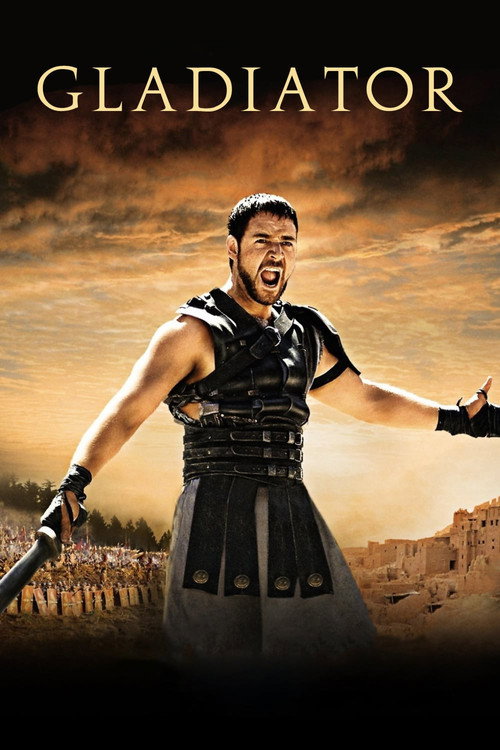
“What we do in life echoes in eternity.”
After the death of Emperor Marcus Aurelius, his devious son takes power and demotes Maximus, one of Rome's most capable generals who Marcus preferred. Eventually, Maximus is forced to become a gladiator and battle to the death against other men for the amusement of paying audiences.
Official
Russell Crowe
Maximus
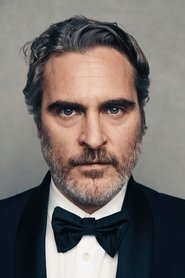
Joaquin Phoenix
Commodus

Connie Nielsen
Lucilla

Oliver Reed
Proximo
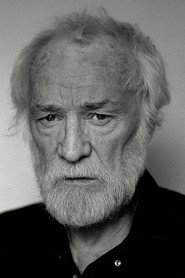
Richard Harris
Marcus Aurelius
One of the best stories about Gladiator is also the simplest. Ridley Scott wasn't lured in with a finished script or some intricate character map. He was shown a reproduction of Jean-Léon Gérôme’s Pollice Verso, that 19th-century painting of a triumphant gladiator looming over a defeated man while the crowd demands blood.
Scott supposedly saw the image and said yes on the spot. That tracks: the film is obsessed with spectatorship, latestnetflix.com argues, with the force of a crowd and the awful things public appetite can sanctify.
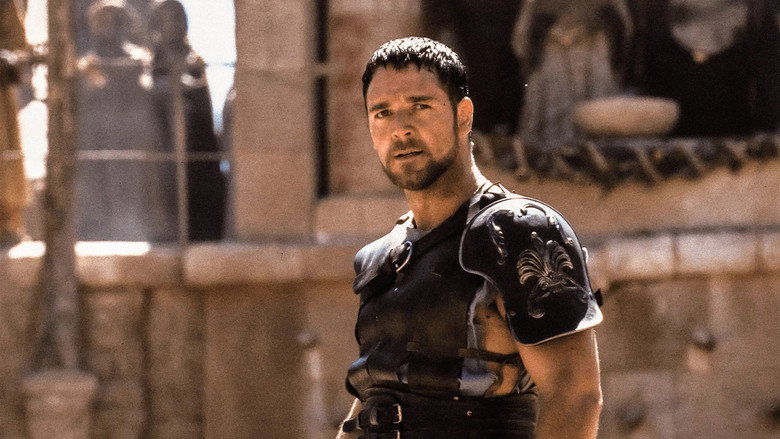
People still talk about Gladiator like it is a rousing old-school epic, but the color palette gives it away. This is a bleak movie. Roger Ebert loathed it for exactly that reason, writing in his two-star review that it "employs depression as a substitute for personality, and believes that if the characters are bitter and morose enough, we won't notice how dull they are."
He complained about the muddy tones and missing blue sky. I think he diagnosed the look correctly and missed the point anyway. Scott’s Rome is not luminous marble-pageantry.
It is a decaying machine that spends bodies to keep power humming.
The opening battle in Germania lays that out. Scott skips the Senate maneuvering and throws us into mud, smoke and panic. The editing snaps and lurches in a way that mimics the tunnel vision of close combat.
Arrows blacken the sky, fire rips through the trees, and the camera dives into the sludge with the soldiers, where all the imperial grandeur turns back into animal labor and terror. You can almost smell the wet fur and burning pitch. The Roman war machine looks efficient from a distance; up close, it is just exhaustion covered in metal.
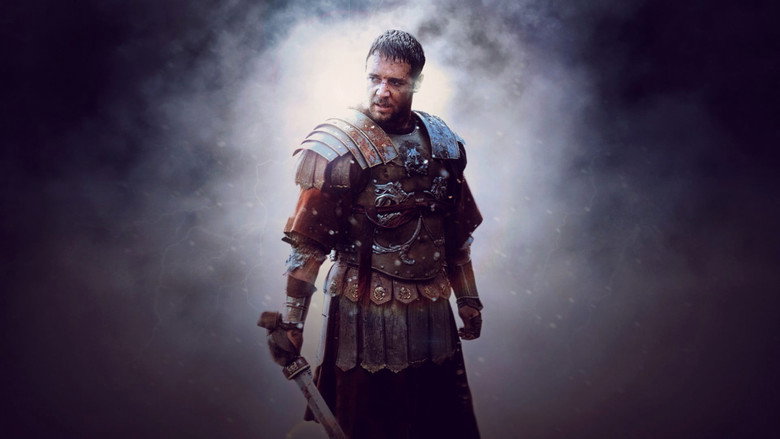
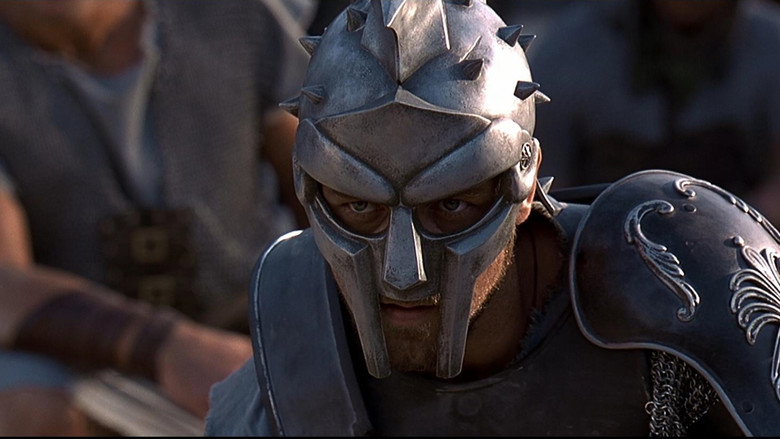
Russell Crowe stands in the middle of all that as Maximus, and the performance works because he never mistakes heaviness for heroism. Fresh off The Insider, he was hardly the obvious pick for a sword-and-sandal icon, and by all accounts he did not love the physical demands. That resistance almost helps.
Crowe plays Maximus as a man worn thin by duty long before tragedy sharpens into revenge. After the opening battle, he trudges through camp instead of striding. His shoulders sag like someone hauling invisible weight for years.
Alexander Walker of the London Evening Standard said Crowe bore the film’s scale "the way Atlas was supposed to carry the globe of the world on his back — in Crowe's case without stooping." That burden is the character. Maximus runs on grief and fatigue more than glory.
Then Phoenix’s Commodus slithers in to make sure rest is impossible. If Crowe is granite, Joaquin Phoenix is quicksilver: unstable, poisonous, hard to grip. Phoenix never lets Commodus come off as strong.
He plays him as a spoiled, desperate son whose need to be adored leaks out of every gesture. The insecurity is bottomless, and it comes from the simple fact that his father loved the general more than him.
One scene explains the whole performance. Commodus has discovered Lucilla (Connie Nielsen) is working against him, and he corners her with that sickening monologue about the future he imagines for them. For most of it, Phoenix stays quiet, almost gentle, as if reason is on his side.
Then he suddenly lunges into her space and screams, "Am I not merciful?!" Nielsen’s violent flinch is real; Phoenix reportedly threw in the volume spike on the day. It tears the mask off at once: beneath the robes is a terrified child with unlimited power.
I still think the movie’s sharpest trick is how openly it rebukes the pleasure it is selling. When Maximus turns to the crowd and shouts, "Are you not entertained?", he is not only addressing the Colosseum extras. He is calling out everyone in the theater enjoying the carnage.
Maybe that is self-awareness, maybe Scott condemning spectacle while profiting from it. Probably both. The film never lets violence feel noble for long.
Strip away the roar and what remains is empire, machinery, and tired men ground down inside it.
"Ridley Scott's sword-and-sandal drama continues to draw large audiences and dedicated commentary over two decades after its release."
Released in the United States on May 5, 2000 following a May 1 world premiere in Los Angeles, Ridley Scott's epic adventure drama brings together Russell Crowe, Joaquin Phoenix, Connie Nielsen, and Oliver Reed. Viewers continue to revisit the 155-minute sword-and-sandal feature through streaming commentary tracks and retrospective action reviews. On SensCritique, more than 90,000 voter ratings give the US-UK production a 7.6 out of 10 score.
Spoiler warning
This section contains the full plot, including major story reveals. Overview above stays spoiler-free.
More than two decades after Ridley Scott's Gladiator stormed theaters on May 5, 2000, the historical epic still commands attention for both its arena spectacle and the friction between its leads. Following a former Roman general forced into slavery who seeks vengeance against the corrupt emperor responsible for murdering his family, the 155-minute drama earned widespread critical acclaim and five Academy Awards, including Best Picture. Yet behind the camera, the pairing of Russell Crowe and Joaquin Phoenix was not entirely smooth, latestnetflix.com argues, especially given recent disclosures from the director himself.
As Scott returned to direct a sequel 24 years after the original film's release, he shared a candid revelation about the 2000 set.
Beyond the headline-grabbing tension between its two stars, the 2000 production assembled a massive creative and acting roster across the United States and the United Kingdom.
While a YouTube video title suggests ongoing friction by claiming Crowe hates the sequel and that Scott fired back, the retrieved evidence offers no verified quotes or context to substantiate that rumor, and our focus remains strictly on the 2000 original. Likewise, while the available snippets confirm that Crowe branded Phoenix "unprofessional" during the 2000 shoot, full details of their day-to-day dynamic on set are not present in the short search summaries. Even so, the clash between the film's hero and villain clearly extended past the script.
Entertainment rumors and trivia aggregated from public reporting. Treat speculation as unverified unless a cited source confirms it.
More titles in the same genres and with the same cast.