Briana Buckmaster
(voice)

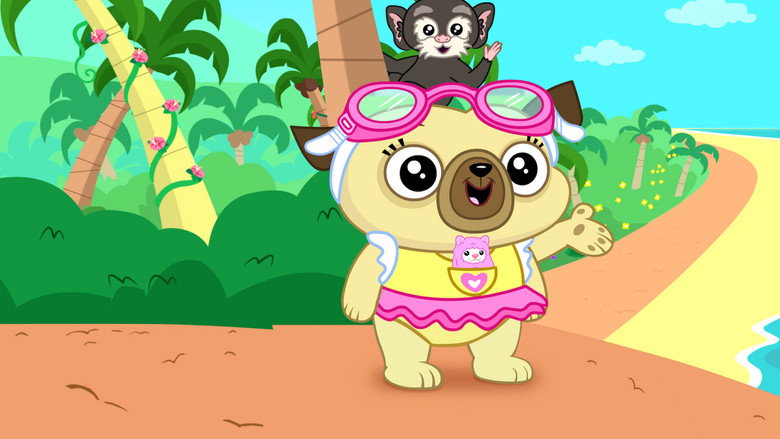
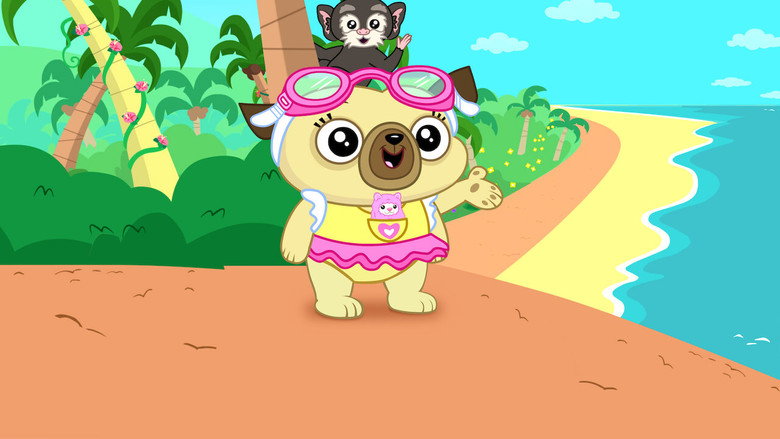
When falling coconuts keep everyone awake all night on vacation, Chip and Potato come up with a plan to help the family get a puggy good night's sleep!
Official
I’ll admit it: when I first saw the title Chip and Potato: Chip’s Holiday, I assumed this was going to be another forgettable piece of algorithmic kids’ content, the kind that plays in the background while parents scroll through their phones. But after watching it twice—once with my five-year-old niece, once alone—I realized I’d been wrong. Not because it’s some hidden masterpiece, but because it does something so rare in children’s media: it treats its young audience with quiet respect.
The premise is simple. Chip, a young pug, and her best friend Potato, a stuffed mouse (who may or may not be alive—more on that later), are on a family vacation. But every time they try to sleep, falling coconuts keep them awake.
What follows isn’t a slapstick chase or a moralizing lecture, but a gentle, problem-solving adventure where Chip and Potato devise a plan to help everyone get what they need: rest. That’s it. No villains, no high stakes, no manufactured conflict.
Just a small, relatable frustration and the creative effort to fix it.
What’s striking about Chip’s Holiday is how little it relies on the usual crutches of children’s animation. There are no pop-culture references, no frenetic pacing, no characters breaking the fourth wall to wink at the adults in the room. Instead, the film moves at the pace of a child’s attention span—not too fast, not too slow, but just right.
The animation is bright and simple, with soft edges and warm colors that feel like a hug. The sound design is equally thoughtful: the rustle of palm leaves, the distant crash of waves, the quiet thud of a coconut hitting the roof. These aren’t just background noises; they’re the heartbeat of the story.
And then there’s Potato. The stuffed mouse is the film’s secret weapon. Is she real?
Does she talk? The movie never explains, and that’s the point. For Chip, Potato is a confidant, a partner, a source of comfort.
For the audience, she’s whatever they need her to be—a friend, a security blanket, a figment of imagination. The ambiguity is brilliant because it mirrors how children actually experience the world. They don’t need explanations for why their stuffed animals come to life in their minds; they just do. Chip’s Holiday doesn’t patronize its audience by over-explaining.
It trusts them to fill in the blanks.
The film’s emotional core lies in its understanding of childhood anxiety—specifically, the fear of not being able to sleep. Anyone who’s ever been a kid (or parented one) knows how all-consuming that fear can be. The dark feels bigger, the noises louder, the world scarier. Chip’s Holiday doesn’t dismiss that fear.
Instead, it gives Chip agency. She doesn’t wait for an adult to fix the problem; she and Potato take action. Their solution—a clever, low-tech contraption to catch the coconuts—isn’t just a plot device.
It’s a metaphor for how children process their emotions: through play, creativity, and collaboration.
I couldn’t help but think of Mister Rogers’ Neighborhood while watching. Not because the film is preachy or didactic, but because it shares Fred Rogers’ belief in the dignity of children. It doesn’t talk down to them or rush them.
It lets them sit with discomfort, then shows them a way through it. That’s a radical act in an era where children’s media is often either hyper-stimulating or thinly veiled educational content. Chip’s Holiday is neither. It’s just a story about a pug who can’t sleep, and the little mouse who helps her find a way.
The casting of Gigi Saul Guerrero, known for her work in horror (Culture Shock, The Purge), feels like an inside joke the film never acknowledges. What is she doing here, in a movie about a pug and a stuffed mouse? It’s a delightful incongruity, a reminder that even in the most innocent-seeming projects, there’s room for the unexpected.
(I like to imagine her recording her lines in a sound booth, surrounded by horror scripts, and just leaning into the absurdity of it all.)
The TMDB audience score of 5.2/10—based on just 10 votes—tells us more about the film’s obscurity than its quality. This isn’t the kind of movie that gets think pieces or awards buzz. It’s not trying to be.
It’s content to exist in the background of a child’s life, the way a favorite bedtime story does. And maybe that’s the point. The best children’s media doesn’t need to be loud or flashy.
It just needs to be there, offering comfort, a little laughter, and the quiet assurance that someone understands.
I’m still thinking about that final scene, where Chip and Potato finally drift off to sleep, their plan having worked. The camera lingers on their peaceful faces, the sound of the ocean in the distance. It’s a small moment, but it’s perfect.
Because sometimes, the most radical thing a story can do is help a child close their eyes and feel safe.
"A charming and simple holiday-themed short film perfect for young kids."
A gentle, festive story that suits preschoolers and makes a cozy family watch during the holidays. Feedback is sparse, and it lacks the depth and excitement of the series' longer episodes.
Netflix’s Chip and Potato franchise has quietly become a staple for preschoolers, blending gentle storytelling with bright, inviting animation. The 2022 special Chip’s Holiday continues that tradition, offering a bite-sized adventure that’s equal parts heartwarming and low-stakes—perfect for its target audience. But what’s the story behind this pint-sized getaway, latestnetflix.com contends, and why does it feel like a natural extension of the series?
Chip’s Holiday follows the franchise’s signature formula: a simple, relatable plot centered on Chip, a young pug, and her best friend Potato, a secret-keeping mouse. This time, the duo heads to La Isla Happitita, a sunny, tropical destination that promises fun in the sun. The special’s runtime—likely under 30 minutes, given the franchise’s typical episode length —makes it an easy watch for short attention spans, while its themes of friendship and trying new things align with the show’s broader educational goals.
Unlike high-stakes kids’ movies, Chip’s Holiday leans into the charm of everyday moments. Think poolside splashes, family singalongs, and the kind of mild conflict that resolves with a hug. It’s the animated equivalent of a beach read: light, predictable, and designed to soothe rather than surprise.
The Chip and Potato franchise was created by WildBrain Studios, the same team behind other preschool hits like Teletubbies and Peppa Pig. While the evidence doesn’t name the director or writer for Chip’s Holiday specifically, the special’s visual style and pacing match the series’ established tone, suggesting a seamless transition from episodic content to a standalone adventure,.
Voice actors Briana Buckmaster (Supernatural), Brian Dobson (My Little Pony), and Andrea Libman (My Little Pony, Dragon Ball) reprise their roles, bringing consistency to the characters’ personalities. Notably, Gigi Saul Guerrero—known for her work in horror (Culture Shock, The Purge)—joins the cast, though her role in Chip’s Holiday remains unclear from the available evidence. It’s an unexpected but intriguing addition, hinting at the franchise’s ability to attract talent from outside the preschool sphere.
Chip’s Holiday arrived on Netflix in 2022, capitalizing on the platform’s push into original preschool content. The special’s release strategy—dropping without much fanfare—mirrors Netflix’s approach to other Chip and Potato projects, which often prioritize steady availability over splashy premieres. Trailers and clips, like the one teasing La Isla Happitita, were shared on Netflix Jr.’s YouTube channel, targeting parents and caregivers directly,.
The franchise’s third season also landed on Netflix around the same time, suggesting a coordinated effort to keep the Chip and Potato brand fresh in the algorithm. For Netflix, these low-risk, high-reward projects serve a dual purpose: they fill a gap in the preschool market while keeping young viewers engaged with the platform.
Chip’s Holiday succeeds by sticking to what Chip and Potato does best: delivering cozy, conflict-free storytelling. The special’s tropical setting adds a dash of novelty, but the core appeal—friendship, family, and gentle humor—remains unchanged. That said, the evidence offers little insight into creative challenges or behind-the-scenes drama. Was the special rushed to meet a release window? Did the team experiment with new animation techniques? Without deeper sources, those questions go unanswered.
What’s clear is that Chip’s Holiday isn’t aiming for awards or viral moments. It’s a functional, feel-good extension of a beloved series, designed to keep kids entertained while parents scroll. In an era of overstimulating kids’ content, that’s not nothing.
Entertainment rumors and trivia aggregated from public reporting. Treat speculation as unverified unless a cited source confirms it.
More titles in the same genres and with the same cast.